


Activity-driven synapse elimination leads paradoxically to domination by inactive neurons
- PMID: 10559405
- PMCID: PMC6782962
- DOI: 10.1523/JNEUROSCI.19-22-09975.1999
Activity-driven synapse elimination leads paradoxically to domination by inactive neurons
Abstract
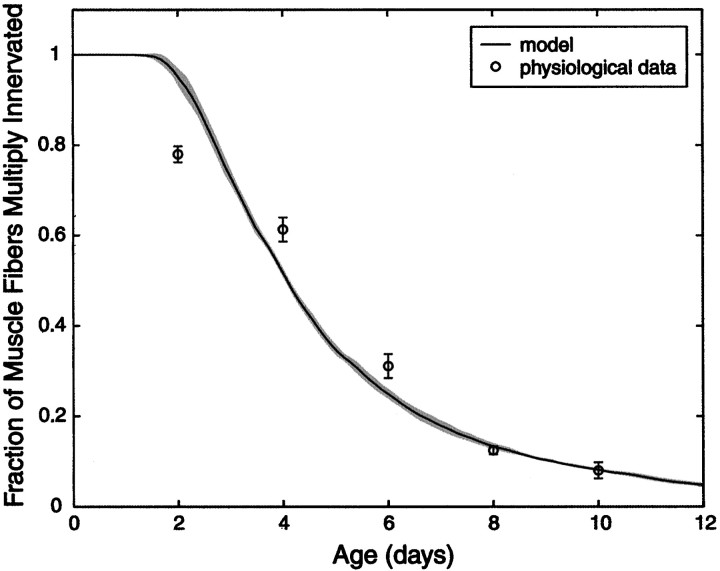
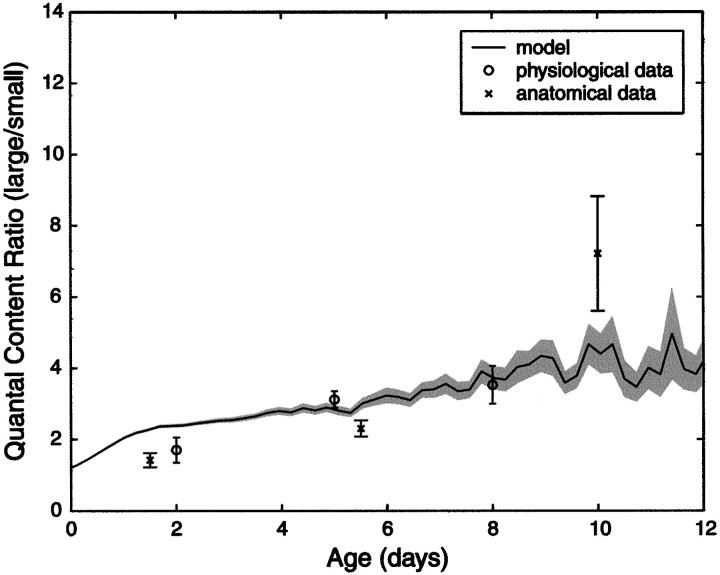
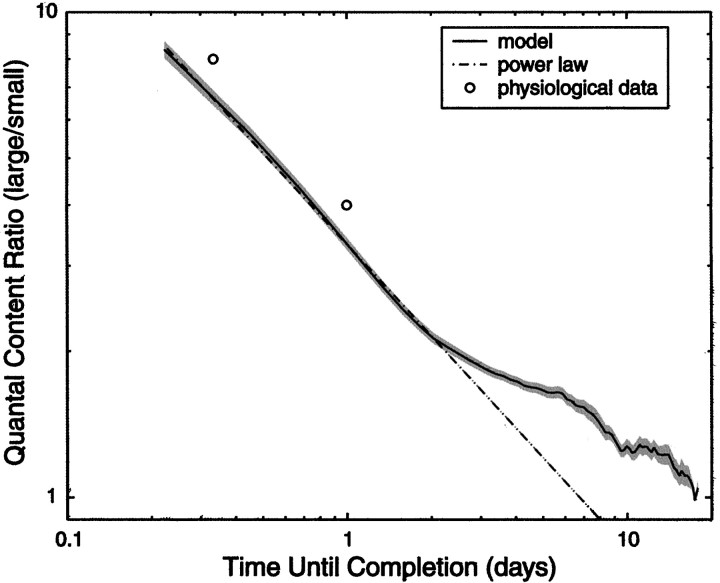
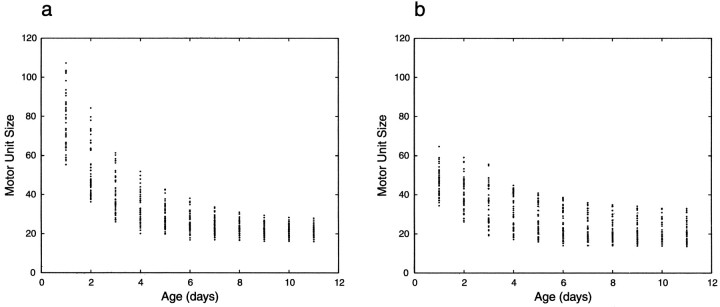
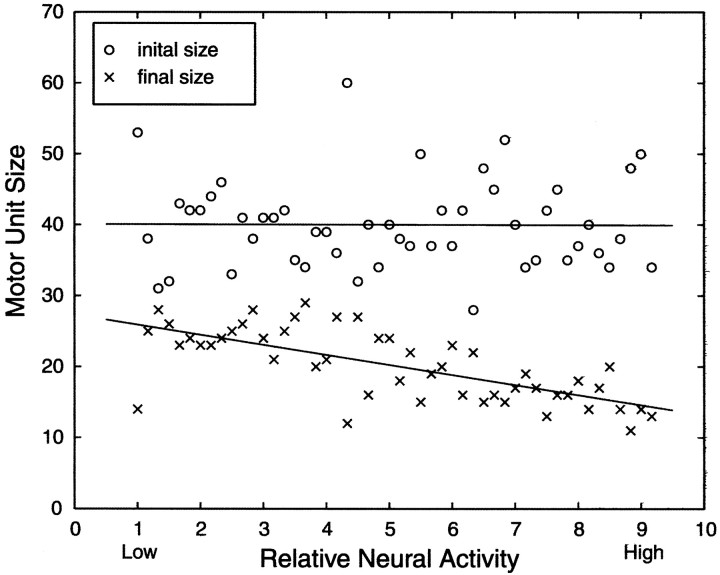
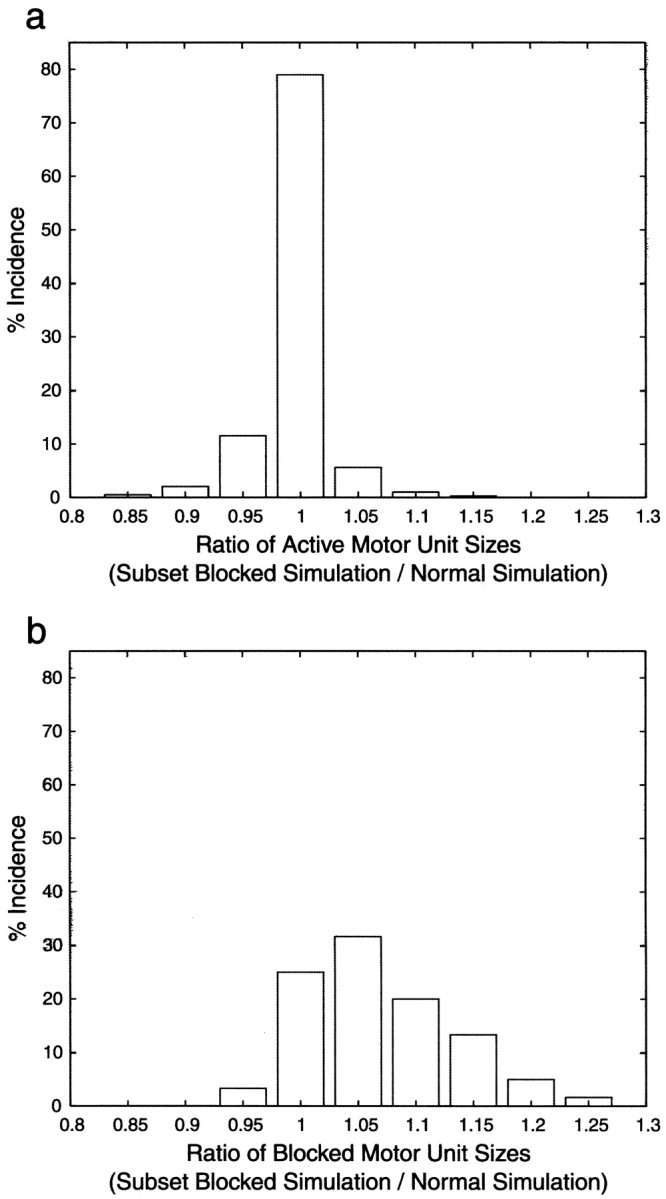
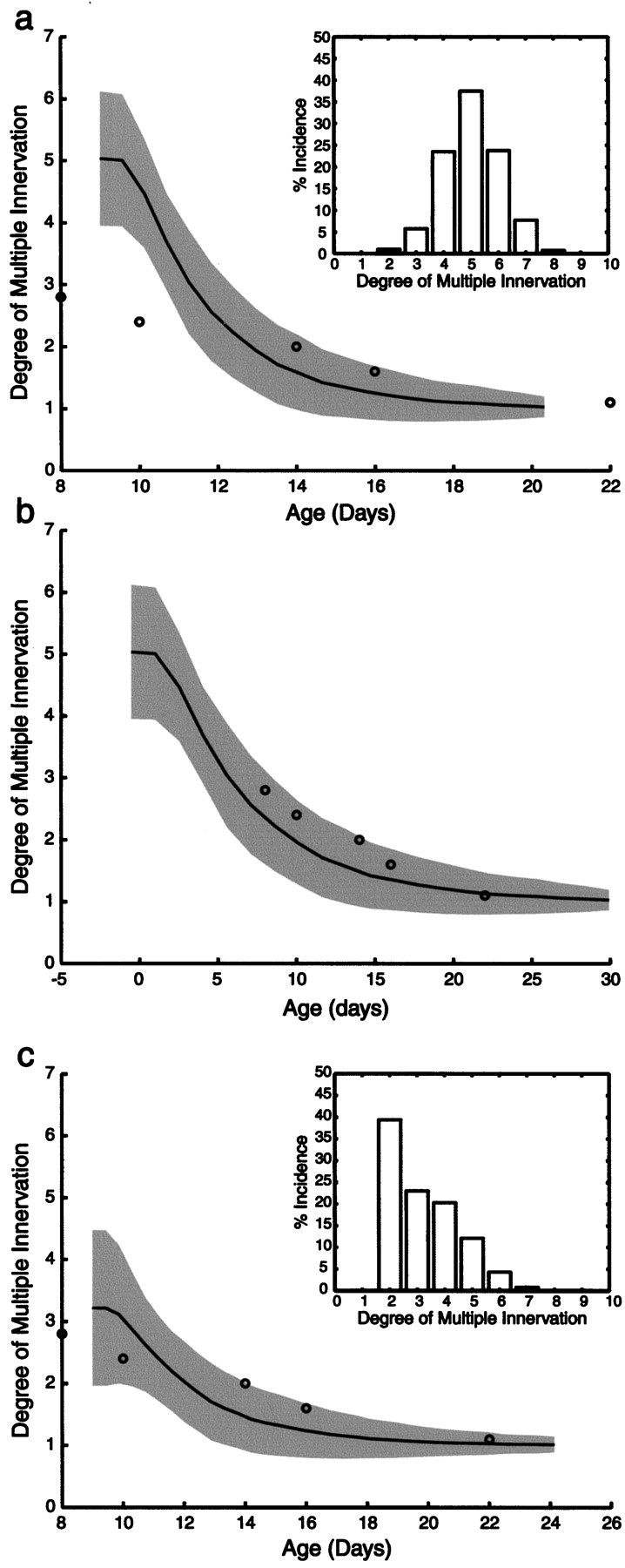
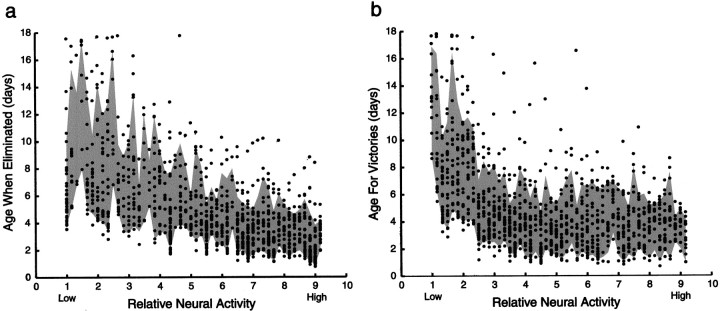
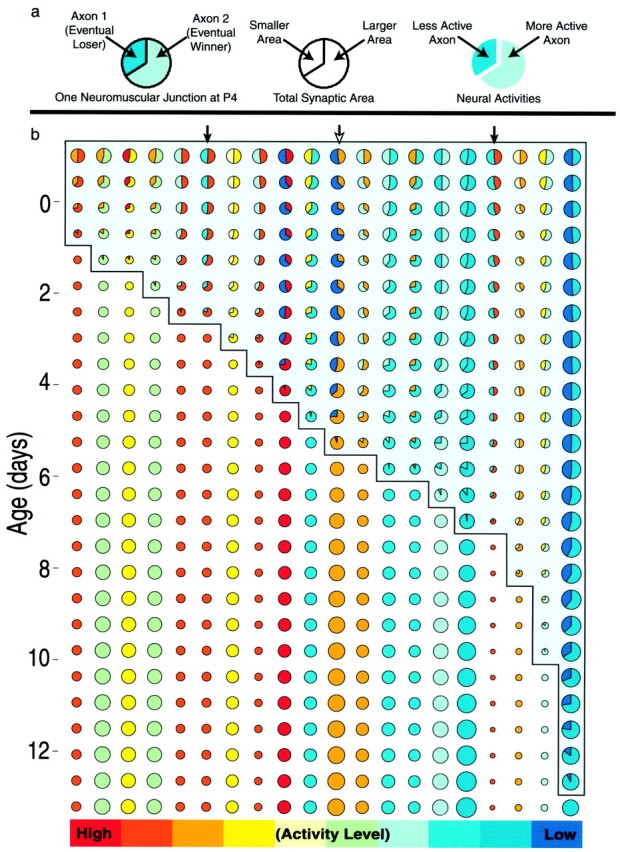
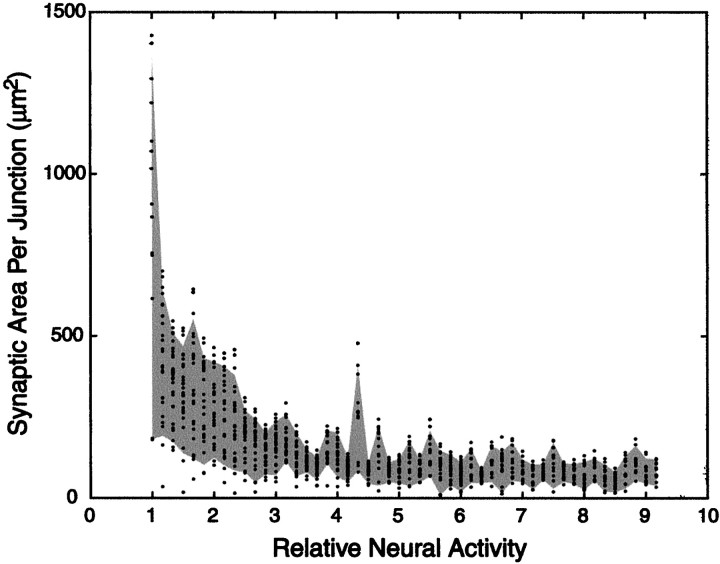
In early postnatal life, multiple motor axons converge at individual neuromuscular junctions. However, during the first few weeks after birth, a competitive mechanism eliminates all the inputs but one. This phenomenon, known as synapse elimination, is thought to result from competition based on interaxonal differences in patterns or levels of activity (for review, see Lichtman,1995). Surprisingly, experimental data support two opposite views of the role of activity: that active axons have a competitive advantage (Ribchester and Taxt, 1983; Ridge and Betz, 1984; Balice-Gordon and Lichtman, 1994) and that inactive axons have a competitive advantage (Callaway et al., 1987, 1989). To understand this paradox, we have formulated a mathematical model of activity-mediated synapse elimination. We assume that the total amount of transmitter released, rather than the frequency of release, mediates synaptic competition. We further assume that the total synaptic area that a neuron can support is metabolically constrained by its activity level and size. This model resolves the paradox by showing that a competitive advantage of higher frequency axons early in development is overcome at later stages by greater synaptic efficacy of axons firing at a lower rate. This model both provides results consistent with experiments in which activity has been manipulated and an explanation for the origin of the size principle (Henneman, 1985).
Figures
References
-
- Balice-Gordon RJ, Lichtman JW. Long-term synapse loss induced by focal blockade of postsynaptic receptors. Nature. 1994;372:519–524. - PubMed
-
- Balice-Gordon RJ, Chua CK, Nelson CC, Lichtman JW. Gradual loss of synaptic cartels precedes axon withdrawal at developing neuromuscular junctions. Neuron. 1993;11:801–815. - PubMed
-
- Bennett MR, Robinson J. Growth and elimination of nerve terminals at synaptic sites during polyneuronal innervation of muscle cells: a trophic hypothesis. Proc R Soc Lond B Biol Sci. 1989;235:299–320. - PubMed
Publication types
MeSH terms
LinkOut - more resources
Full Text Sources
Medical
