


Detection of fluconazole-resistant Candida strains by a disc diffusion screening test
- PMID: 10565896
- PMCID: PMC85829
- DOI: 10.1128/JCM.37.12.3856-3859.1999
Detection of fluconazole-resistant Candida strains by a disc diffusion screening test
Abstract
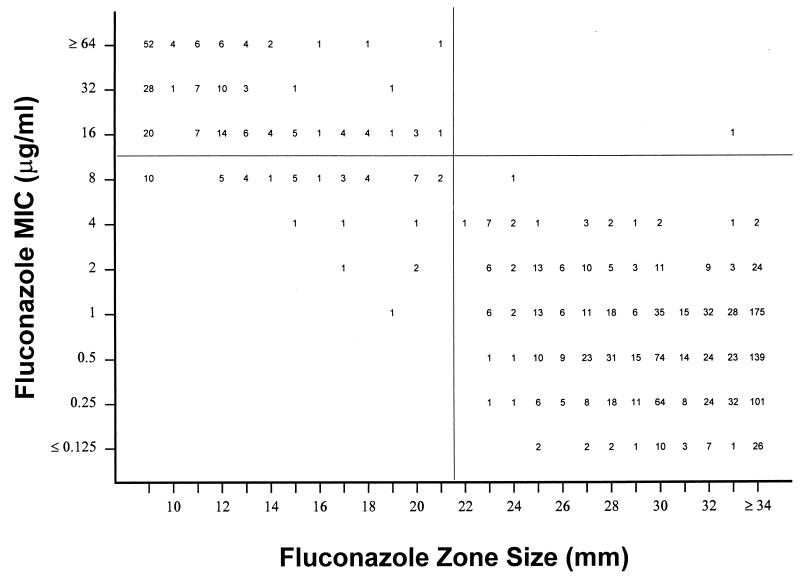
A commercial disc diffusion test has been evaluated as a screening method for the detection of Candida species with decreased susceptibility to fluconazole. A total of 1,407 Candida strains of different species were tested, and the results were compared with the MIC results. The recently published National Committee for Clinical Laboratory Standards breakpoint criteria have been used. Isolates were classified as susceptible if the MIC for the isolates was </=8 microg/ml, susceptible-dose dependent (S-DD) if the MIC was 16 to 32 microg/ml, and resistant if the MIC was >/=64 microg/ml. All 77 resistant strains and 121 of 122 S-DD strains had fluconazole zone diameters of </=21 mm, and most of the strains (91%) had zone diameters of </=15 mm. It was not possible to distinguish between resistant and S-DD strains by the disc test. Among a total of 1,208 strains found to be susceptible by the microdilution method, 49 (4. 1%) yielded fluconazole zone sizes of </=21 mm and would have been misclassified as resistant or S-DD strains on the basis of the disc test. For the majority (86%) of these 49 strains the fluconazole MIC was 8 microg/ml. The fluconazole disc test is recommended as a simple and reliable screening test for the detection of Candida strains with decreased susceptibility to fluconazole. Fluconazole MICs should be determined for strains found to be resistant by the disc test. The reason for confirmatory testing is twofold: to determine if isolates are resistant or S-DD, since the disc test does not make this distinction, and to identify fluconazole-susceptible strains that are found to be falsely resistant by the fluconazole disc test.
Figures
References
-
- Bille J. When should Candida isolates be tested for susceptibility to azole antifungal agents? Eur J Clin Microbiol Infect Dis. 1997;16:281–282. - PubMed
-
- Bruun B, Westh H, Stenderup J. Fungemia: an increasing problem in a Danish university hospital 1989 to 1994. J Clin Microbiol Infect. 1995;1:124–126. - PubMed
-
- Cantón E, Pemán J, Carrillo-Muñoz A, Orero A, Ubeda P, Viudes A, Gobernado M. Fluconazole susceptibilities of bloodstream Candida sp. isolates as determined by National Committee for Clinical Laboratory Standards method M27-A and two other methods. J Clin Microbiol. 1999;37:2197–2200. - PMC - PubMed
-
- Chakrabarti A, Ghosh A, Batra R, Kaushal A, Roy P, Singh H. Antifungal susceptibility pattern of non-albicans Candida species & distribution of species isolated from candidaemia cases over a 5 year period. Indian J Med Res. 1996;104:171–176. - PubMed
MeSH terms
Substances
LinkOut - more resources
Full Text Sources
Other Literature Sources
Medical
