. 1999 Dec;37(12):3990-6.
doi: 10.1128/JCM.37.12.3990-3996.1999.

Sensitive and specific serodiagnosis of Lyme disease by enzyme-linked immunosorbent assay with a peptide based on an immunodominant conserved region of Borrelia burgdorferi vlsE

Affiliations

Sensitive and specific serodiagnosis of Lyme disease by enzyme-linked immunosorbent assay with a peptide based on an immunodominant conserved region of Borrelia burgdorferi vlsE

F T Liang et al. J Clin Microbiol. 1999 Dec.

Abstract

VlsE, the variable surface antigen of Borrelia burgdorferi, contains an immunodominant conserved region named IR(6). In the present study, the diagnostic performance of a peptide enzyme-linked immunosorbent assay (ELISA) based on a 26-mer synthetic peptide (C(6)) with the IR(6) sequence was explored. Sensitivity was assessed with serum samples (n = 210) collected from patients with clinically defined Lyme disease at the acute (early localized or early disseminated disease), convalescent, or late disease phase. The sensitivities for acute-, convalescent-, and late-phase specimens were 74% (29 of 39), 85 to 90% (34 of 40 to 35 of 39), and 100% (59 of 59), respectively. Serum specimens from early neuroborreliosis patients were 95% positive (19 of 20), and those from an additional group of patients with posttreatment Lyme disease syndrome yielded a sensitivity of 62% (8 of 13). To assess the specificity of the peptide ELISA, 77 serum samples from patients with other spirochetal or chronic infections, autoimmune diseases, or neurologic diseases and 99 serum specimens from hospitalized patients in an area where Lyme disease is not endemic were examined. Only two potential false positives from the hospitalized patients were found, and the overall specificity was 99% (174 of 176). Precision, which was assessed with a panel of positive and negative serum specimens arranged in blinded duplicates, was 100%. Four serum samples with very high anti-OspA antibody titers obtained from four monkeys given the OspA vaccine did not react with the C(6) peptide. This simple, sensitive, specific, and precise ELISA may contribute to alleviate some of the remaining problems in Lyme disease serodiagnosis. Because of its synthetic peptide base, it will be inexpensive to manufacture. It also will be applicable to serum specimens from OspA-vaccinated subjects.


Figures
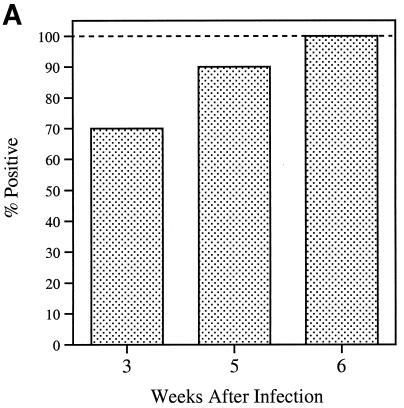
FIG. 1
FIG. 1
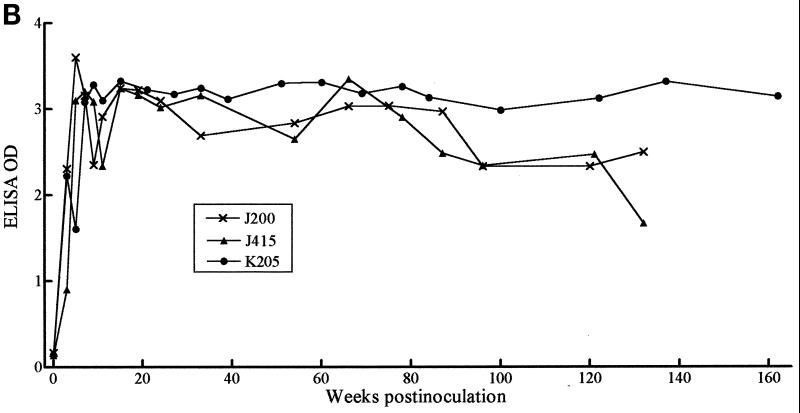
Early and persisting IgG antibody response to C6 in infected monkeys. After infection, serum samples were serially collected from 10 animals and tested for IgG antibodies with the C6 ELISA. (A) Fraction of the animals that became positive at weeks 3, 5, and 6 postinfection. (B) Persistence of response over time for three animals. The last point of each curve corresponds to the serum specimen collected at the time of sacrifice. All sera were diluted 1:200.
FIG. 1
FIG. 1
Early and persisting IgG antibody response to C6 in infected monkeys. After infection, serum samples were serially collected from 10 animals and tested for IgG antibodies with the C6 ELISA. (A) Fraction of the animals that became positive at weeks 3, 5, and 6 postinfection. (B) Persistence of response over time for three animals. The last point of each curve corresponds to the serum specimen collected at the time of sacrifice. All sera were diluted 1:200.
FIG. 2
FIG. 2
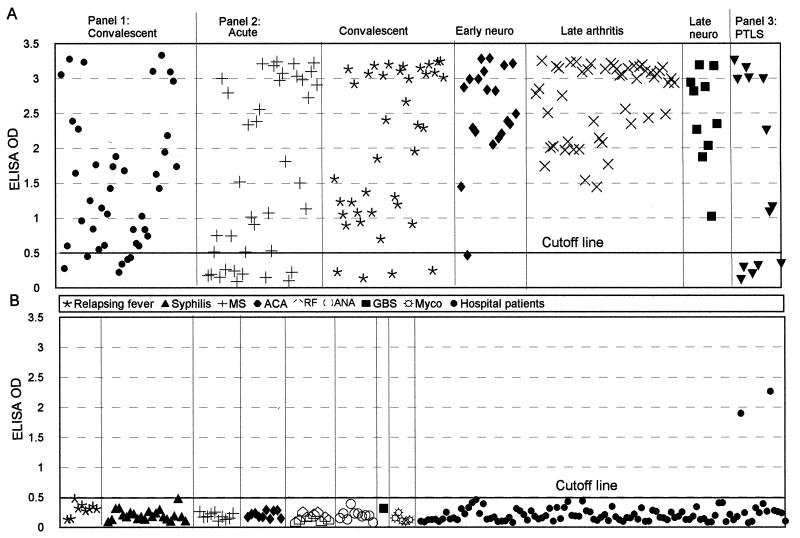
Assessment of sensitivity (A) and specificity (B) of the C6 ELISA. (A) Three panels of serum samples from patients with Lyme disease were tested with the C6 ELISA at a serum dilution of 1:200. Panel 1 was composed of specimens collected during the convalescent phase; panel 2 was composed of samples from the acute, convalescent, early disseminated (early neuroborreliosis [neuro]), and late (arthritis and neuroborreliosis [neuro]) phases; and panel 3 was composed of samples from patients with posttreatment Lyme disease syndrome (PTLS). (B) Specimens were from patients with relapsing fever, syphilis, multiple sclerosis (MS), positive anticardiolipin antibody (ACA), positive rheumatoid factor (RF), positive antinuclear antibody (ANA), Guillain-Barré syndrome (GBS), or mycobacterial infection (Myco). In addition, 99 serum specimens from patients of a hospital in Louisiana, where Lyme disease is not endemic, were tested; the cutoff OD value (0.500) was defined as the mean plus 3 SDs for 97 serum samples from this panel.
FIG. 3
FIG. 3
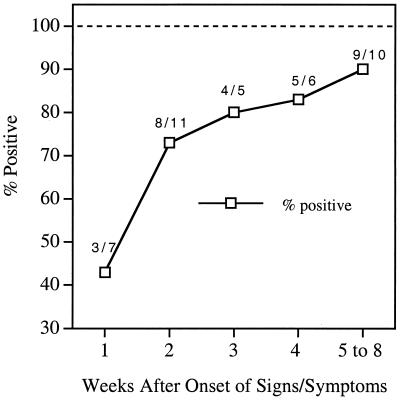
Fraction of positive samples as a function of time after disease onset. The anti-C6 antibody-positive fraction of serum samples obtained at consecutive weeks after the onset of signs or symptoms is shown. The acute-phase group of serum specimens from panel 2 was used at a dilution of 1:200.

References

    1. Bakken L L, Callister S M, Wand P J, Schell R F. Interlaboratory comparison of test results for detection of Lyme disease by 516 participants in the Wisconsin State Laboratory of Hygiene/College of American Pathologists proficiency testing program. J Clin Microbiol. 1997;35:537–543. - PMC - PubMed
    1. Barbour A G, Tessier S L, Hayes S F. Variation in a major surface protein of Lyme disease spirochetes. Infect Immun. 1984;45:94–100. - PMC - PubMed
    1. Barbour A G, Hayes S F, Heiland R A, Schrumpf M E, Tessier S F. A Borrelia genus-specific monoclonal antibody binds to a flagellar epitope. Infect Immun. 1986;52:549–554. - PMC - PubMed
    1. Barony G, Merrifield R B. The peptides: analysis, synthesis, & biology. New York, N.Y: Academic Press; 1980. pp. 3–285.
    1. Burkot T R, Schriefer M E, Larsen S A. Cross-reactivity to Borrelia burgdorferi proteins in serum samples from residents of a tropical country nonendemic for Lyme disease. J Infect Dis. 1997;175:466–469. - PubMed

Publication types

MeSH terms