. 1999 Dec;19(12):8003-15.
doi: 10.1128/MCB.19.12.8003.

Biochemical analysis of the intrinsic Mcm4-Mcm6-mcm7 DNA helicase activity

Affiliations

Biochemical analysis of the intrinsic Mcm4-Mcm6-mcm7 DNA helicase activity

Z You et al. Mol Cell Biol. 1999 Dec.

Abstract

Mcm proteins play an essential role in eukaryotic DNA replication, but their biochemical functions are poorly understood. Recently, we reported that a DNA helicase activity is associated with an Mcm4-Mcm6-Mcm7 (Mcm4,6,7) complex, suggesting that this complex is involved in the initiation of DNA replication as a DNA-unwinding enzyme. In this study, we have expressed and isolated the mouse Mcm2, 4,6,7 proteins from insect cells and characterized various mutant Mcm4,6,7 complexes in which the conserved ATPase motifs of the Mcm4 and Mcm6 proteins were mutated. The activities associated with such preparations demonstrated that the DNA helicase activity is intrinsically associated with the Mcm4,6,7 complex. Biochemical analyses of these mutant Mcm4,6,7 complexes indicated that the ATP binding activity of the Mcm6 protein in the complex is critical for DNA helicase activity and that the Mcm4 protein may play a role in the single-stranded DNA binding activity of the complex. The results also indicated that the two activities of DNA helicase and single-stranded DNA binding can be separated.


Figures
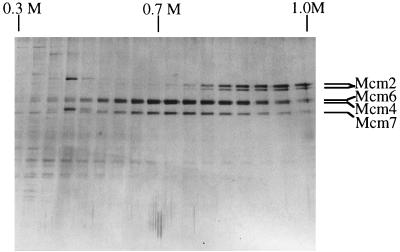
FIG. 1
FIG. 1
Purification of the recombinant Mcm2, Mcm4, Mcm6, and Mcm7 proteins by histone-Sepharose column chromatography. The recombinant proteins were produced in High 5 insect cells coinfected with recombinant baculoviruses carrying the Mcm2-his-Mcm7 and his-Mcm4-Mcm6 genes. Mcm proteins in the lysed cell extracts were purified by Ni-NTA affinity column chromatography followed by histone-Sepharose column chromatography. Proteins eluted from the histone column were subjected to SDS-PAGE (10% polyacrylamide) and stained with silver. Bands of the Mcm2, Mcm4, Mcm6, and Mcm7 proteins are indicated.
FIG. 2
FIG. 2
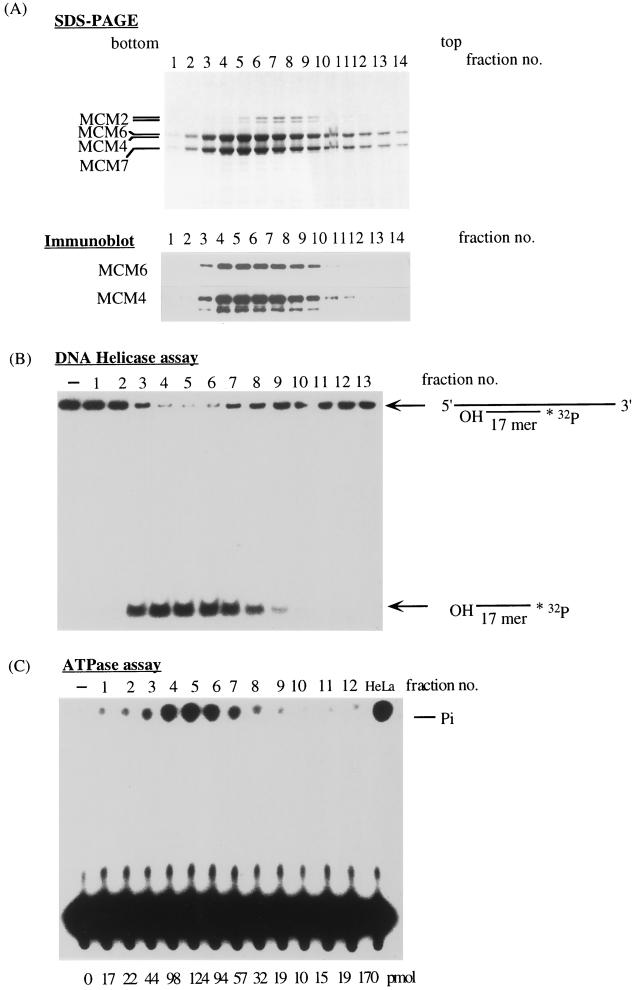
Purified Mcm4,6,7 complex has both DNA helicase and ATPase activities. (A) The histone-Sepharose fractions that mainly contain Mcm4, Mcm6, and Mcm7 proteins were pooled and further fractionated by glycerol gradient centrifugation. Proteins in the fractions were analyzed by SDS-PAGE and stained with silver or immunoblotted with antibodies to Mcm6 or Mcm4, as indicated. (B) DNA helicase activity that displaces 32P-labeled 17-mer oligonucleotides annealed with M13 DNA was examined in the gradient fractions. The positions of the annealed oligomer and the released oligomer are indicated. (C) The ATPase activity of the Mcm4,6,7 protein complex was measured in the presence of single-stranded DNA, and the released 32P was detected by thin-layer chromatography. The ATPase activity of the Mcm4,6,7 protein complex purified from HeLa cells was measured (HeLa). The released phosphate (Pi) (picomoles) was calculated and is indicated at the bottom.
FIG. 3
FIG. 3
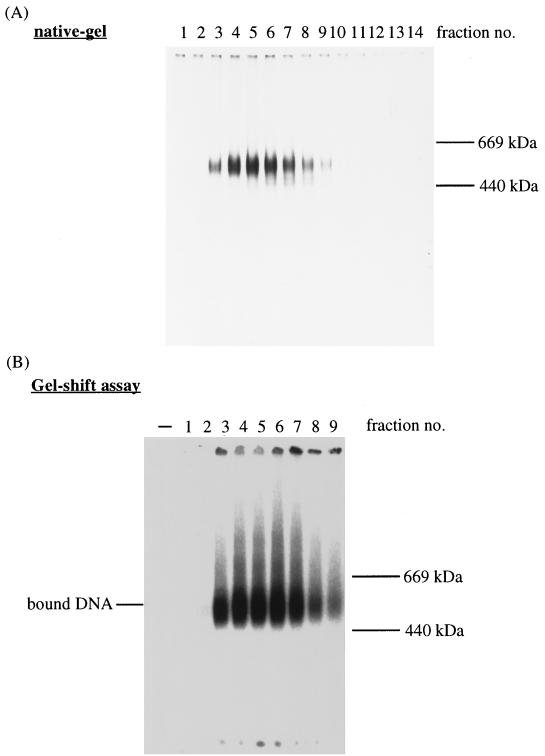
The Mcm4,6,7 protein complex can bind single-stranded DNA. (A) Proteins in the gradient fractions were electrophoresed on a 5% native polyacrylamide gel and stained with silver. As markers, thyroglobulin (669 kDa) and ferritin (440 kDa) were electrophoresed. (B) A gel shift assay was carried out with the Mcm4,6,7 protein complexes present in the gradient fractions. 32P-labeled 37-mer oligonucleotides were incubated with the fractions. After cross-linking, DNA-protein complexes were separated by native PAGE (5% polyacrylamide). Autoradiography of the dried gel was performed.
FIG. 4
FIG. 4
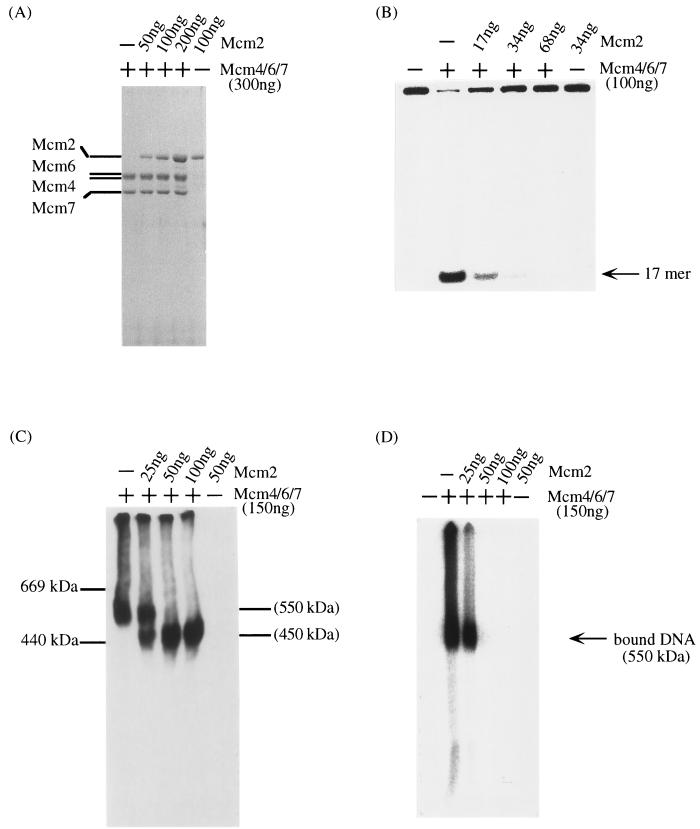
Inhibition of Mcm4,6,7 DNA helicase activity by Mcm2. Increasing amounts of His6-tagged mouse Mcm2 proteins purified from baculovirus-infected cells were incubated with the recombinant Mcm4,6,7 complex in 50 mM Tris-HCl (pH 7.9)–20 mM 2-mercaptoethanol–5 mM MgCl2–5 mM ATP–0.01% Triton X-100 for 30 min at 37°C. Aliquots of these reaction mixtures were analyzed by SDS-PAGE (A), for the activity of DNA helicase (B), by native gel electrophoresis (C), and for the activity of single-stranded DNA binding (D). The amount of Mcm2 and the presence of the Mcm4,6,7 complex are indicated at the top of each panel. In panel A, proteins were stained with Coomassie brilliant blue. In panel C, Mcm4 protein in Mcm complexes was detected with anti-Mcm4 antibodies as described in Materials and Methods.
FIG. 5
FIG. 5
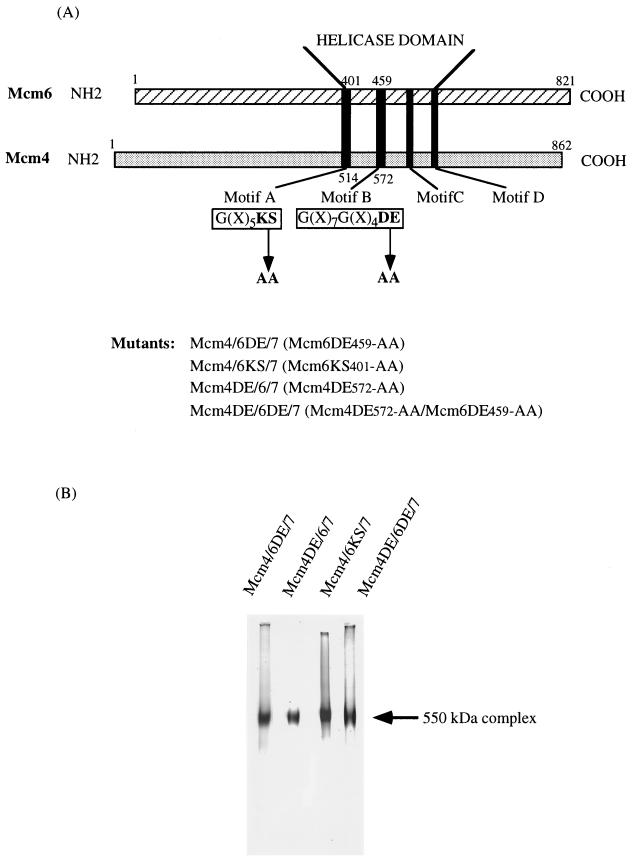
Mutations introduced into Mcm4 and Mcm6 proteins for the formation of various mutant Mcm4,6,7 complexes. (A) A schematic presentation of the Mcm4 and Mcm6 proteins depicts the DNA-dependent ATPase motifs A, B, C, and D in the conserved regions, and the mutagenized amino acids in motifs A and B are indicated. A set of mutants of Mcm complexes constructed are shown. (B) Purified mutant Mcm4,6,7 complexes were electrophoresed on 5% native gels, and the proteins were stained with silver.
FIG. 6
FIG. 6
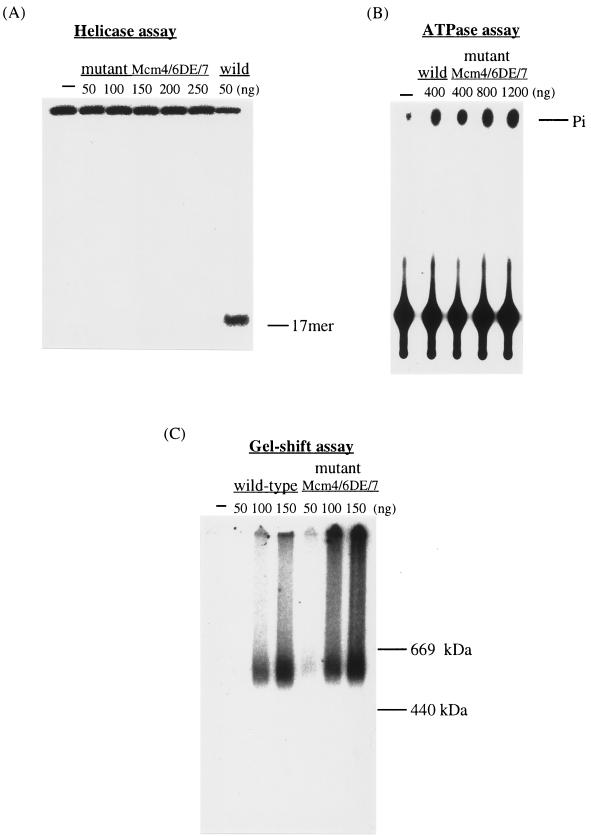
A defect in the DNA helicase activity of the Mcm4,6,7 complex containing mutated Mcm6. The DNA helicase (A), ATPase (B), and single-stranded DNA binding (C) activities of the mutant Mcm4,6,7 complex where DE in motif B of the Mcm6 protein was converted to AA (Mcm4,6DE-AA,7) were measured and compared with those of the wild-type Mcm4,6,7 complex (wild). Increasing amounts of the mutant complex were added to the reaction mixtures as indicated. Pi, phosphate.
FIG. 7
FIG. 7
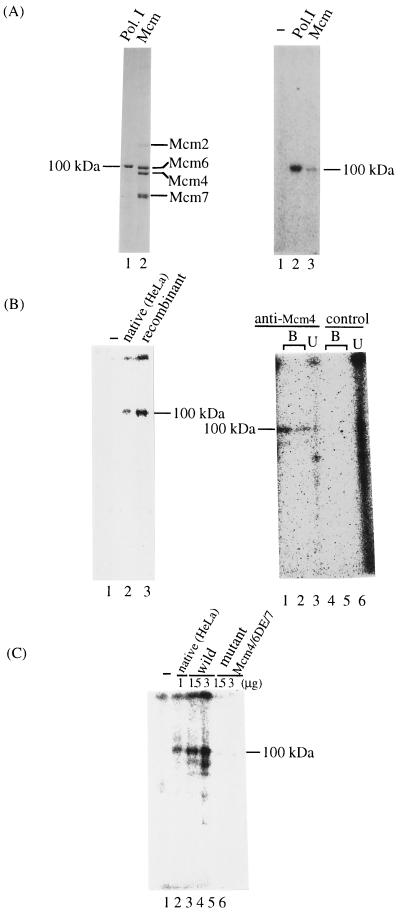
Mutation in motif B of the Mcm6 protein results in the reduction of ATP binding activity of the Mcm4,6,7 complex. (A) Native Mcm4,6,7 complex of HeLa cells (lane 2) and E. coli DNA polymerase I (Pol. I) (lane 1) were electrophoresed in an SDS–8% polyacrylamide gel and then stained with silver (left). [α-32P]ATP was incubated in the absence (lane 1) or the presence of Mcm proteins (1.5 μg, lane 3) or polymerase I (lane 2) under UV irradiation, and the proteins were electrophoresed through an SDS–8% polyacrylamide gel (right). The cross-linked proteins were detected by using a Bio-Image Analyzer. (B) [α-32P]ATP was incubated in the absence (lane 1) or the presence of native HeLa (lane 2) or wild-type recombinant Mcm4,6,7 complex (lane 3) as in panel A. Half of the reaction mixture was analyzed directly by SDS-PAGE (10% polyacrylamide) (left); the other half was immunodepleted with anti-Mcm4 antibody beads (lanes 1 to 3) or control beads (lanes 4 to 6). Proteins bound (lanes B) and unbound (lanes U) to the beads were electrophoresed (right). (C) Similar experiments were conducted on the mutant Mcm4,6DE-AA,7 complex. [α-32P]ATP was incubated in the absence (lane 1) or presence (lane 2) of native HeLa cells, increasing amounts of wild-type Mcm4,6,7 complex (lanes 3 and 4), or the mutant Mcm4,6DE-AA,7 complex (lanes 5 and 6) as indicated under UV irradiation. Proteins were analyzed by SDS-PAGE (10% polyacrylamide).
FIG. 8
FIG. 8
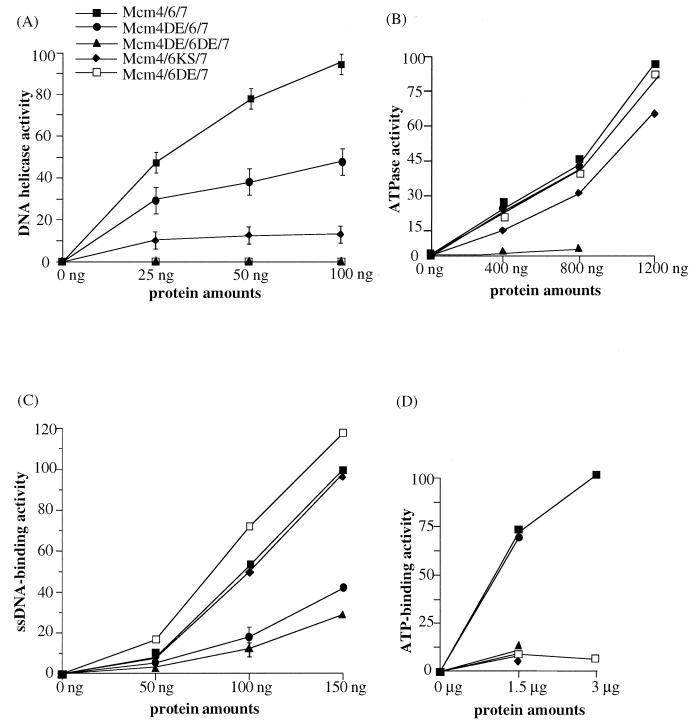
Characterization of various mutant forms of Mcm4,6,7 complex. The activities of DNA helicase (A), ATPase (B), single-stranded DNA binding (C), and ATP binding (D) were investigated. The designations of the mutant Mcm4,6,7 complexes are described in the legend to Fig. 5 and in the text. The reactions were performed under standard conditions with various amounts of the wild-type and mutant Mcm4,6,7 complexes. Each activity was quantitated, and the activities of the wild type and mutant complexes are expressed in relation to the activity of the wild-type complex at the highest dose, where this activity was regarded as 100. In panel A, 3.7 fmol of 17-mer was displaced in the presence of the highest dose of the wild-type complex. In panel B, 184 pmol of phosphate was released in the presence of the highest dose of the wild-type complex. Values from two independent experiments are shown as vertical bars, and their average in several Mcm complexes is plotted in panels A and C.

References

    1. Adachi Y, Usukura J, Yanagida M. A globular complex formation by Nda1 and the other five members of the MCM protein family in fission yeast. Genes Cells. 1997;2:467–479. - PubMed
    1. Aparicio O M, Weinstein D M, Bell S P. Components and dynamics of DNA replication complexes in S. cerevisiae: redistribution of MCM proteins and Cdc45p during S phase. Cell. 1997;91:59–69. - PubMed
    1. Austin S, Dixon R. The prokaryotic enhancer binding protein NTRC has an ATPase activity which is phosphorylation and DNA dependent. EMBO J. 1992;11:2219–2228. - PMC - PubMed
    1. Borowiec J A. DNA helicases. In: DePamphilis M L, editor. DNA replication in eukaryotic cells. Vol. 1. Cold Spring Harbor, N.Y: Cold Spring Harbor Laboratory; 1996. pp. 545–574.
    1. Burkhart R, Schulte D, Hu D, Musahl C, Göhring F, Knippers R. Interactions of human nuclear proteins P1Mcm3 and P1Cdc46. Eur J Biochem. 1995;228:431–438. - PubMed

Publication types

MeSH terms

Substances