. 1999 Dec;19(12):8103-12.
doi: 10.1128/MCB.19.12.8103.

Evidence for a protein mutator in yeast: role of the Hsp70-related chaperone ssb in formation, stability, and toxicity of the [PSI] prion

Affiliations

Evidence for a protein mutator in yeast: role of the Hsp70-related chaperone ssb in formation, stability, and toxicity of the [PSI] prion

Y O Chernoff et al. Mol Cell Biol. 1999 Dec.

Abstract

Propagation of the yeast protein-based non-Mendelian element [PSI], a prion-like form of the release factor Sup35, was shown to be regulated by the interplay between chaperone proteins Hsp104 and Hsp70. While overproduction of Hsp104 protein cures cells of [PSI], overproduction of the Ssa1 protein of the Hsp70 family protects [PSI] from the curing effect of Hsp104. Here we demonstrate that another protein of the Hsp70 family, Ssb, previously implicated in nascent polypeptide folding and protein turnover, exhibits effects on [PSI] which are opposite those of Ssa. Ssb overproduction increases, while Ssb depletion decreases, [PSI] curing by the overproduced Hsp104. Both spontaneous [PSI] formation and [PSI] induction by overproduction of the homologous or heterologous Sup35 protein are increased significantly in the strain lacking Ssb. This is the first example when inactivation of an unrelated cellular protein facilitates prion formation. Ssb is therefore playing a role in protein-based inheritance, which is analogous to the role played by the products of mutator genes in nucleic acid-based inheritance. Ssb depletion also decreases toxicity of the overproduced Sup35 and causes extreme sensitivity to the [PSI]-curing chemical agent guanidine hydrochloride. Our data demonstrate that various members of the yeast Hsp70 family have diverged from each other in regard to their roles in prion propagation and suggest that Ssb could serve as a proofreading component of the enzymatic system, which prevents formation of prion aggregates.


Figures
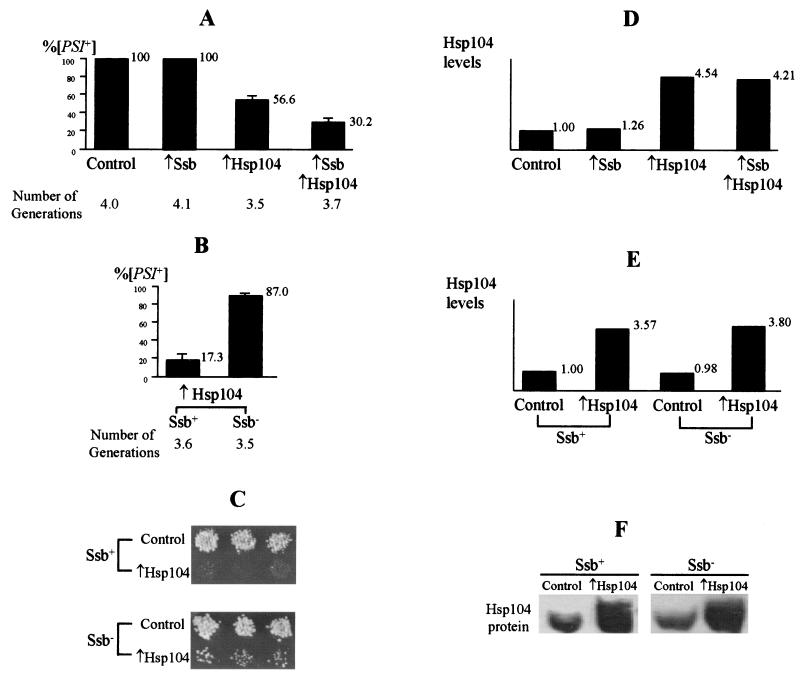
FIG. 1
FIG. 1
Effects of Ssb protein on [PSI] curing by overproduced Hsp104. (A) Ssb overproduction increases [PSI] curing by overproduced Hsp104 in yeast strain OT56. Plasmid combinations: Control, pRS316GAL plus pLA1; ↑Ssb, pRS316GAL-SSB1 plus pLA1; ↑Hsp104, pRS316GAL plus pH28; ↑Ssb ↑Hsp104, pRS316GAL-SSB1 plus pH28. The isogenic weak [PSI+] strain OT55 (39) also was not cured of [PSI] by Ssb overproduction alone (not shown). [PSI] curing was measured after 22.5 h of induction in Gal+Raf liquid medium at 25°C as described in Material and Methods. Number of generations (G) was calculated according to the formula G = log2(C2/C1), where C2 and C1 are concentrations of CFU at the end and start of incubation in Gal+Raf medium, respectively. Only plasmid-containing colonies were counted. (B) Ssb depletion inhibits [PSI] curing by galactose-induced Hsp104. Strains were GT81-1C (Ssb+) and GT146 (Ssb). The Hsp104-overproducing plasmid was pYS-GAL104. [PSI] curing was measured after 24 h of induction in Gal+Raf liquid medium at 30°C. Numbers of generations were calculated as described above. Differences between the samples, which express normal levels of Ssb and elevated levels of Hsp104, in panels A and B are apparently due to use of different [PSI+] strains. (C) Ssb depletion decreases [PSI] curing by constitutively overproduced Hsp104. Strains were GT81-1C (Ssb+) and GT127 (Ssb). The Hsp104-overproducing plasmid was pLH105; the matching control plasmid was YEp13. Transformants were selected on −Leu medium and velveteen replica plated onto −Ade medium, which is not selective for the plasmid. Growth is indicative of [PSI+]. (D) Relative Hsp104 levels determined by Western blotting and densitometry after 22.5 h of induction in Gal+Raf medium at 25°C. Yeast cultures and strain and plasmid designations are the same as for panel A. Amounts of total protein loaded were normalized according to the total Sup35 protein levels (not shown). (E and F) Relative Hsp104 levels determined by densitometry (E) and photographs of the Western blots (F) after 24 h of induction in Gal+Raf medium at 30°C. Strains were GT81-1C (Ssb+) and GT146 (Ssb). Plasmids: Control, pRS316GAL; ↑Hsp104, pYS-GAL104. Equal amounts of total protein were loaded, according to Coomassie blue staining (not shown).
FIG. 2
FIG. 2
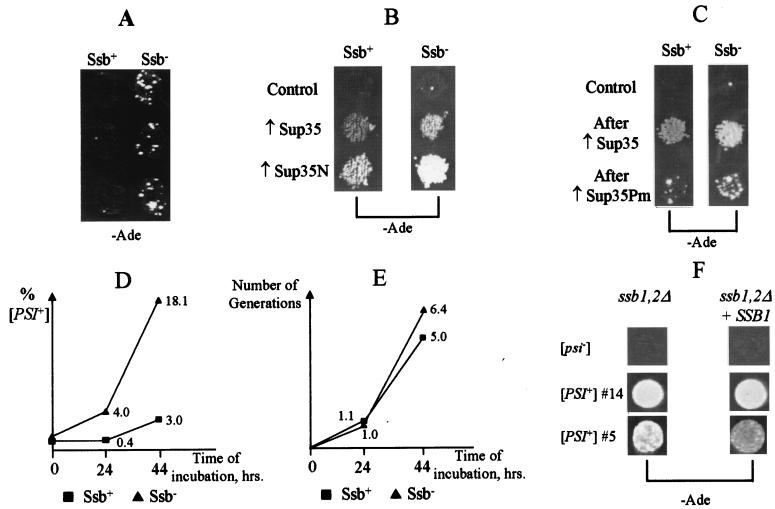
Effects of Ssb depletion on [PSI] formation. All experiments were performed in the [psi PIN+] yeast strains GT159 (Ssb+) and GT157 (Ssb). (A) Double ssb1/2Δ deletion increases frequency of the spontaneous appearance of [PSI+] (Ade+) colonies. Several independent colonies of each strain were patched on YPD medium, grown, and velveteen replica plated onto −Ade medium. The −Ade plate was photographed after 10 days of incubation. (B) Double ssb1/2Δ deletion increases suppression of ade1-14 (UGA) by the overproduced Sup35 or Sup35N. Plasmids: Control, pEMBL-yex; ↑Sup35, pEMBL-SUP35; ↑Sup35N, pEMBL-SUP35-ΔBal. The −Ade plates were photographed after 6 days of incubation. (C) Double ssb1/2Δ deletion increases efficiency of [PSI] induction by the overproduced S. cerevisiae Sup35 protein or P. methanolica Sup35 (Sup35Pm) protein (qualitative assay). Plasmids: Control, pRS316; ↑Sup35, CEN-GAL-SUP35; ↑Sup35Pm, pRS316GAL-SUP35Pm. Transformants were incubated on −Ura/Gal medium and velveteen replica plated onto glucose −Ade medium. Plates were photographed after 8 days of incubation. Eleven independent Ade+ derivatives, induced by CEN-GAL-SUP35, were checked further. All maintained the Ade+ phenotype after the loss of plasmid and were GuHCl curable, which confirms the presence of [PSI]. (D) Double ssb1/2Δ deletion increases efficiency of [PSI] induction by the overproduced S. cerevisiae Sup35 protein (quantitative assay). Transformants bearing the CEN-GAL-SUP35 plasmid were grown in the −Ura/Gal+Raf medium, where expression of the GAL-SUP35 construct is induced. Frequencies of the [PSI+] cells in each culture were determined after various periods of time as described in Materials and Methods. The experiments were repeated with two independent transformants per strain, with similar results. The average numbers are shown. (E) Double ssb1/2Δ deletion has only slight effect on growth rate of the [psi PIN+] strain, which overexpresses the Sup35 protein. Strains and plasmids are the same as for panel D. Numbers of generations in Gal+Raf medium were determined as described for Fig. 1A. Results for one representative transformant are shown. (F) Effects of Ssb protein on the ade1-14 (UGA) suppression mediated by [PSI]. The [PSI+] derivatives, obtained in the ssb1/2Δ [psi PIN+] strain GT157, were transformed with either plasmid YCp-SSB1 (ssb1/2Δ + SSB1) or control matching plasmid pRS316 (ssb1/2Δ). The resulting transformants were patched on −Ura medium and velveteen replica plated onto −Ura-Ade medium. Plates were photographed after 5 days of incubation. A total of 14 independent [PSI+] derivatives were tested, and at least eight transformants were tested for each strain-plasmid combination. The representative examples are shown. See also comments in the text.
FIG. 3
FIG. 3
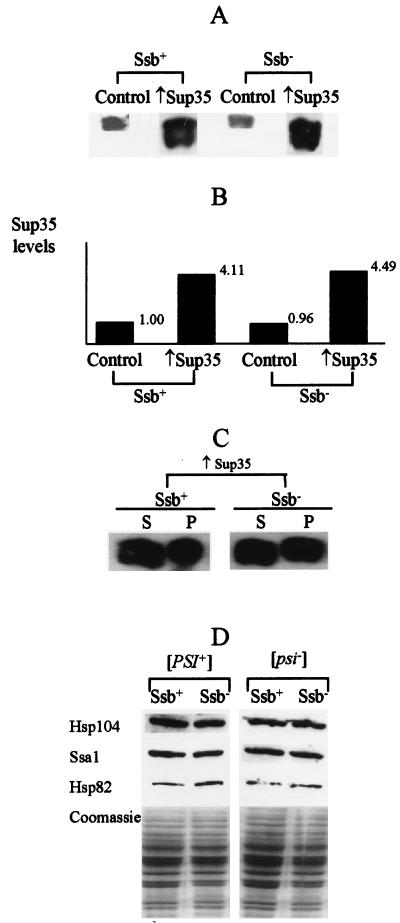
Levels of the Sup35 and heat shock proteins in the Ssb+ and Ssb strains. (A and B) Double ssb1/2Δ deletion does not affect levels of the overproduced Sup35 protein. Plasmids: Control, pRS316GAL; ↑Sup35, CEN-GAL-SUP35. Total protein lysates were prepared from the cells grown for 44 h in −Ura/Gal+Raf medium, separated by SDS-PAGE, and Western blotted with the Sup35-specific antibodies. Western blot photograph (A) and relative Sup35 protein levels as determined by densitometry (B) are shown. Equal amounts of total protein were loaded, according to Coomassie blue staining (not shown). (C) Double ssb1/2Δ deletion does not affect distribution of the overproduced Sup35 protein between the soluble (supernatant [S]) and insoluble (pellet [P]) fractions. The protein extracts prepared from the CEN-GAL-SUP35 transformants after 44 h of incubation in −Ura/Gal+Raf medium, were fractionated by centrifugation as described previously (39). The S and P fractions were separated by SDS-PAGE and Western blotted with Sup35-specific antibodies. (D) Levels of heat shock proteins in Ssb+ and Ssb strains. Strains [PSI+] Ssb+, GT81-1C; [PSI+] Ssb, GT146; [psi] Ssb+, GT174; [psi] Ssb, GT175. The protein extracts were subjected to SDS-PAGE and Western blotted with the antibodies specific to Hsp104, Ssa1, or Hsp82. Equal amounts of each sample, run on a gel stained with Coomassie blue, are shown for comparison.
FIG. 4
FIG. 4
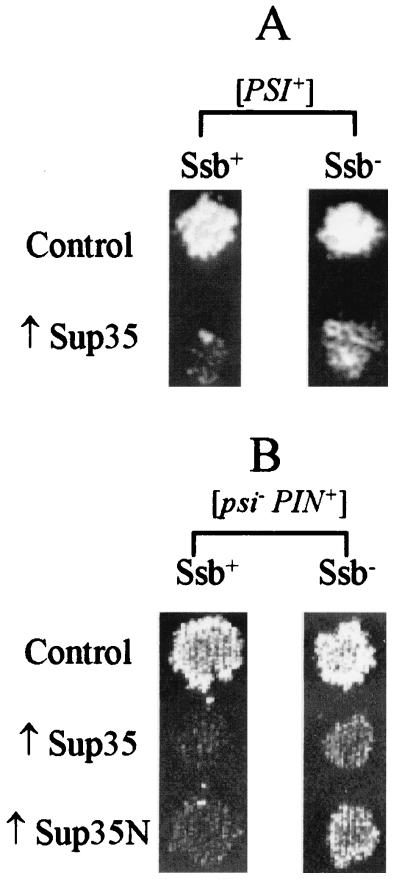
Toxicity of overproduced Sup35 protein in Ssb+ and Ssb strains. (A) The ssb1/2Δ deletion decreases toxicity of the overproduced Sup35 protein in the [PSI+] strain. Yeast strains: Ssb+, GT81-1C; Ssb, GT146. Plasmids, Control, pRS316GAL; ↑Sup35, CEN-GAL-SUP35. The −Ura/Gal plates, on which the GAL-SUP35 construct is activated, were photographed after 7 days of incubation. At least eight independent transformants were tested for each strain-plasmid combination; representative examples are shown. No differences between the strains and plasmids were observed on glucose −Ura medium, where GAL-SUP35 is inactive. (B) The ssb1/2Δ deletion decreases toxicity of multicopy SUP35 and SUP35N plasmids in the [psi PIN+] strain. Yeast strains: Ssb+, GT159; Ssb, GT157. Plasmids: Control, pEMBL-yex; ↑Sup35, pEMBL-SUP35; ↑Sup35N, pEMBL-SUP35-ΔBal. Transformants were selected on −Ura medium and velveteen replica plated onto −Leu medium. Growth on −Leu requires plasmid amplification up to about 100 copies per cell (21). The −Leu plates were photographed after 2 days of incubation.
FIG. 5
FIG. 5
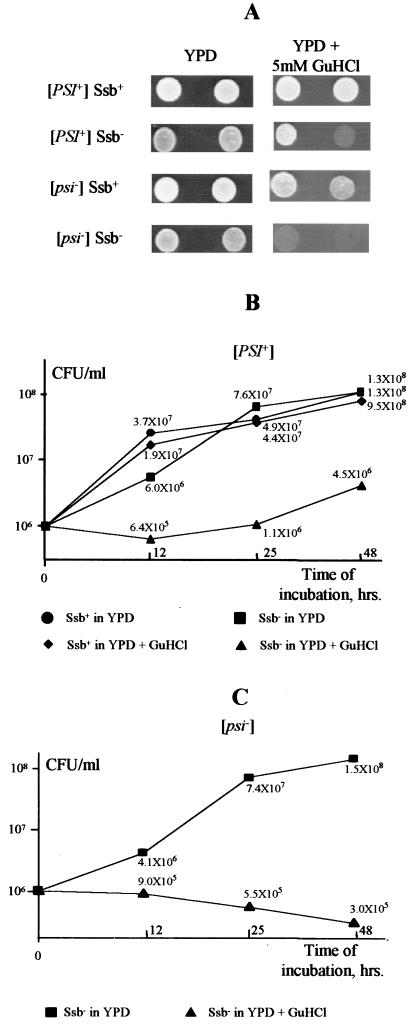
Sensitivity of Ssb strains to GuHCl. (A) Qualitative assay. Yeast strains: [PSI+] Ssb+, GT81-1C; [PSI+] Ssb, GT127, [psi] Ssb+, GT117; [psi] Ssb, GT139. The [psi] strains shown are [pin]. However, similar results were obtained for the [psi PIN+] strains GT159 and GT157 (not shown), indicating that levels of resistance to GuHCl are not affected by the presence or absence of the [PIN] factor. Yeast cells grown on YPD plates were diluted in sterile H2O at approximately 107 cells/ml. The original solution and the 10-fold dilution (from left to right) were plated onto YPD and YPD–5 mM GuHCl media. Plates were photographed after 1 day of incubation at 30°C. Differences remained after longer periods of incubation. (B and C) Quantitative assays. Yeast [PSI+] strains (B) were GT81-1C (Ssb+) and GT127 (Ssb); the yeast [psi] Ssb strain (C) was GT139. Yeast cultures were grown in the liquid YPD medium with or without 5 mM GuHCl with agitation. After certain periods of time, aliquots of the cultures were taken, plated onto YPD medium, and grown for 4 to 5 days. Concentrations of CFU, which correspond to the viable cells, were determined.

References

    1. Aigle M, Lacroute F. Genetical aspects of [URE3], a non-mitochondrial cytoplasmically inherited mutation in yeast. Mol Gen Genet. 1975;136:327–335. - PubMed
    1. Baudin A, Ozier-Kalogeropoulos O, Denouel A, Lacroute F, Cullin C. A simple and efficient method for direct gene deletion in Saccharomyces cerevisiae. Nucleic Acids Res. 1993;21:3329–3330. - PMC - PubMed
    1. Boorstein W R, Ziegelhoffer T, Craig E A. Molecular evolution of the HSP70 multigene family. J Mol Evol. 1994;38:1–17. - PubMed
    1. Broach J R, Strathern J N, Hicks J B. Transformation in yeast: development of a hybrid cloning vector and isolation of the CAN1 gene. Gene. 1979;8:121–133. - PubMed
    1. Cesareni G, Murray A H. Plasmid vectors carrying the replication origin of filamentous single-stranded phages. In: Setlow J K, editor. Genetic engineering: principles and methods. Vol. 4. New York, N.Y: Plenum Press; 1987. pp. 13–154.

Publication types

MeSH terms

LinkOut - more resources