. 1999 Dec;19(12):8136-45.
doi: 10.1128/MCB.19.12.8136.

PCAF interacts with tax and stimulates tax transactivation in a histone acetyltransferase-independent manner

Affiliations

PCAF interacts with tax and stimulates tax transactivation in a histone acetyltransferase-independent manner

H Jiang et al. Mol Cell Biol. 1999 Dec.

Erratum in

  • Mol Cell Biol 2000 Mar;20(5):1897

Abstract

Recent studies have shown that the p300/CREB binding protein (CBP)-associated factor (PCAF) is involved in transcriptional activation. PCAF activity has been shown strongly associated with histone acetyltransferase (HAT) activity. In this report, we present evidence for a HAT-independent transcription function that is activated in the presence of the human T-cell leukemia virus type 1 (HTLV-1) Tax protein. In vitro and in vivo GST-Tax pull-down and coimmunoprecipitation experiments demonstrate that there is a direct interaction between Tax and PCAF, independent of p300/CBP. PCAF can be recruited to the HTLV-1 Tax responsive element in the presence of Tax, and PCAF cooperates with Tax in vivo to activate transcription from the HTLV-1 LTR over 10-fold. Point mutations at Tax amino acid 318 (TaxS318A) or 319 to 320 (Tax M47), which have decreased or no activity on the HTLV-1 promoter, are defective for PCAF binding. Strikingly, the ability of PCAF to stimulate Tax transactivation is not solely dependent on the PCAF HAT domain. Two independent PCAF HAT mutants, which knock out acetyltransferase enzyme activity, activate Tax transactivation to approximately the same level as wild-type PCAF. In contrast, p300 stimulation of Tax transactivation is HAT dependent. These studies provide experimental evidence that PCAF contains a coactivator transcription function independent of the HAT activity on the viral long terminal repeat.


Figures
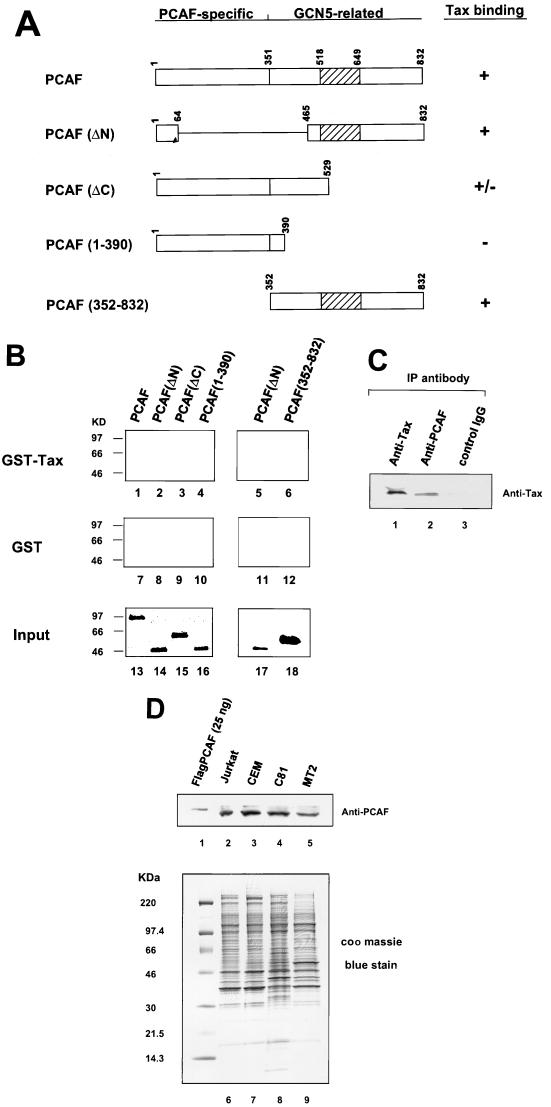
FIG. 1
FIG. 1
In vitro and in vivo binding assays showing that Tax associates with the C-terminal part of PCAF. (A) Schematic of PCAF. Hatched regions represent the HAT domain. (B) GST-Tax pull-down experiment. Flag-tagged PCAF and PCAF truncations were detected by anti-Flag M2 antibody Western blotting. Lanes 1 to 6, GST-Tax pull-down; lanes 7 to 12, GST control; lanes 13 to 18, input representing one-fourth of the amount added to the binding reaction. (C) In vivo co-IP of Tax with PCAF. Extracts from HTLV-1-transformed C81 cells were incubated with anti-Tax polyclonal, anti-PCAF polyclonal, or control IgG antibody to precipitate Tax and associated proteins. Immunoprecipitates were subjected to SDS-PAGE, a polyvinylidene transferred to membrane, and analyzed by Western blotting with an anti-Tax antibody. (D) PCAF expression levels in T cells and HTLV-1-transformed cells. Extracts from Jurkat, CEM, C81, and MT2 cells were subjected to SDS-PAGE and analyzed by Western blotting with an anti-PCAF antibody (lanes 1 to 5). Lane 1 is 25 ng of purified Flag-PCAF protein. The bottom panel represent a Coomassie blue-stained gel to demonstrate that equivalent amounts of protein were added to the gel.
FIG. 2
FIG. 2
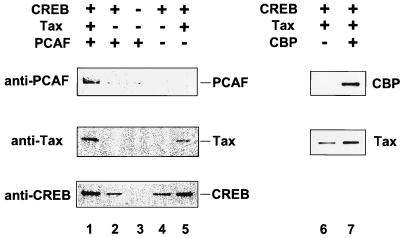
Biotinylated HTLV-1 TRE DNA pull-down experiment in which 0.2 μg of 5′-biotinylated DNA was incubated with different combinations of 20 pmol of CREB, TaxH6, Flag-PCAF, and CBP(1-682) in 100 μl of buffer as outlined in Materials and Methods. Western blotting with anti-PCAF polyclonal (top, lanes 1 to 5), anti-Tax (middle, lanes 1 to 7), anti-CREB polyclonal (bottom, lanes 1 to 5), and anti-CBP (top, lanes 6 and 7) antibodies was used to analyze the components in the pulled down DNA-protein complex.
FIG. 3
FIG. 3
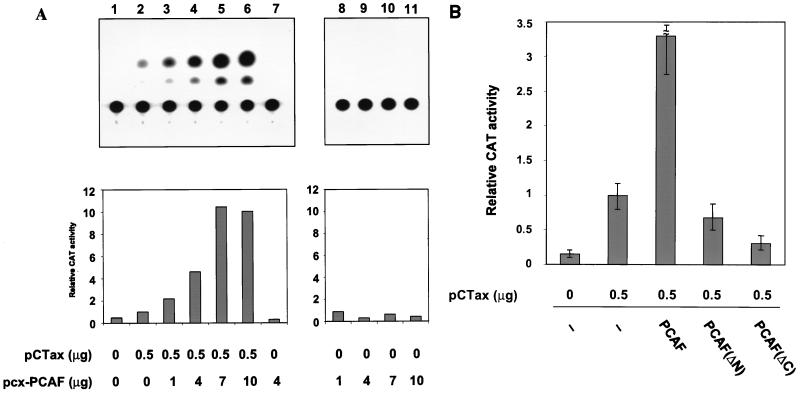
PCAF stimulates Tax-mediated HTLV-1 transcription. (A) Human T-lymphocyte Jurkat cells were transiently transfected with 5 μg of HTLV-1–CAT reporter plasmid and pCTax and pcx-PCAF expression vectors as indicated. Cells were harvested after 24 h of incubation as described in Materials and Methods, and 1 μg of lysate was used for CAT assay. CAT activity was normalized to protein concentration. A bar graph representing the quantitative analysis of the CAT assay is shown below. The relative activities presented are calculated as fold activity, with the activity in the presence of Tax alone equal to 1. (B) Activity of PCAF mutants on activation of the HTLV-1 promoter. Four micrograms of each PCAF plasmid and 0.5 μg of pCTax were cotransfected into Jurkat cells with the HTLV-1 LTR reporter pU3RCAT. CAT assays were performed as described above. The results are the average of three independent assays.
FIG. 4
FIG. 4
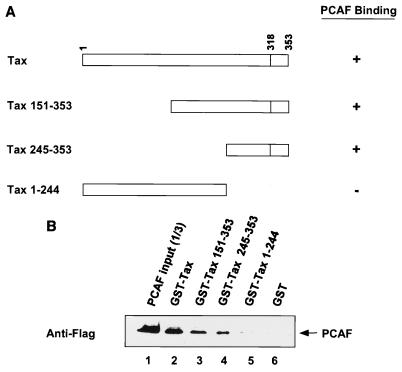
Mapping the domain of Tax required for interaction with PCAF. (A) Schematic of Tax deletion mutants. (B) PCAF binds to the carboxy-terminal domain of Tax. PCAF and purified GST-Tax fusion proteins were incubated, pulled down with glutathione beads, and analyzed by Western blot analysis using an anti-Flag antibody.
FIG. 5
FIG. 5
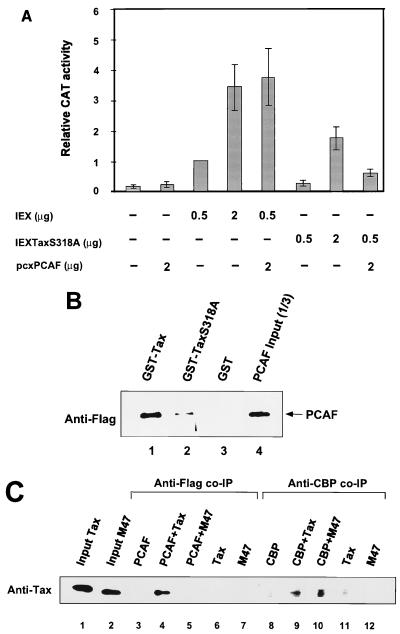
Tax mutants S318A and M47 fail to interact with PCAF in vitro and in vivo. (A) Jurkat transfection and CAT assay using IEXTax and IEX-TaxS318A. The pU3RCAT reporter was transfected with either wild-type IEXTax or mutant IEX-TaxS318A in the absence and presence of PCAF as indicated. Cells were then incubated for 24 h, and extracts were prepared as described in Materials and Methods. The relative activities presented are calculated as fold activity. (B) PCAF interacts weakly with Tax mutant S318A. PCAF was incubated with either GST-Tax or GST-TaxS318A, pulled down with glutathione beads, and assayed by Western blot analysis. (C) Tax mutant M47 (L319R-L320S) fails to interact with PCAF. Wild-type or M47 Tax was incubated with Flag-tagged PCAF or CBP(1-682) and subsequently immunoprecipitated with either an anti-Flag or anti-CBP antibody. Immunoprecipitates were run on an SDS-gel, and Western blot analysis was performed with an anti-Tax antibody. Lanes 1 and 2 represent one-fourth of the Tax or M47 protein added to the in vitro binding assay.
FIG. 6
FIG. 6
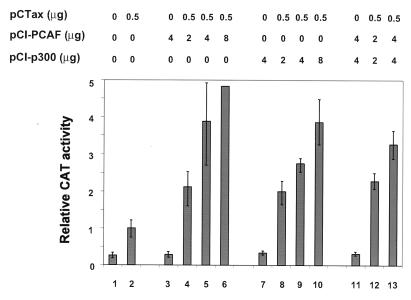
Comparison of the activities of PCAF and p300 as coactivators on the HTLV-1 promoter. Tax, PCAF, and p300 expression vectors were cotransfected with 5 μg of pU3RCAT into Jurkat cells as indicated. The relative activities presented are calculated as fold activity, with the activity in the presence of Tax alone equal to 1. The values represent the average of three independent experiments.
FIG. 7
FIG. 7
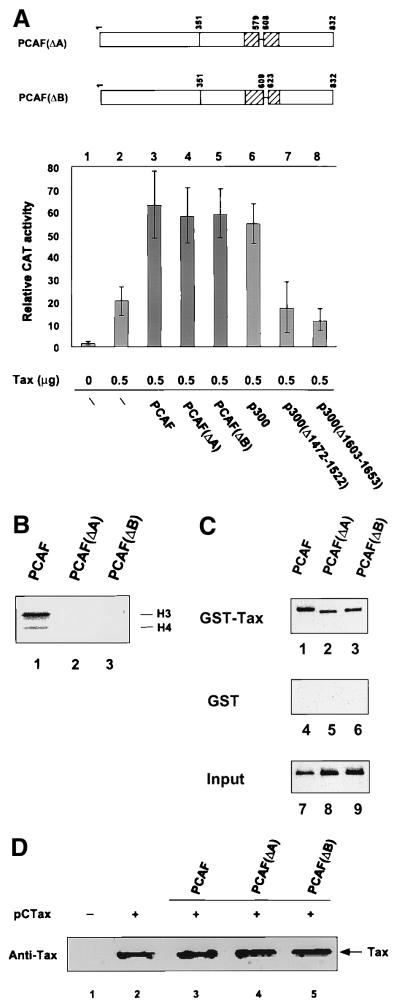
Effect of the PCAF HAT domain on HTLV-1 transcription. (A) Jurkat cells were transfected Tax and PCAF, PCAF HAT mutants, p300, or p300 HAT mutants as indicated, and CAT assays were performed as described in Materials and Methods. PCAF(ΔA) contains a deletion of amino acids 579 to 608; PCAF(ΔB) contains a deletion of amino acids 609 to 623. Both deletion mutants lack HAT activity. Two p300 mutants containing deletions with the p300 HAT domain, amino acids 1472 to 1522 and 1603 to 1653, were compared to wild-type p300. The PCAF and p300 proteins were expressed from the same pCI vector. (B) Histone acetylation assay. Both PCAF(ΔA) and PCAF(ΔB) were expressed as Flag-tagged fusion proteins in baculovirus-infected cells and purified through an anti-Flag affinity column. The positions of histones H3 and H4 in the gel are indicated. (C) Interaction of GST-Tax with PCAF and PCAF deletion mutants. The GST binding assays were performed as described in Materials and Methods. GST-bound proteins were subjected to SDS-PAGE, and Western blot analysis was performed with an anti-Flag M2 antibody. The top, middle, and bottom panels represent GST-Tax-bound, GST-bound, and input PCAF protein, respectively. The bottom panel represents one-fourth of the PCAF added to the GST-Tax or GST binding assays. (D) PCAF, PCAF(ΔA), and PCAF(ΔB) do not increase Tax expression level. Jurkat cells were cotransfected with 5 μg of pCTax with either control plasmid (lane 2), PCAF (lane 3), PCAF(ΔA) (lane 4), or PCAF(ΔB) (lane 5). Nuclear extracts were made, and 60-μg aliquots of the proteins were subjected to SDS-PAGE and analyzed by anti-Tax Western blotting.

References

    1. Adya N, Giam C Z. Distinct regions in human T-cell lymphotropic virus type I tax mediate interactions with activator protein CREB and basal transcription factors. J Virol. 1995;69:1834–1841. - PMC - PubMed
    1. Adya N, Zhao L J, Huang W, Boros I, Giam C Z. Expansion of CREB’s DNA recognition specificity by Tax results from interaction with Ala-Ala-Arg at positions 282-284 near the conserved DNA-binding domain of CREB. Proc Natl Acad Sci USA. 1994;91:5642–5646. - PMC - PubMed
    1. Avantaggiati M L, Ogryzko V, Gardner K, Giordano A, Levine A S, Kelly K. Recruitment of p300/CBP in p53-dependent signal pathways. Cell. 1997;89:1175–1184. - PubMed
    1. Bannister A J, Kouzarides T. The CBP co-activator is a histone acetyltransferase. Nature. 1996;384:641–643. - PubMed
    1. Bannister A J, Oehler T, Wilhelm D, Angel P, Kouzarides T. Stimulation of c-Jun activity by CBP: c-Jun residues Ser63/73 are required for CBP induced stimulation in vivo and CBP binding in vitro. Oncogene. 1995;11:2509–2514. - PubMed

MeSH terms