. 1999 Dec;19(12):8219-25.
doi: 10.1128/MCB.19.12.8219.

Pbx-Hox heterodimers recruit coactivator-corepressor complexes in an isoform-specific manner

Affiliations

Pbx-Hox heterodimers recruit coactivator-corepressor complexes in an isoform-specific manner

H Asahara et al. Mol Cell Biol. 1999 Dec.

Abstract

Homeobox (hox) proteins have been shown to regulate cell fate and segment identity by promoting the expression of specific genetic programs. In contrast to their restricted biological action in vivo, however, most homeodomain factors exhibit promiscuous DNA binding properties in vitro, suggesting a requirement for additional cofactors that enhance target site selectivity. In this regard, the pbx family of homeobox genes has been found to heterodimerize with and thereby augment the DNA binding activity of certain hox proteins on a subset of potential target sites. Here we examine the transcriptional properties of a forced hox-pbx heterodimer containing the pancreas-specific orphan homeobox factor pdx fused to pbx-1a. Compared to the pdx monomer, the forced pdx-pbx1a dimer, displayed 10- to 20-fold-higher affinity for a consensus hox-pbx binding site but was completely unable to bind a hox monomer recognition site. The pdx-pbx dimer stimulated target gene expression via an N-terminal trans-activation domain in pdx that interacts with the coactivator CREB binding protein. The pdx-pbx dimer was also found to repress transcription via a C-terminal domain in pbx-1a that associates with the corepressors SMRT and NCoR. The transcriptional properties of the pdx-pbx1 complex appear to be regulated at the level of alternative splicing; a pdx-pbx polypeptide containing the pbx1b isoform, which lacks the C-terminal extension in pbx1a, was unable to repress target gene expression via NCoR-SMRT. Since pbx1a and pbx1b are differentially expressed in endocrine versus exocrine compartments of the adult pancreas, our results illustrate a novel mechanism by which pbx proteins may modulate the expression of specific genetic programs, either positively or negatively, during development.


Figures
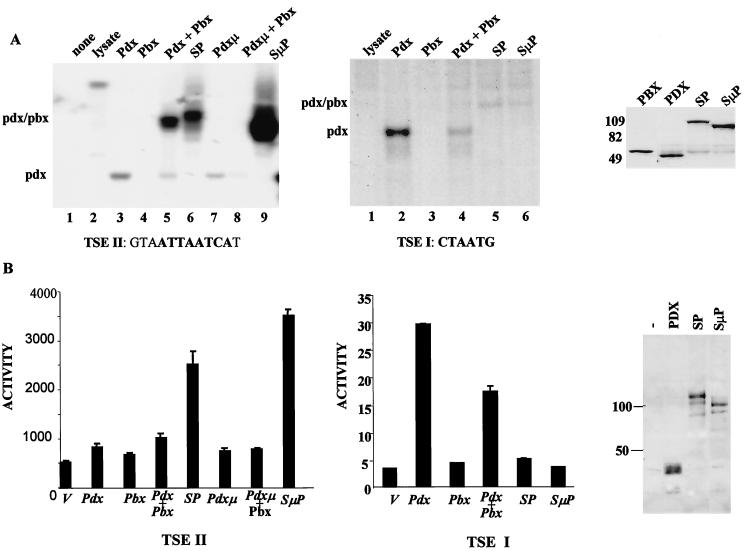
FIG. 1
FIG. 1
A forced pdx-pbx heterodimer, referred to as SP, binds selectively to and stimulates target gene expression from a consensus hox-pbx (TSEII) but not a monomeric hox (TSEI) binding site on the somatostatin promoter. (A) Gel mobility shift assay of SP binding activity compared with monomeric pdx on somatostatin TSEII (left) and TSEI (middle) elements. pbx interaction-defective pdx polypeptides containing (FPWMK/AAGGQ) substitution in the pbx interaction motif (aa 119 to 123) were examined either in the context of the pdx monomer (pdxμ) or a forced heterodimer (SμP). Gel mobility shift assays were performed with 32P-labeled somatostatin oligonucleotides plus in vitro-translated pdx and pbx polypeptides. (Right) Western blot assay of in vitro-translated pbx, pbx, SP, and SμP constructs show equivalent levels of expression. (B) Transient assay of pdx and SP polypeptides after cotransfection with somatostatin TSEII (left) and TSEI (middle) reporter constructs. In this and all subsequent assays, reporter activity is shown after normalizing to β-Gal activity from co-transfected RSV–β-Gal construct. (Right) Western blot assay of pdx, SP, and SμP polypeptides in nuclear extracts of transfected 293T cells with pdx-specific antiserum.
FIG. 2
FIG. 2
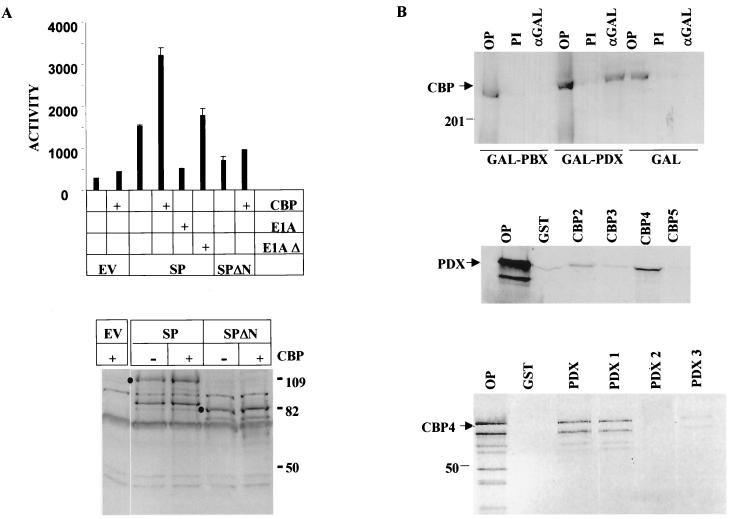
The pdx-pbx heterodimer stimulates target gene expression via an N-terminal trans-activation domain in pdx that associates with the coactivator CBP. (A) The top panel shows the transcriptional activity of wild-type (SP) or mutant (SPΔN) pdx-pbx forced heterodimer lacking N-terminal Pdx trans-activation domain (aa 1 to 135) in 293T cells. SP and SPΔN activities were evaluated on a somatostatin TSEII luciferase reporter plasmid. Cells cotransfected with CBP and E1A expression vectors (wild type and CBP/P300 interaction defective [E1AΔ]) indicated. In the bottom panel, the expression levels of SP and SPΔN in transfected 293T cells by Western blot assay with anti-pdx antiserum are shown. Cells co-transfected with CBP expression vector or empty vector indicated over each lane. (B) CBP associates with the N-terminal trans-activation domain of pdx in vivo. (Top) Western blot assay of CBP recovered from immunoprecipitates of GAL4 (αGAL) in 293T cells cotransfected with expression plasmids for CBP plus either GAL4 DNA-binding domain (aa 1 to 147), GAL4-PDX, or GAL4-PBX, as shown. OP, 10% of total input extract; PI, preimmune serum. (Middle) GST pull-down assay of 35S-labeled CBP fragments with the following amino acid endpoints: CBP2 (1 to 737), CBP3 (737 to 1626), CBP4 (1626 to 2260), and CBP5 (2260 to 2389). Assays were performed with GST or GST-pdx polypeptides bound to glutathione-Sepharose beads as indicated. OP, 10% of total input. (Bottom) GST pull-down assay of 35S-labeled CBP4 (aa 1626 to 2260) with GST-pdx polypeptides with the following amino acid endpoints: PDX, full-length pdx (1 to 283). PDX1 (1 to 140), PDX2 (141 to 215), and PDX3 (210 to 283).
FIG. 3
FIG. 3
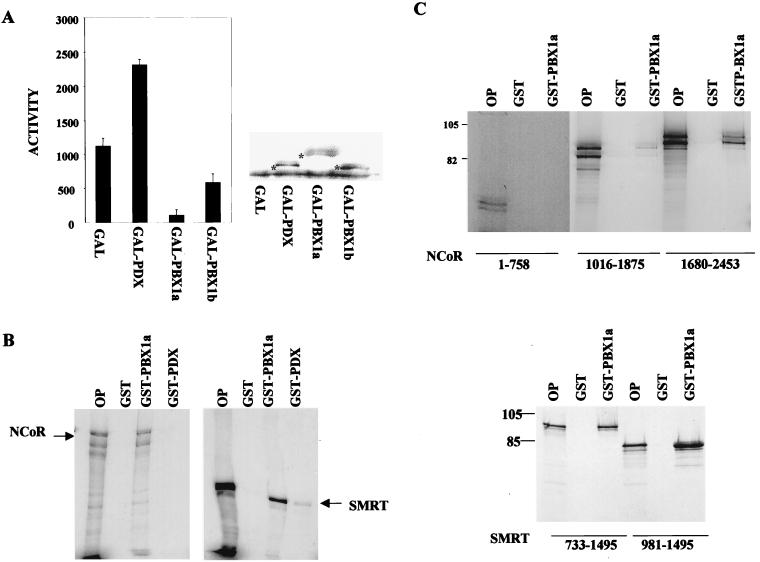
pbx1a associates with the corepressors NCoR and SMRT. (A) Transient-transfection assay of GAL4-pbx1a and GAL4-pbx1b polypeptides on a GAL4 thymidine kinase luciferase reporter plasmid in 293T cells. The activities of GAL4 DNA-binding domain and GAL4-pdx polypeptides are shown for comparison. A Western blot assay of nuclear extracts from transfected 293T cells with αGAL4 antiserum was done to show comparable expression levels of each GAL4 fusion construct. Asterisks indicate immunoreactive bands corresponding to each polypeptide. (B) GST pull-down assays of 35S-labeled NCoR and SMRT after incubation with GST, GST-pbx1a, or GST-pdx polypeptides in vitro. OP, 10% of input. (C) Carboxy-terminal domains of NCoR and SMRT associate with pbx1a. GST pull-down assay of 35S-labeled NCoR (top) and SMRT (bottom) polypeptides with GST or GST-pbx1a glutathione-Sepharose resins. Inclusive amino acid endpoints for each NCoR and SMRT polypeptide are shown.
FIG. 4
FIG. 4
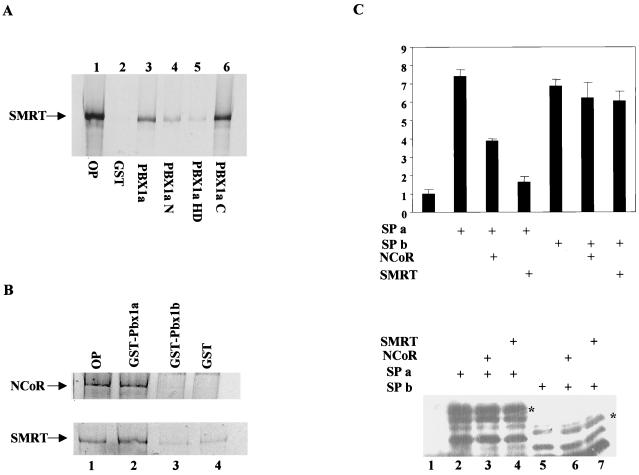
NCoR and SMRT are selectively recruited to pdx-pbx complexes containing pbx1a but not the alternatively spliced pbx1b polypeptide, which lacks the carboxy-terminal NcoR-SMRT interaction domain. (A) GST pull-down assay of 35S-labeled NCoR and SMRT polypeptides to GST-pdx1a and GST-pdx1b resins or GST only. OP, 10% of total input. (B) Pull-down assay of 35S-labeled SMRT with GST-pbx polypeptides. OP, 10% of total SMRT input; pull-downs were performed with glutathione-Sepharose resins containing either GST alone (GST), full-length GST-pbx1a (Pbx1a), or pbx fragments including N-terminal aa 1 to 240 (Pbx1aN), residues 233 to 320 containing the homeodomain (PBX1aHD), or carboxy-terminal residues 287 to 430 (PBX1aC). (C) In the upper panel, the results of a transient-transfection assay of SPa and SPb expression constructs containing full-length pdx fused to pbx1a and pbx1b, respectively, are shown. SPa and SPb activities were examined on a somatostatin TSEII luciferase reporter. Cotransfection with NCoR or SMRT expression vectors is as indicated. The lower panel shows a Western blot assay of nuclear extracts from transfected 293T cells with anti-pdx antiserum to show comparable expression of SPa (lanes 2 to 4) and SPb (lanes 5 to 7). Lane 1 shows extracts from cells transfected with empty vector.
FIG. 5
FIG. 5
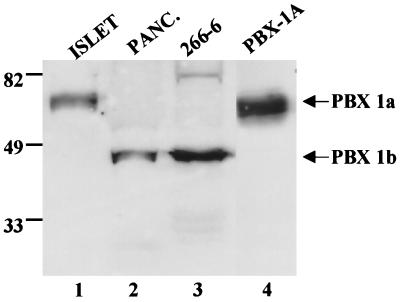
pbx1a and pbx1b isoforms are differentially expressed in pancreatic islets and acinar cells. A Western blot assay of whole-cell extracts from freshly isolated islets (ISLET), whole pancreas (PANC.), and the acinar cell line 266-6 was done with α pbx-1-specific antiserum. The migration of in vitro-translated pbx1a polypeptide is shown. The relative positions of pbx1b and pbx1a polypeptides are indicated.

References

    1. Alland L, Muhle R, Hou H, Potes J, Chin L, Schreiber-Agus N, DePinho R. A Role for N-CoR and histone deacetylase in Sin3-mediated transcriptional repression. Nature. 1997;387:49–55. - PubMed
    1. Bannister A J, Kouzarides T. The CBP co-activator is a histone acetyltransferase. Nature. 1996;384:641–643. - PubMed
    1. Chan S, Jaffe L, Capovilla M, Botas J, Mann R. The DNA binding specificity of ultrabithorax is modulated by cooperative interactions with extradenticle, another homeoprotein. Cell. 1994;78:603–615. - PubMed
    1. Chang C, Shen W, Rozenfeld S, Lawrence H, Largman C, Cleary M. Pbx proteins display hexapeptide-dependent cooperative DNA binding with a subset of Hox proteins. Genes Dev. 1995;9:663–674. - PubMed
    1. Chen J, Evans R. A transcriptional co-repressor that interacts with nuclear hormone receptors. Nature. 1995;377:454–457. - PubMed

Publication types

MeSH terms