. 1999 Dec;19(12):8505-12.
doi: 10.1128/MCB.19.12.8505.

Non-AUG initiation of AGAMOUS mRNA translation in Arabidopsis thaliana

Affiliations

Non-AUG initiation of AGAMOUS mRNA translation in Arabidopsis thaliana

J L Riechmann et al. Mol Cell Biol. 1999 Dec.

Abstract

The MADS box organ identity gene AGAMOUS (AG) controls several steps during Arabidopsis thaliana flower development. AG cDNA contains an open reading frame that lacks an ATG triplet to function as the translation initiation codon, and the actual amino terminus of the AG protein remains uncharacterized. We have considered the possibility that AG translation can be initiated at a non-AUG codon. Two possible non-AUG initiation codons, CUG and ACG, are present in the 5' region of AG mRNA preceding the highly conserved MADS box sequence. We prepared a series of AG genomic constructs in which these codons are mutated and assayed their activity in phenotypic rescue experiments by introducing them as transgenes into ag mutant plants. Alteration of the CTG codon to render it unsuitable for acting as a translation initiation site does not affect complementation of the ag-3 mutation in transgenic plants. However, a similar mutation of the downstream ACG codon prevents the rescue of the ag-3 mutant phenotype. Conversely, if an ATG is introduced immediately 5' to the disrupted ACG codon, the resulting construct fully complements the ag-3 mutation. The AG protein synthesized in vitro by initiating translation at the ACG position is active in DNA binding and is of the same size as the AG protein detected from floral tissues, whereas AG polypeptides with additional amino-terminal residues do not appear to bind DNA. These results indicate that translation of AG is initiated exclusively at an ACG codon and prove that non-AUG triplets may be efficiently used as the sole translation initiation site in some plant cellular mRNAs.


Figures
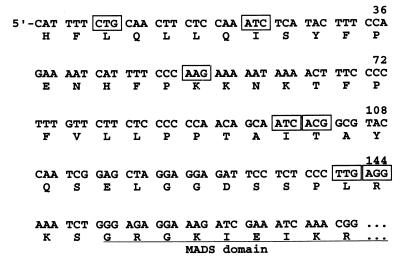
FIG. 1
FIG. 1
Sequence of the 5′ region of AG cDNA (63). The deduced amino acid sequence is shown below the nucleotide sequence, with residues that form part of the highly conserved MADS domain underlined. Triplets 5′ to the MADS box coding sequence that differ from ATG in only one nucleotide are boxed.
FIG. 2
FIG. 2
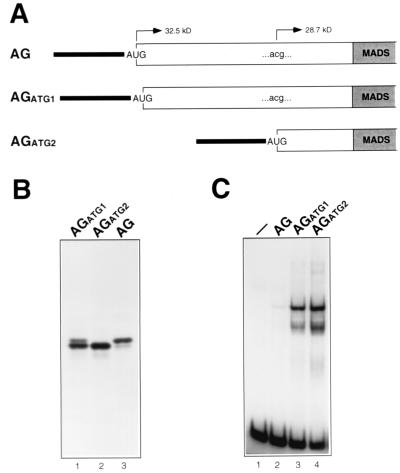
Analysis of AG proteins synthesized in vitro by initiating translation at positions corresponding to the 5′ end of AG cDNA (AG), the CTG codon (AGATG1), and the ACG codon (AGATG2). (A) Schematic representation of the 5′ region of AG RNAs synthesized from pSPUTK-AG, pSPUTK-AGATG1, and pSPUTK-AGATG2. The β-globin leader sequence, derived from pSPUTK, is represented as a black line, and the AG sequence is represented as a bar (in gray for the MADS domain coding sequence). The ACG100–102 codon, present in pSPUTK-AG and pSPUTK-AGATG1, is indicated. (B) Products synthesized by in vitro translating AGATG1, AGATG2, and AG RNAs. (C) DNA-binding activity of the products synthesized by in vitro translating AG, AGATG1, and AGATG2 RNAs. A control with unprogrammed reticulocyte lysate is shown (lane 1).
FIG. 3
FIG. 3
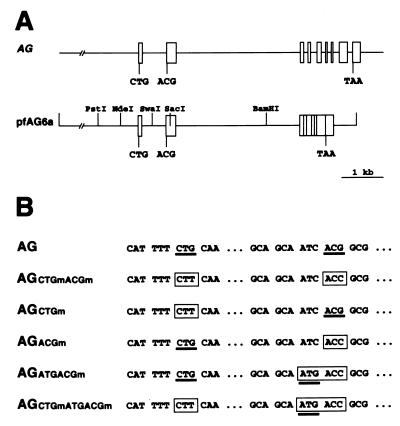
Mutations engineered in an AG genomic construct to determine the AG translation initiation codon in vivo. (A) Scheme of the AG genomic region and of the AG construct in pfAG6a. Exons are represented as boxes and introns as lines. Positions of the CTG and ACG triplets (in exons 1 and 2, respectively) and of the TAA stop codon are indicated. Restriction sites used for the introduction of the different mutations used in this study into pfAG6a are indicated. (B) Mutagenesis of the CTG and ACG codons. For each construct, mutated codons are boxed, and triplets that could conceivably act as a translation initiation codon are underlined.
FIG. 4
FIG. 4
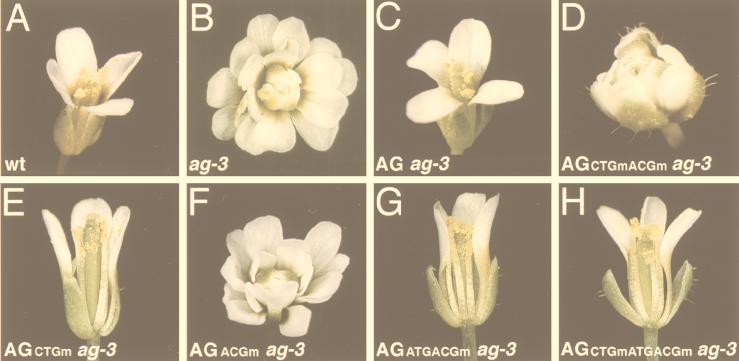
AG RNA translation is initiated at an ACG codon in vivo. (A) Wild-type (wt) A. thaliana (Ler) flower. (B) ag-3 homozygous flower, showing petals and sepals in place of stamens and carpels. (C) AG ag-3 flower showing a wild-type phenotype. The ag-3 mutation is complemented by an AG transgene (pfAG6a construct). (D) AGCTGmACGm ag-3 flower consisting of sepals and petals only. The ag-3 mutant phenotype is not rescued by the AGCTGmACGm transgene. (E) AGCTGm ag-3 flower. The ag-3 mutation is complemented: one sepal and one petal have been removed to reveal the stamens and carpels. (F) AGACGm ag-3 flower showing the ag-3 mutant phenotype. (G) AGATGACGm ag-3 flower. The ag-3 mutation is complemented by the AGATGACGm transgene. One sepal and one petal have been removed. (H) AGCTGmATGACGm ag-3 flower showing complete rescue of the ag-3 mutant phenotype by the AGCTGmATGACGm transgene.
FIG. 5
FIG. 5
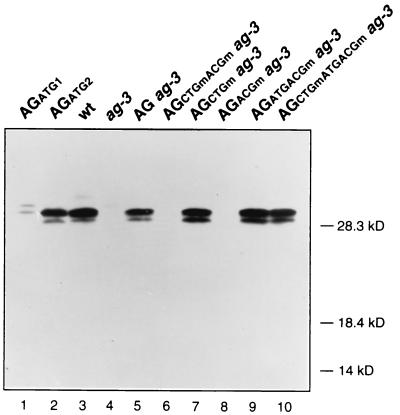
Immunological detection of AG protein. Samples used in the Western blot are proteins synthesized by in vitro translation of AGATG1 and AGATG2 synthetic RNAs (lanes 1 and 2) and extracts from flowers (up to stage 10) of wild-type (Ler), ag-3, AG ag-3, AGCTGmACGm ag-3, AGCTGm ag-3, AGACGm ag-3, AGATGACGm ag-3, and AGCTGmATGACGm ag-3 plants.
FIG. 6
FIG. 6
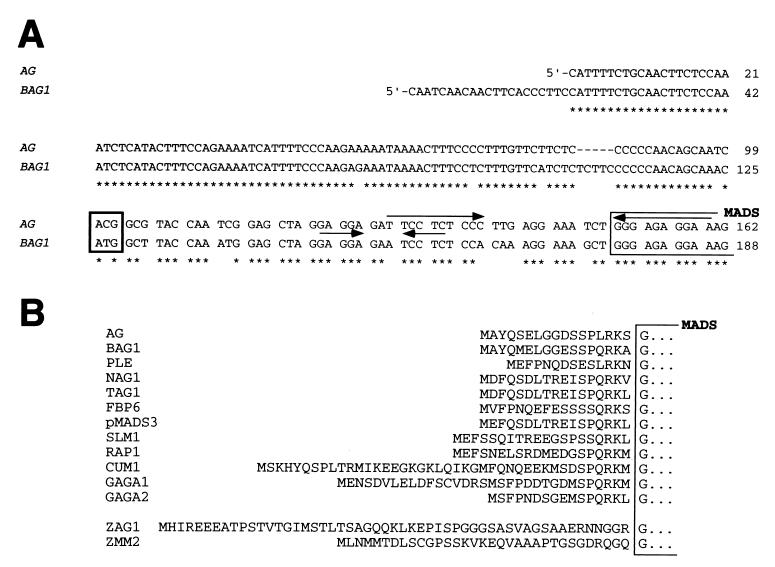
Comparison of AG and homologous genes. (A) Sequence of the 5′ region of AG (63) and BAG1 (38) cDNAs. The respective initiation codons, ACG and ATG, are boxed. Inverted repeated sequences that could potentially form a secondary structure in AG mRNA are indicated by arrows; nucleotide identities between AG and BAG1 sequences are indicated by asterisks. The beginning of the MADS box coding sequence is also indicated. (B) Amino acid sequence of the amino-terminal region of AG, BAG1, PLE (from Antirrhinum; GenBank accession no. S53900), NAG1 (from tobacco; L23925), TAG1 (from tomato; L26295), FBP6 and pMADS3 (from petunia; X68675 and X72916, respectively), SLM1 (from Silene latifolia, white campion; X80488), RAP1 (from Rumex acetosa, sorrel; X89107), CUM (from cucumber; AF035438), GAGA1 and GAGA2 (from Gerbera hybrida; AJ009722 and AJ009723), and ZAG1 and ZMM2 (from maize; L18924 and L81162). The amino acid sequence of these AG-related proteins is derived from the conceptual translation of the corresponding nucleotide sequences. All of these genes are homologous to AG and exhibit comparable expression patterns, but functional evidence showing that they are indeed AG orthologs is not available for all of them. For example, FBP6 may not be an AG cognate homolog (24). In some plant species, two homologous genes with overlapping but nonidentical activities are required for the functions that in Arabidopsis are carried out by AG (for example ZAG1 and ZMM2 in maize [40]).

References

    1. Acland P, Dixon M, Peters G, Dickson C. Subcellular fate of the Int-2 oncoprotein is determined by choice of initiation codon. Nature. 1990;343:662–665. - PubMed
    1. Becerra S P, Rose J A, Hardy M, Baroudy B M, Anderson C W. Direct mapping of adeno-associated virus capsid proteins B and C: a possible ACG initiation codon. Proc Natl Acad Sci USA. 1985;82:7919–7923. - PMC - PubMed
    1. Bechtold N, Ellis J, Pelletier G. In planta Agrobacterium mediated gene transfer by infiltration of adult Arabidopsis thaliana plants. C R Acad Sci. 1993;316:1194–1199.
    1. Boeck R, Kolakofsky D. Positions +5 and +6 can be major determinants of the efficiency of non-AUG initiation codons for protein synthesis. EMBO J. 1994;13:3608–3617. - PMC - PubMed
    1. Bowman J L, Smyth D R, Meyerowitz E M. Genes directing flower development in Arabidopsis. Plant Cell. 1989;1:37–52. - PMC - PubMed

Publication types

Associated data

LinkOut - more resources