


Effect of MALP-2, a lipopeptide from Mycoplasma fermentans, on bone resorption in vitro
- PMID: 10569738
- PMCID: PMC97030
- DOI: 10.1128/IAI.67.12.6281-6285.1999
Effect of MALP-2, a lipopeptide from Mycoplasma fermentans, on bone resorption in vitro
Abstract
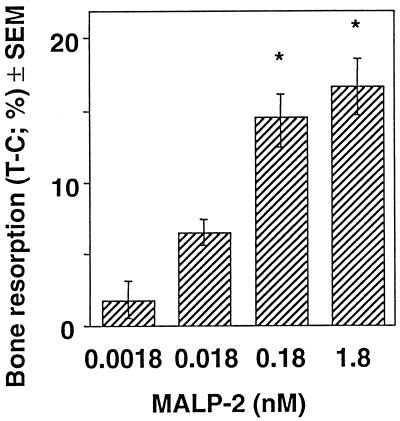
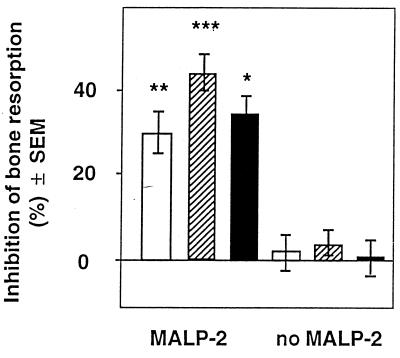
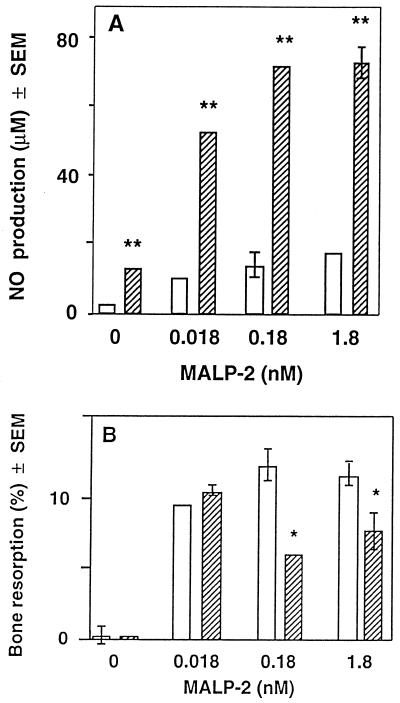
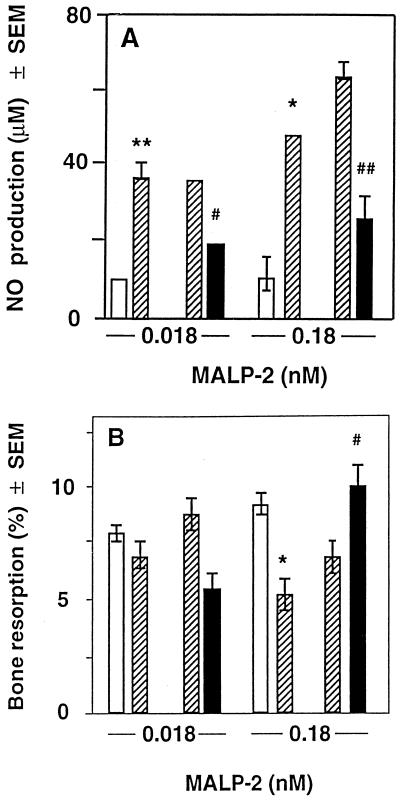
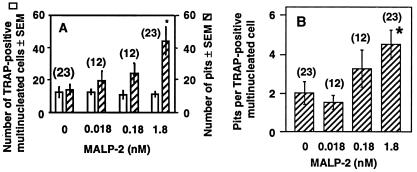
Mycoplasmas may be associated with rheumatoid arthritis in various animal hosts. In humans, mycoplasma arthritis has been recorded in association with hypogammaglobulinemia. Mycoplasma fermentans is one mycoplasma species considered to be involved in causing arthritis. To clarify which mycoplasmal compounds contribute to the inflammatory, bone-destructive processes in arthritis, we used a well-defined lipopeptide, 2-kDa macrophage-activating lipopeptide (MALP-2) from M. fermentans, as an example of a class of macrophage-activating compounds ubiquitous in mycoplasmas, to study its effects on bone resorption. MALP-2 stimulated osteoclast-mediated bone resorption in murine calvaria cultures, with a maximal effect at around 2 nM. Anti-inflammatory drugs inhibited MALP-2-mediated bone resorption by about 30%. This finding suggests that MALP-2 stimulates bone resorption partially by stimulating the formation of prostaglandins. Since interleukin-6 (IL-6) stimulates bone resorption, we investigated IL-6 production in cultured calvaria. MALP-2 stimulated the liberation of IL-6, while no tumor necrosis factor was detectable. Additionally, MALP-2 stimulated low levels of NO in calvaria cultures, an effect which was strongly increased in the presence of gamma interferon, causing an inhibition of bone resorption. MALP-2 stimulated the bone-resorbing activity of osteoclasts isolated from long bones of newborn rats and cultured on dentine slices without affecting their number. In bone marrow cultures, MALP-2 inhibited the formation of osteoclasts. It appears that MALP-2 has two opposing effects: it increases the bone resorption in bone tissue by stimulation of mature osteoclasts but inhibits the formation of new ones.
Figures
References
-
- Arnett T R, Spowage M. Modulation of the resorptive activity of rat osteoclasts by small changes in extracellular pH near the physiological range. Bone. 1996;18:277–279. - PubMed
-
- Badolato R, Oppenheim J J. Role of cytokines, acute-phase proteins, and chemokines in the progression of rheumatoid arthritis. Semin Arthritis Rheum. 1996;26:526–538. - PubMed
-
- Brennan F M, Zachariae C O, Chantry D, Larsen C G, Turner M, Maini R N, Matsushima K, Feldmann M. Detection of interleukin 8 biological activity in synovial fluids from patients with rheumatoid arthritis and production of interleukin 8 mRNA by isolated synovial cells. Eur J Immunol. 1990;20:2141–2144. - PubMed
-
- Cole B C, Knudtson K L, Oliphant A, Sawitzke A D, Pole A, Manohar M, Benson L S, Ahmed E, Atkin C L. The sequence of the Mycoplasma arthritidis superantigen, MAM: identification of functional domains and comparison with microbial superantigens and plant lectin mitogens. J Exp Med. 1996;183:1105–1110. - PMC - PubMed
-
- Damoulis P D, Hauschka P V. Cytokines induce nitric oxide production in mouse osteoblasts. Biochem Biophys Res Commun. 1994;201:924–931. - PubMed
Publication types
MeSH terms
Substances
LinkOut - more resources
Full Text Sources
