. 1999 Dec;67(12):6350-7.
doi: 10.1128/IAI.67.12.6350-6357.1999.

Group B streptococcal surface proteins as targets for protective antibodies: identification of two novel proteins in strains of serotype V

Affiliations

Group B streptococcal surface proteins as targets for protective antibodies: identification of two novel proteins in strains of serotype V

T Areschoug et al. Infect Immun. 1999 Dec.

Abstract

Strains of group B streptococcus (GBS) express surface proteins that confer protective immunity. In particular, most strains of the four classical capsular serotypes (Ia, Ib, II, and III) express either of the Rib and alpha proteins, two members of the same protein family. Here, we report a study of surface proteins expressed by strains of serotype V, which has recently emerged as an important serotype among GBS strains causing serious disease. Two novel GBS proteins were identified, purified, and characterized. One of these proteins, designated Fbs, was immunologically unrelated to other GBS surface proteins. This approximately 110-kDa protein was found in 15 of 49 (31%) type V isolates but in few strains of other serotypes. The Fbs proteins expressed by different strains showed limited variation in size. The most common surface protein among type V strains, found in 29 of 49 (59%) isolates, was designated Rib-like, since it cross-reacted with Rib but was not immunologically identical to Rib. Characterization of this Rib-like protein showed that the N-terminal sequence (12 residues) was identical to that of alpha, although these two proteins lacked cross-reactivity. The biochemical and immunological properties of the Rib-like GBS protein indicate that it is closely related to the R28 protein of Streptococcus pyogenes. Importantly, passive and active immunization experiments with mice showed that the Fbs and Rib-like proteins are targets for protective antibodies. These two proteins are therefore of interest for analysis of pathogenic mechanisms and for vaccine development.


Figures
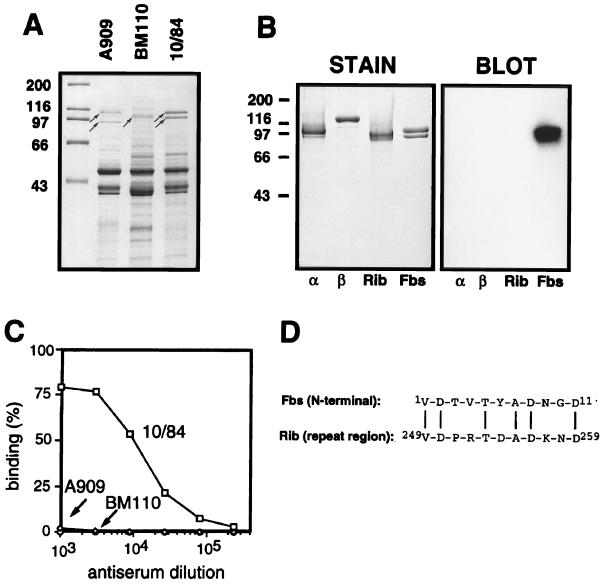
FIG. 1
FIG. 1
Identification of Fbs and characterization of the purified protein. (A) Mutanolysin extracts of group B streptococcal strains analyzed by SDS-PAGE. High-molecular-weight surface proteins appear as distinct bands (arrows). Strains used were A909, a type Ia strain expressing the α (top arrow) and β (bottom arrow) proteins; BM110, a type III strain expressing protein Rib (arrow); and the type V strain 10/84, expressing the protein Fbs (doublet band). (B) Western blot analysis of purified preparations of the α, β, Rib, and Fbs proteins, with rabbit anti-Fbs serum. The antiserum was used at a 1:1,000 dilution, and bound antibodies were detected with 125I-labeled protein G. The autoradiogram was deliberately overexposed to demonstrate the lack of cross-reactivity between Fbs and the α, β, and Rib proteins. In a control blot with preimmune rabbit serum, no signal was obtained. Molecular mass markers for panels A and B are in kilodaltons. (C) Analysis of group B streptococcal strains for cell surface expression of Fbs. The bacteria were analyzed for ability to bind mouse anti-Fbs antibodies, by using 125I-labeled protein A to detect bound antibodies. Strains used were A909 (type Ia), BM110 (type III), and 10/84 (type V). (D) Alignment of the N-terminal amino acid sequence of protein Fbs and an amino acid sequence from the repeat region of protein Rib (34). Vertical lines denote residue identity. The experiments shown here were performed at least twice with similar results.
FIG. 2
FIG. 2
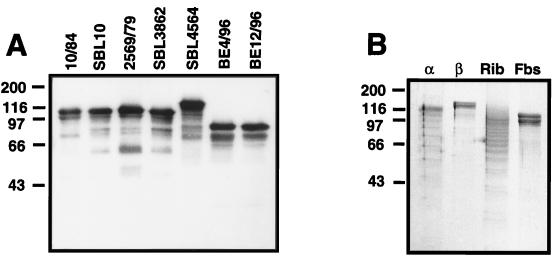
Characterization of protein Fbs: size variation and lack of ladder formation in SDS-PAGE gels. (A) Western blot analysis of mutanolysin extracts from seven different Fbs-expressing strains of serotype V, with rabbit anti-Fbs serum. Bound antibodies were detected with radiolabeled protein G. In a control blot with preimmune rabbit serum, no signal was obtained. (B) SDS-PAGE of purified proteins after boiling at acidic pH. Solutions of the α, β, Rib, and Fbs proteins were adjusted to pH 4.0, mixed with sample buffer, boiled for 5 min, and subjected to SDS-PAGE (34). The α and Rib proteins, but not β or Fbs, form a characteristic ladder, apparently due to hydrolysis of acid-sensitive Asp-Pro bonds in the repeat regions (34). Molecular mass markers are in kilodaltons. These experiments were performed twice with similar results.
FIG. 3
FIG. 3
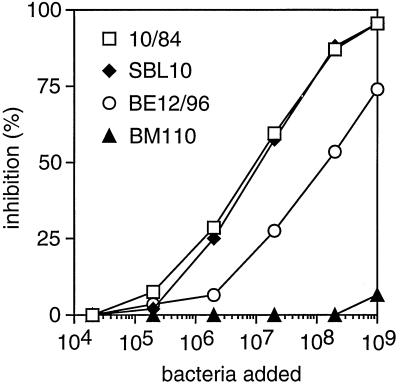
Immunological comparison of Fbs proteins expressed by different GBS type V strains. Suspensions of whole bacteria were used to inhibit the binding of rabbit anti-Fbs antibodies to purified protein Fbs immobilized in microtiter plates. The figure shows data obtained with three Fbs-expressing strains (10/84, SBL10, and BE12/96) and the type III strain BM110, which does not express Fbs. This experiment was performed twice with similar results.
FIG. 4
FIG. 4
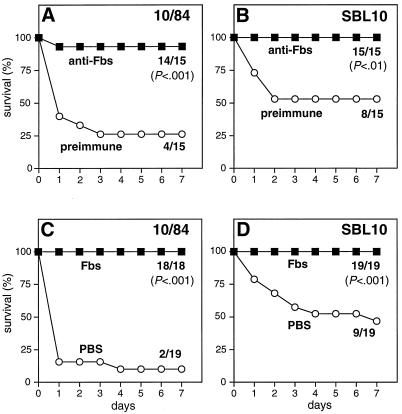
Antibodies against Fbs protect mice against lethal infection with Fbs-expressing GBS strains. (A and B) Passive immunization. C3H/HeN mice were injected i.p. with 0.1 ml of rabbit anti-Fbs serum. Control mice received preimmune rabbit antiserum. The mice were challenged i.p. 4 h later with an ∼LD90 of log-phase bacteria. (Due to interexperimental variation, the survival was higher than 10% in some cases.) Two Fbs-expressing GBS type V strains, 10/84 and SBL10, were used, as indicated. Deaths were recorded daily for a period of 7 days, and the final ratios (number of surviving mice to number of mice challenged) are indicated. The P values were calculated by the Fisher exact test. (C and D) Active immunization. C3H/HeN mice were vaccinated with highly purified protein Fbs. Control mice received PBS. The vaccinated mice were challenged i.p. with an ∼LD90 of log-phase bacteria. Strains used were the same Fbs-expressing type V strains as used for the passive immunization experiments, and data are presented in the same way as described above.
FIG. 5
FIG. 5
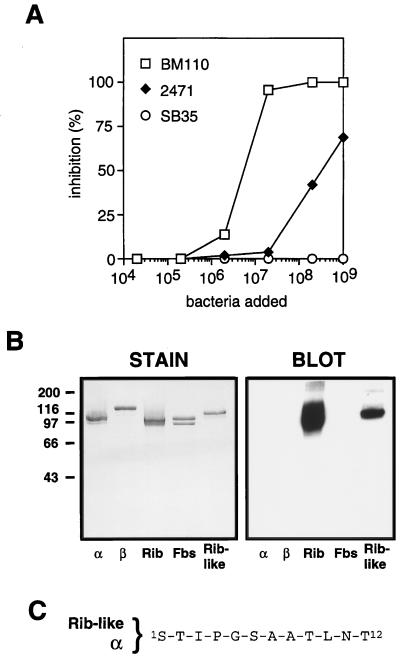
Identification of a Rib-like protein expressed by type V strain 2471. (A) Inhibition test with whole bacteria. Suspensions of whole bacteria were used to inhibit the binding of rabbit anti-Rib antibodies to Rib immobilized in microtiter plates. Strains used were the Rib-expressing type III strain BM110, the type V strain 2471, and the type Ib strain SB35, which expresses the α and β proteins. (B) Western blot analysis of purified preparations of five GBS surface proteins: the α, β, Rib, Fbs, and Rib-like proteins. The blot was analyzed with mouse antiserum (diluted 1:500) against the purified Rib-like protein, and bound antibodies were detected with radiolabeled protein A. In a control blot with preimmune mouse serum, no signals were obtained. Molecular mass markers are in kilodaltons. (C) The N-terminal amino acid sequence of the Rib-like protein is identical to that of the α protein (26, 30). Experiments for panels A and B were performed twice with similar results.
FIG. 6
FIG. 6
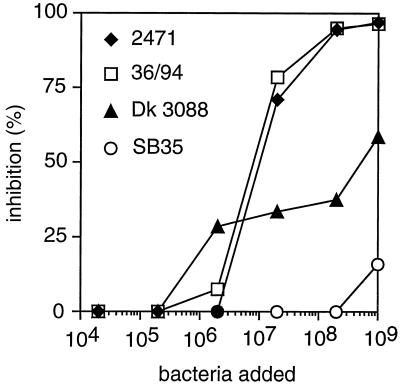
Immunological comparison of Rib-like proteins expressed by different GBS type V isolates. Suspensions of whole bacteria were used to inhibit the binding of rabbit anti-Rib-like antibodies to purified Rib-like protein immobilized in microtiter plates. Data from three strains expressing Rib-like proteins (2471, 36/94, and Dk 3088) are shown in the figure. The type Ib strain SB35 was used as a negative control. This experiment was performed twice with similar results.
FIG. 7
FIG. 7
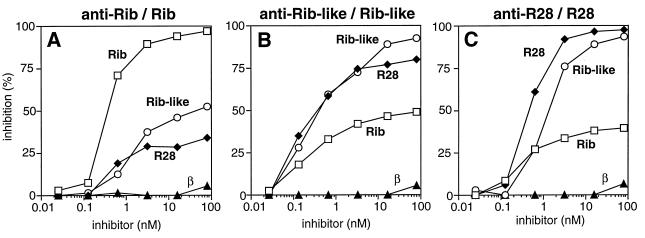
Analysis of the immunological relationship between the Rib and Rib-like proteins from GBS and the R28 protein from S. pyogenes. Each panel shows an inhibition experiment, in which the binding of rabbit antibodies to an immobilized protein was inhibited by the addition of different purified proteins. The combination of antiserum and immobilized protein is indicated above each panel, and the purified proteins used for inhibition are indicated at the corresponding curves. Each of these experiments was performed at least twice with similar results.

References

    1. Baker C J, Edwards M S. Group B streptococcal infection. In: Remington J S, Klein J O, editors. Infectious diseases of the fetus and the newborn infant. W. B. Philadelphia, Pa: Saunders Company; 1995. pp. 980–1054.
    1. Bevanger L, Naess A I. Mouse-protective antibodies against the Ibc proteins of group B streptococci. Acta Pathol Microbiol Immunol Scand Sect B. 1985;93:121–124. - PubMed
    1. Blumberg H M, Stephens D S, Modansky M, Erwin M, Elliot J, Facklam R R, Schuchat A, Baughman W, Farley M M. Invasive group B streptococcal disease: the emergence of serotype V. J Infect Dis. 1996;173:365–373. - PubMed
    1. Domingo P, Barquet N, Alvarez M, Coll P, Nava J, Garau J. Group B streptococcal meningitis in adults: report of twelve cases and review. Clin Infect Dis. 1997;25:1180–1187. - PubMed
    1. Edwards M S, Kasper D L, Jennings H J, Baker C J, Nicholson-Weller A. Capsular sialic acid prevents activation of the alternative complement pathway by type III, group B streptococci. J Immunol. 1982;128:1278–1283. - PubMed

Publication types

MeSH terms