. 1999 Dec;43(12):2915-21.
doi: 10.1128/AAC.43.12.2915.

Proteoglycan and collagen biochemical variations during fluoroquinolone-induced chondrotoxicity in mice

Affiliations

Proteoglycan and collagen biochemical variations during fluoroquinolone-induced chondrotoxicity in mice

M A Simonin et al. Antimicrob Agents Chemother. 1999 Dec.

Abstract

Although fluoroquinolone antibacterials have a broad therapeutic use, with a relatively low incidence of severe side effects, they have been reported to induce lesions in the cartilage of growing animals by a mechanism that remains unclear. This study was undertaken to determine the potentially deleterious effect of a high dose of pefloxacin (400 mg/kg of body weight) on two main constituents of cartilage in mice, i.e., proteoglycans and collagen. Variations in levels of proteoglycan anabolism measured by in vivo [(35)S]sulfate incorporation into cartilage and oxidative modifications of collagen assessed by detection of carbonyl derivatives were monitored after administration of pefloxacin. Treatment of mice with 1 day of pefloxacin treatment significantly decreased the rate of biosynthesis of proteoglycan for the first 24 h. However, no difference was observed after 48 h. The decrease in proteoglycan synthesis was accompanied by a marked drop in serum sulfate concentration and a concomitant increase in urinary sulfate excretion. The decrease in proteoglycan synthesis, also observed ex vivo, may suggest a direct effect of pefloxacin on this process, rather than it being a consequence of a low concentration of sulfate. On the other hand, treatment with pefloxacin for 10 days induced oxidative damage to collagen. In conclusion, this study demonstrates, for the first time, that pefloxacin administration to mice leads to modifications in the metabolism and integrity of extracellular proteins, such as collagen and proteoglycans, which may account for the side effects observed. These results offer new insights to explain quinolone-induced disorders in growing articular cartilage.


Figures

FIG. 1
FIG. 1
Effects of pefloxacin administration on the kinetics of 35S incorporation in the blood and cartilage of mice in vivo.
FIG. 2
FIG. 2
Effects in mice of treatment with a single oral dose (400 mg/kg) of pefloxacin on the incorporation of simultaneously administered 35S in vivo in blood (log plot) (A) and FHCs (B). Controls received the same volume of saline solution instead of pefloxacin. Values for 35S incorporation are means ± SEM of results from four experiments. ∗, P < 0.05; ∗∗, P < 0.01 versus controls, by Student’s t test.
FIG. 3
FIG. 3
Effect in mice of the same treatment described for Fig. 1 on the incorporation of 35S in patellar central cartilage and peripheral fibrocartilage (log plot). Controls received the same volume of saline solution instead of pefloxacin. Values for 35S incorporation are means ± SEM of results from four experiments with five mice each for levels of radioactivity incorporated. ∗, P < 0.05; ∗∗, P < 0.01 versus controls, by Student’s t test.
FIG. 4
FIG. 4
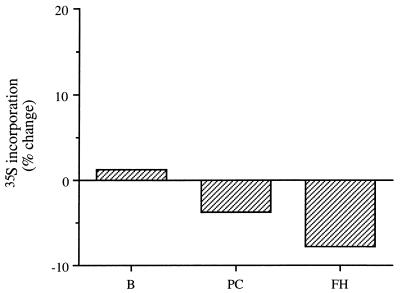
Proteoglycan synthesis measured by the in vivo changes in levels of incorporation of 35S 48 h after a single oral dose (400 mg/kg) of pefloxacin and 24 h after intraperitoneal administration of 35S (2 μCi/g). Values are percentages reflecting the difference in 35S incorporation in treated mice from that in controls receiving the same volume of saline only (means of results from two experiments with five mice each). B, blood; PC, central patellar cartilage; FH, FHCs.
FIG. 5
FIG. 5
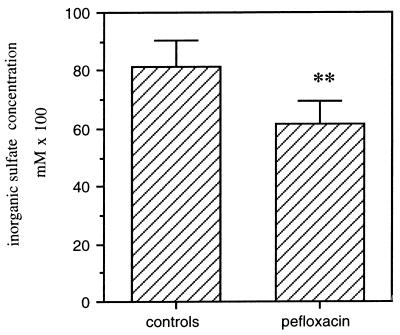
Effect of pefloxacin (400 mg/kg) administered orally to mice on the concentration of inorganic sulfate 24 h after drug administration. Values for inorganic sulfate are means ± SEM of sulfate concentrations from three experiments. ∗∗, P < 0.01 versus controls, by Student’s t test.
FIG. 6
FIG. 6
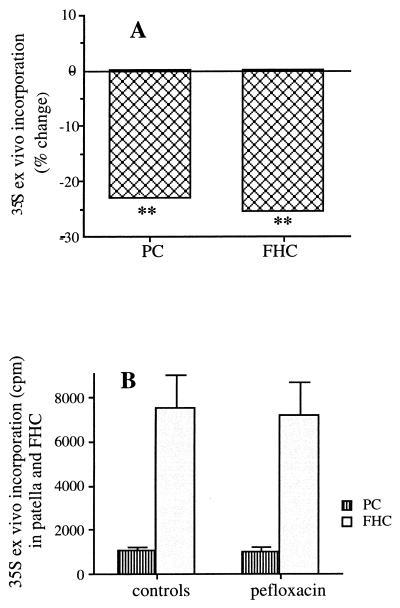
Effects of pefloxacin on proteoglycan synthesis measured by the changes in the levels of incorporation of 35S ex vivo 24 h after a single oral dose (400 mg/kg), relative to the levels of incorporation in controls receiving the same volume of saline solution (A), and 48 h after a single oral dose (400 mg/kg), relative to the levels of incorporation in controls receiving the same volume of saline only (B). Duplicate experiments were performed with eight mice each. PC, central patellar cartilage.
FIG. 7
FIG. 7
Effect of pefloxacin administration on carbonyl derivative formation in the collagen of articular cartilage revealed by immunochemical detection. Fifteen micrograms of DNPH-derivatized protein was loaded into each lane. (A) Lanes 1 to 3, articular cartilage collagen of mice treated with a single dose of pefloxacin (400 mg/kg); lanes 4 to 6, articular cartilage collagen of mice given saline solution. (B) Lanes 1 to 4, articular cartilage collagen of mice which received pefloxacin (400 mg/kg/day) for 10 days (duplicate loads); lanes 5 to 8, articular cartilage collagen of mice receiving saline solution.
FIG. 8
FIG. 8
Effect of pefloxacin administration on carbonyl derivative formation in articular cartilage collagen. Shown is a densitometric analysis of the blots in Fig. 7. Values are means ± standard deviations of results from two experiments. ∗, P ≤ 0.05 versus controls, by Student’s t test.

References

    1. Bendele A M, Hulman J F, Harvey A K, Hrubey P S, Chandrasekhar S. Passive role of articular chondrocytes in quinolone-induced arthropathy in guinea pigs. Toxicol Pathol. 1990;18:304–312. - PubMed
    1. Brenneisen P, Briviba K, Wlaschek M, Wenk J, Scharffetter- Kochanek K. Hydrogen peroxide (H2O2) increases the steady-state mRNA levels of collagenase/MMP-1 in human dermal fibroblasts. Free Radic Biol Med. 1997;22:515–524. - PubMed
    1. Burkhardt J E, Walterspiel J N, Schaad U B. Quinolone arthropathy in animals versus children. Clin Infect Dis. 1997;25:1196–1204. - PubMed
    1. Burkhardt J E, Hill M A, Lamar C H, Smith G N, Carlton W W. Effects of difloxacin on the metabolism of glycosaminoglycans and collagen in organ cultures of articular cartilage. Fundam Appl Toxicol. 1993;20:257–263. - PubMed
    1. Burkhardt J E, Hill M A, Carlton W W, Kesterson J W. Histologic and histochemical changes in articular cartilages of immature Beagle dogs dosed with difloxacin, a fluoroquinolone. Vet Pathol. 1990;27:162–170. - PubMed

Publication types

MeSH terms