


Biochemical and phylogenetic analyses of a cold-active beta-galactosidase from the lactic acid bacterium Carnobacterium piscicola BA
- PMID: 10584002
- PMCID: PMC91742
- DOI: 10.1128/AEM.65.12.5443-5450.1999
Biochemical and phylogenetic analyses of a cold-active beta-galactosidase from the lactic acid bacterium Carnobacterium piscicola BA
Abstract
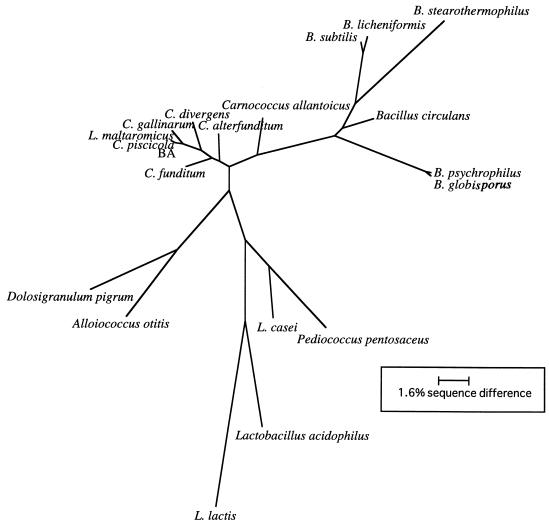
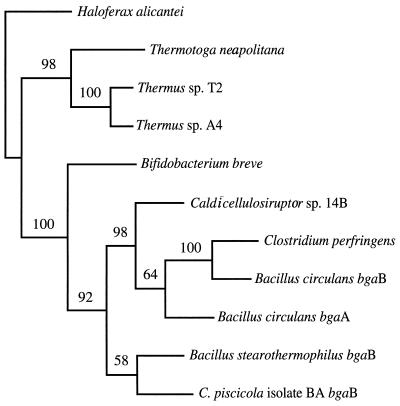
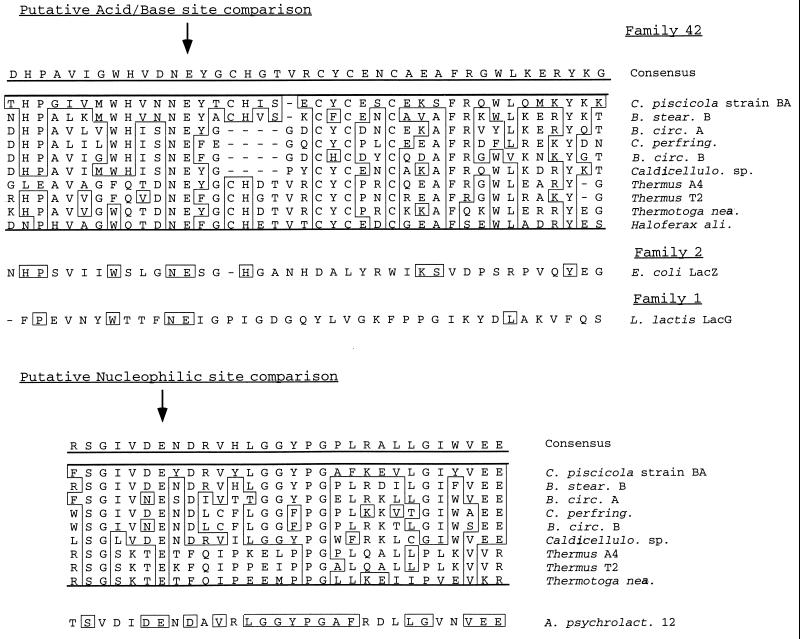
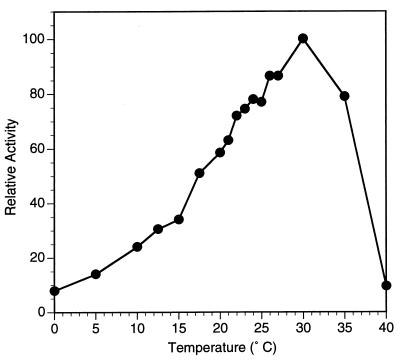
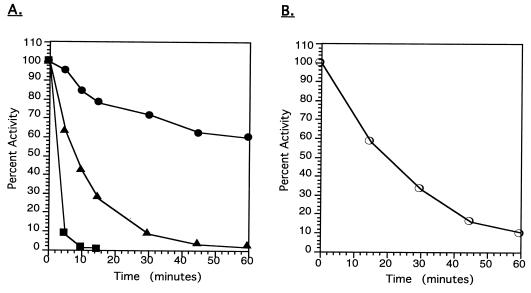
We are investigating glycosyl hydrolases from new psychrophilic isolates to examine the adaptations of enzymes to low temperatures. A beta-galactosidase from isolate BA, which we have classified as a strain of the lactic acid bacterium Carnobacterium piscicola, was capable of hydrolyzing the chromogen 5-bromo-4-chloro-3-indolyl beta-D-galactopyranoside (X-Gal) at 4 degrees C and possessed higher activity in crude cell lysates at 25 than at 37 degrees C. Sequence analysis of a cloned DNA fragment encoding this activity revealed a gene cluster containing three glycosyl hydrolases with homology to an alpha-galactosidase and two beta-galactosidases. The larger of the two beta-galactosidase genes, bgaB, encoded the 76.8-kDa cold-active enzyme. This gene was homologous to family 42 glycosyl hydrolases, a group which contains several thermophilic enzymes but none from lactic acid bacteria. The bgaB gene from isolate BA was subcloned in Escherichia coli, and its enzyme, BgaB, was purified. The purified enzyme was highly unstable and required 10% glycerol to maintain activity. Its optimal temperature for activity was 30 degrees C, and it was inactivated at 40 degrees C in 10 min. The K(m) of freshly purified enzyme at 30 degrees C was 1.7 mM, and the V(max) was 450 micromol. min(-1). mg(-1) with o-nitrophenyl beta-D-galactopyranoside. This cold-active enzyme is interesting because it is homologous to a thermophilic enzyme from Bacillus stearothermophilus, and comparisons could provide information about structural features important for activity at low temperatures.
Figures
References
-
- Adams M W W, Perler F B, Kelly R M. Extremozymes: expanding the limits of biocatalysis. Biotechnology. 1995;13:662–668. - PubMed
-
- Berger J-L, Lee B H, Lacroix C. Purification, properties and characterization of a high-molecular-mass β-galactosidase isoenzyme from Thermus aquaticus YT-1. Biotechnol Appl Biochem. 1997;25:29–41.
-
- Bohm G, Jaenicke R. Relevance of sequence statistics for the properties of extremophilic proteins. Int J Peptide Protein Res. 1994;43:97–106. - PubMed
-
- Brenchley J E. Psychrophilic microorganisms and their cold-active enzymes. J Ind Microbiol. 1996;17:432–437.
-
- Cabot E. The Eyeball Sequence Editor (ESEE), version 1.09d. Rochester, N.Y: University of Rochester; 1990.
Publication types
MeSH terms
Substances
Associated data
- Actions
- Actions
LinkOut - more resources
Full Text Sources
Other Literature Sources
Molecular Biology Databases
Miscellaneous
