


doi: 10.1128/AEM.65.12.5631-5635.1999.
Characterization of a bacteriocin-like substance produced by a vaginal Lactobacillus salivarius strain
Affiliations
- PMID: 10584033
- PMCID: PMC91773
- DOI: 10.1128/AEM.65.12.5631-5635.1999
Item in Clipboard
Characterization of a bacteriocin-like substance produced by a vaginal Lactobacillus salivarius strain
Appl Environ Microbiol.
1999 Dec.
Abstract
A novel bacteriocin-like substance produced by vaginal Lactobacillus salivarius subsp. salivarius CRL 1328 with activity against Enterococcus faecalis, Enterococcus faecium, and Neisseria gonorrhoeae was characterized. The highest level of production of this heat-resistant peptide or protein occurred during the late exponential phase. Its mode of action was shown to be bactericidal. L. salivarius subsp. salivarius CRL 1328 could be used for the design of a probiotic to prevent urogenital infections.
Figures
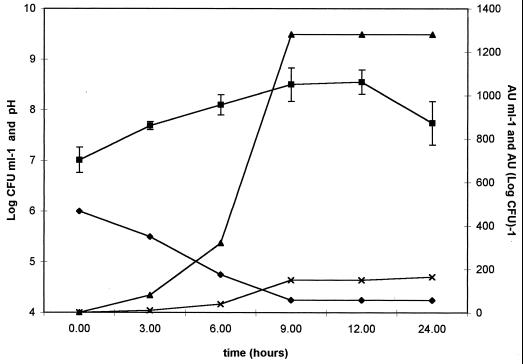
Kinetics of bacteriocin-like substance production during the growth of Lactobacillus salivarius subsp. salivarius CRL 1328. Growth of L. salivarius subsp. salivarius CRL 1328 was determined by the plate count method (■) and culture pH (⧫); bacteriocin concentration is expressed as arbitrary units per milliliter (▴) and per log CFU (×).
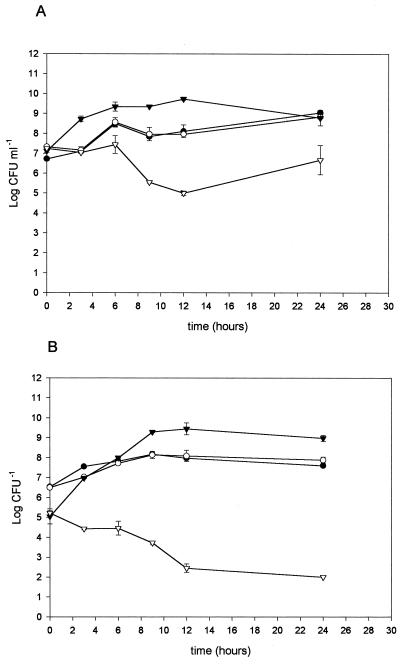
Pure and mixed cultures of L. salivarius subsp. salivarius CRL 1328 and E. faecalis. Lactobacilli were inoculated at 107 CFU ml−1; enterococci were inoculated at 107 (A) and 105 (B) CFU ml−1. Lactobacilli in pure (○) and mixed (●) cultures and enterococci in pure (▾) and mixed (▿) cultures are shown.
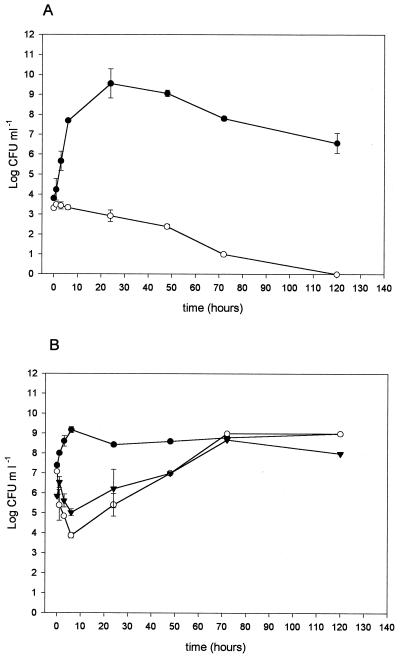
Mode of action of a L. salivarius subsp. salivarius CRL 1328 bacteriocin-like substance against E. faecalis. (A) E. faecalis inoculated at 103 CFU ml−1 without (●) and with (○) bacteriocin. (B) E. faecalis inoculated at 107 CFU ml−1 without bacteriocin (●) and inoculated at 107 (▾) and 105 (○) CFU ml−1 with bacteriocin.
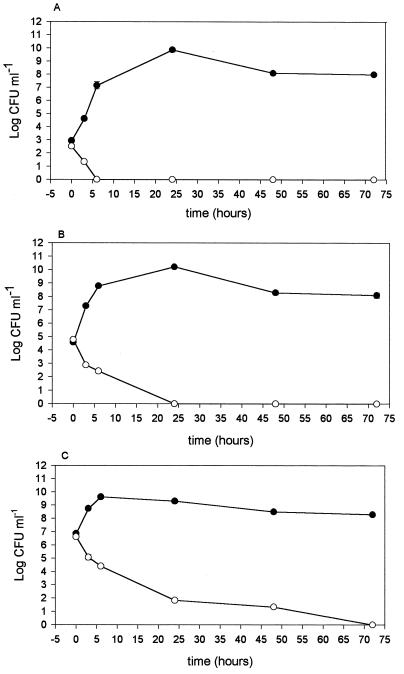
Mode of action of an L. salivarius subsp. salivarius CRL 1328 bacteriocin-like substance against E. faecalis. E. faecalis was inoculated at 103 (A), 105 (B), and 107 (C) CFU ml−1 without bacteriocin (●) and with a twofold bacteriocin concentration (○).
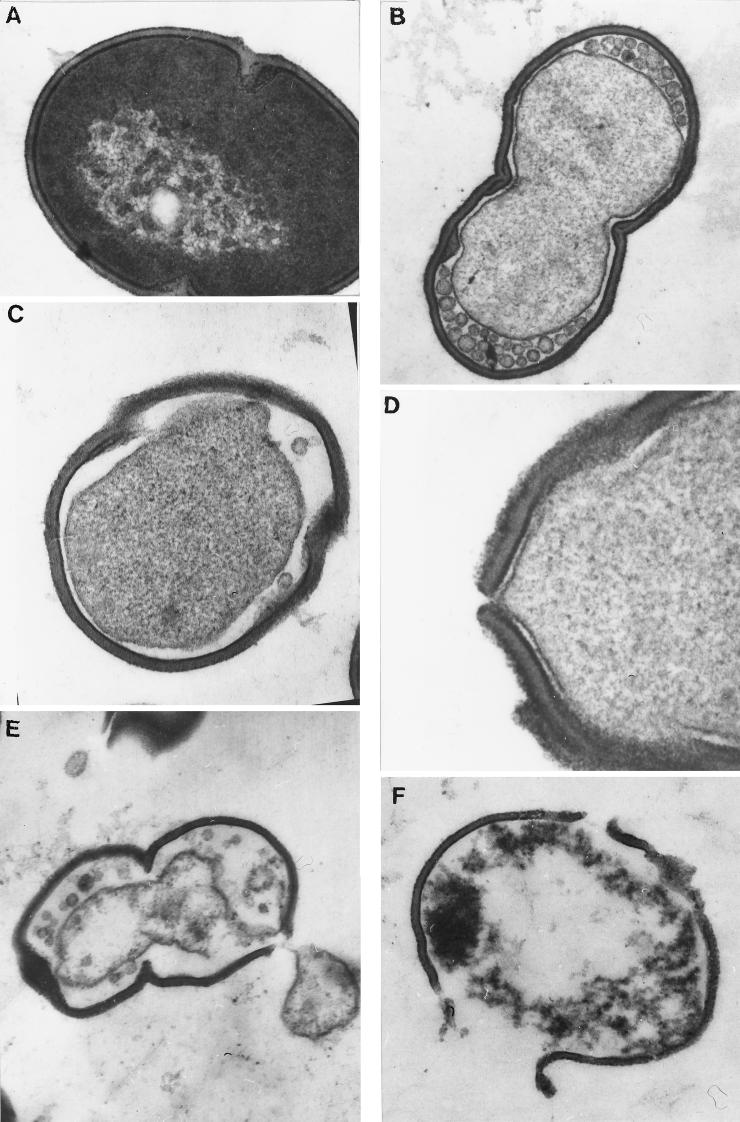
Electron photomicrographs of the effect of L. salivarius subsp. salivarius CRL 1328 bacteriocin-like substance on E. faecalis. The Enterococcus control cell (A), vesiculization of protoplasm (B), vesiculization of protoplasm and a damaged cell wall (C), pore formation in the cell wall (D), a disintegrated cell with loss of the protoplasmic material through a cell wall pore (E), and a disintegrated cell (F) are shown. The method is described in the text.
References
-
- Arihara K, Ogihara S, Mukai T, Itoh M, Kondo Y. Salivacin 140, a novel bacteriocin from Lactobacillus salivarius subsp. salicinius T140 active against pathogenic bacteria. Lett Appl Microbiol. 1996;22:420–424. - PubMed
-
- Baerheim S, Larsen E, Di Granes A. Vaginal application of lactobacilli in the prophylaxis of recurrent lower urinary tract infections in women. Scand J Prim Health Care. 1994;12:239–242. - PubMed
-
- Giori A, Torrani S, Dellaglio F, Bo G, Stola E, Bernuzzi L. Identification of vaginal lactobacilli from asymptomatic women. Microbiologica. 1987;10:377–384. - PubMed
-
- Guillilan S E. Beneficial interrelationships between certain microorganisms and humans: candidate microorganisms for use as dietary adjuncts. J Food Prot. 1979;42:164–167. - PubMed
-
- Havenaar R, Brink B T, Huis In’T Veld J H J. Selection of strains for probiotics use. In: Fuller R, editor. Probiotics. The scientific basis. London, England: Chapman & Hall; 1992. pp. 209–223.
Publication types
MeSH terms
Substances
LinkOut - more resources
Full Text Sources
Other Literature Sources
Molecular Biology Databases
