. 1999 Dec 7;96(25):14264-9.
doi: 10.1073/pnas.96.25.14264.

Inorganic polyphosphate kinase is required to stimulate protein degradation and for adaptation to amino acid starvation in Escherichia coli

Affiliations

Inorganic polyphosphate kinase is required to stimulate protein degradation and for adaptation to amino acid starvation in Escherichia coli

A Kuroda et al. Proc Natl Acad Sci U S A. .

Abstract

Inorganic polyphosphate (polyP) kinase was studied for its roles in physiological responses to nutritional deprivation in Escherichia coli. A mutant lacking polyP kinase exhibited an extended lag phase of growth, when shifted from a rich to a minimal medium (nutritional downshift). Supplementation of amino acids to the minimal medium abolished the extended growth lag of the mutant. Levels of the stringent response factor, guanosine 5'-diphosphate 3'-diphosphate, increased in response to the nutritional downshift, but, unlike in the wild type, the levels were sustained in the mutant. These results suggested that the mutant was impaired in the induction of amino acid biosynthetic enzymes. The expression of an amino acid biosynthetic gene, hisG, was examined by using a transcriptional lacZ fusion. Although the mutant did not express the fusion in response to the nutritional downshift, Northern blot analysis revealed a significant increase of hisG-lacZ mRNA. Amino acids generated by intracellular protein degradation are very important for the synthesis of enzymes at the onset of starvation. In the wild type, the rate of protein degradation increased in response to the nutritional downshift whereas it did not in the mutant. Supplementation of amino acids at low concentrations to the minimal medium enabled the mutant to express the hisG-lacZ fusion. Thus, the impaired regulation of protein degradation results in the adaptation defect, suggesting that polyP kinase is required to stimulate protein degradation.


Figures
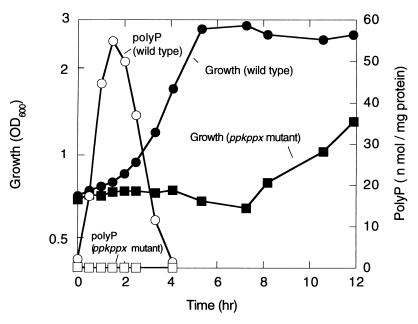
Figure 1
Figure 1
Cell growth and polyP accumulation during the nutritional downshift. E. coli MG1655 (wild type) and CF5802 (ppk ppx mutant) cells were subjected to the nutritional downshift from the 2 × YT to the Mops medium. PolyP accumulated in response to the downshift in the wild type (open circle) but not in the mutant (open square). Growth was measured as the optical density at 600 nm (OD600) in the wild type (filled circle) and the ppk ppx mutant (filled square).
Figure 2
Figure 2
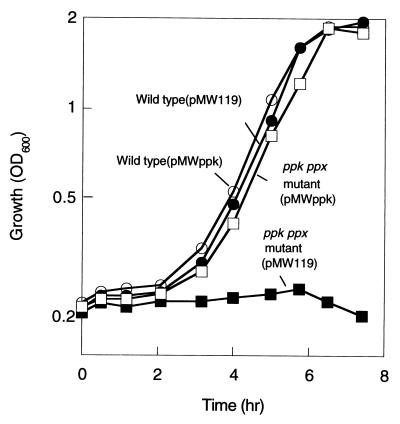
Introduction of the polyP kinase gene into the mutant abolished the growth lag during the nutritional downshift. Growth after the nutritional downshift was measured as the OD600 in the wild type harboring a vector pMW119 (filled circle) and pMWppk (open circle) and in the mutants harboring pMW119 (filled square) and pMWppk (open square).
Figure 3
Figure 3
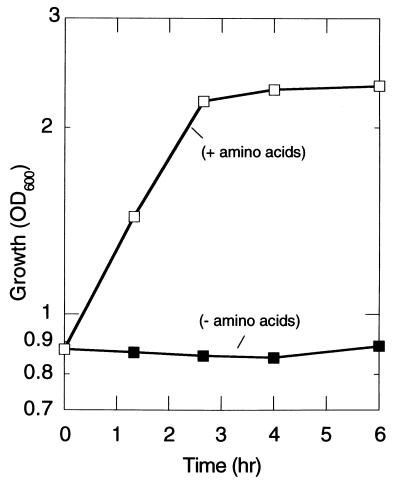
Supplementation of amino acids to the Mops medium abolished the growth lag. Growth after the nutritional downshift was measured as the OD600 in the ppk ppx mutant in the absence (filled square) and presence (open square) of amino acids (50 mg/ml), respectively.
Figure 4
Figure 4
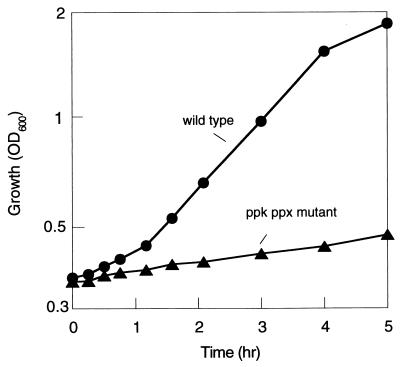
Effect of removal of amino acids from the medium on the growth of the wild type and the ppk ppx mutant. E. coli MG1655 and CF5802 cells grown to mid-log phase in the Mops medium with amino acids (50 mg/liter) were collected and resuspended in the Mops medium without amino acids. Growth was measured as OD600 in the wild type (filled circle) and the ppk ppx mutant (filled triangle).
Figure 5
Figure 5
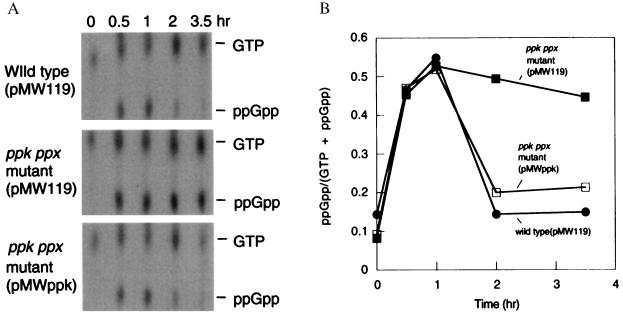
Accumulation of ppGpp during the nutritional downshift. (A) ppGpp was detected on the polyethylenimine-cellulose/TLC plate in the wild type harboring pMW119 and the ppk ppx mutant harboring pMW119 or pMWppk. (B) Relative amounts of ppGpp were indicated as the intensity of ppGpp divided by that of ppGpp plus GTP.
Figure 6
Figure 6
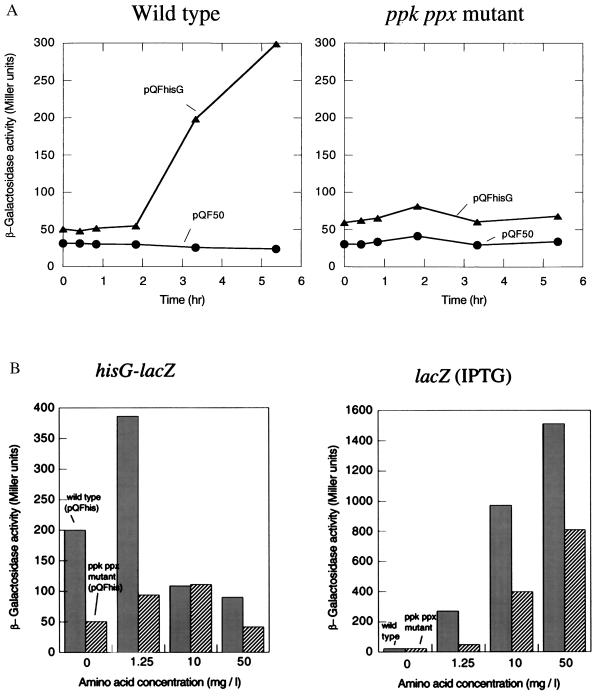
Induction of β-galactosidase during the nutritional downshift. (A) β-galactosidase activities from the hisG-lacZ fusion were measured in the wild type (Left) and the mutant (Right) harboring pQFhis (the hisG-lacZ fusion), respectively. Strains harboring pQF50 (a promoterless lacZ vector) were used as a control (circle). (B) Effects of amino acid supplementation on β-galactosidase production. The wild type (filled bar) and the mutant (striped bar) were downshifted to the Mops medium supplemented with all 20 amino acids at concentrations of 0, 1.25, 10, and 50 mg/liter, respectively. The left panel shows β-galactosidase activities in strains harboring pQFhis. The right panel indicates β-galactosidase activities from the chromosomal lacZ gene in the wild type and the mutant. The chromosomal lacZ gene was induced by adding isopropyl-1-thio-β-d-galactoside (1 mM) to the Mops medium. β-galactosidase activities were measured 3 hr after the nutritional downshift.
Figure 7
Figure 7
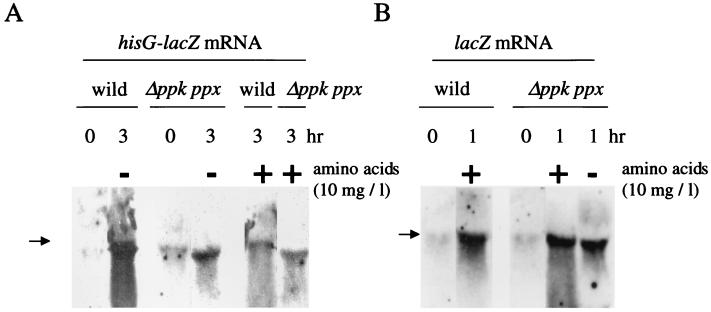
Northern blot analysis of the hisG-lacZ and the lacZ mRNA. (A) RNA was isolated from the wild type and the mutant harboring pQFhis after 0 and 3 hr of the nutritional downshift. Addition of amino acids (10 mg/ml) to the Mops medium was indicated above. RNA (10 μg) was used for hybridization. Arrows indicate the position of 23S rRNA. The fluorescein-labeled lacZ probe was used. (B) RNA was isolated from the wild type and the mutant after 0 and 1 hr of the nutritional downshift. Isopropyl-1-thio-β-d-galactoside (1 mM) was added to the Mops medium to induce the chromosomal lacZ gene.
Figure 8
Figure 8
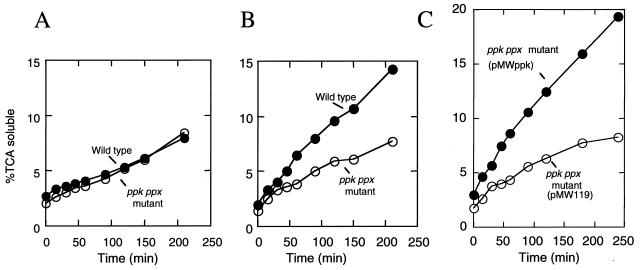
Degradation of intracellular protein during the nutritional downshift. [14C]Leucine was incorporated during exponential growth. The wild type (filled circle) and the ppk ppx mutant (open circle) were resuspended in the 2 × YT rich medium (A) and the Mops minimal medium (B). The ppk ppx mutant harboring pMWppk (filled circle) and pMW119 (open circle) were resuspended in the Mops minimal medium (C). Protein degradation was measured as described in Materials and Methods. Trichloroacetic acid soluble counts at a given time are then expressed as a percentage of the total initially incorporated counts.

References

    1. Kornberg A. J Bacteriol. 1995;177:491–496. - PMC - PubMed
    1. Kulaev I S. The Biochemistry of Inorganic Polyphosphates. New York: Wiley; 1979. - PubMed
    1. Wood H G, Clark J E. Annu Rev Biochem. 1988;57:235–260. - PubMed
    1. Ahn K, Kornberg A. J Biol Chem. 1990;265:11734–11739. - PubMed
    1. Kuroda A, Murphy H, Cashel M, Kornberg A. J Biol Chem. 1997;272:21240–21243. - PubMed

Publication types

MeSH terms

LinkOut - more resources