. 2000 Jan 1;28(1):225-7.
doi: 10.1093/nar/28.1.225.

PRINTS-S: the database formerly known as PRINTS

Affiliations

PRINTS-S: the database formerly known as PRINTS

T K Attwood et al. Nucleic Acids Res. .

Abstract

The PRINTS database houses a collection of protein family fingerprints. These are groups of motifs that together are diagnostically more potent than single motifs by virtue of the biological context afforded by matching motif neighbours. Around 1200 fingerprints have now been created and stored in the database. The September 1999 release (version 24.0) encodes approximately 7200 motifs, covering a range of globular and membrane proteins, modular polypeptides and so on. In addition to its continued steady growth, we report here several major changes to the resource, including the design of an automated strategy for database maintenance, and implementation of an object-relational schema for more efficient data management. The database is accessible for BLAST, fingerprint and text searches at http://www.bioinf.man.ac. uk/dbbrowser/PRINTS/


Figures
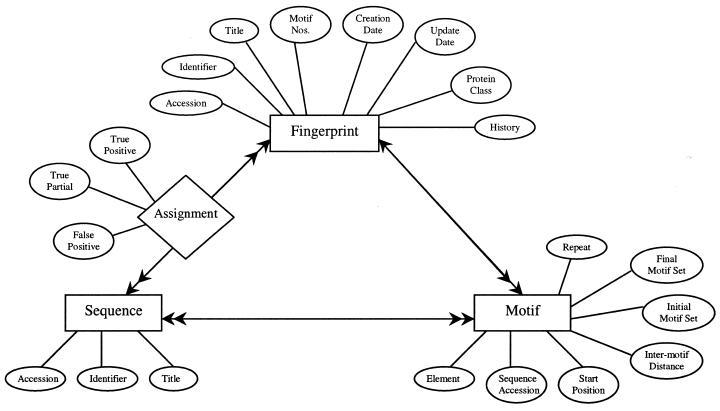
Figure 1
Figure 1
PRINTS-S entity relationship diagram. In order to transpose the current PRINTS databank to a relational database, various models were developed on the basis of existing data fields and their properties. This diagram depicts the PRINTS data space modelled using three entities: fingerprint, motif and sequence (rectangular boxes). Each entity has a relationship with another, as represented by a connecting arrow. A single arrow-head denotes a ‘single relationship’ and a double arrow-head denotes a ‘many relationship’: e.g., one fingerprint has many motifs, and several motifs belong to one fingerprint. The many-to-many relationship between entities ‘fingerprint’ and ‘sequence’ is special, as highlighted by means of a diamond. The diamond represents a function (i.e., a relationship with a property), in this case ‘assignment’: sequences are given assignments dependent on their relationship with the fingerprint (i.e., they may be true positive, true partial or false positive). Ellipses denote specific entity attributes.

References

    1. Hofmann K., Bucher,P., Falquet,L. and Bairoch,A. (1999) Nucleic Acids Res., 27, 215–219. - PMC - PubMed
    1. Henikoff S., Henikoff,J.G. and Pietrokovski,S. (1999) Bioinformatics, 15, 471–479. - PubMed
    1. Bateman A., Birney,E., Durbin,R., Eddy,S.R., Finn,R.D. and Sonhammer,E.L.L. (1999) Nucleic Acids Res., 27, 260–262. Updated article in this issue: Nucleic Acids Res. (2000) 28, 263–266. - PMC - PubMed
    1. Attwood T.K., Flower,D.R., Lewis,A.P., Mabey,J.E., Morgan,S.R., Scordis,P., Selley,J.N. and Wright,W. (1999) Nucleic Acids Res., 27, 220–225. - PMC - PubMed
    1. Parry-Smith D.J. and Attwood,T.K. (1992) Comp. Appl. Biosci., 8, 451–459. - PubMed

Publication types

MeSH terms
