


Human immunodeficiency virus reverse transcriptase and protease sequence database
- PMID: 10592270
- PMCID: PMC102477
- DOI: 10.1093/nar/28.1.346
Human immunodeficiency virus reverse transcriptase and protease sequence database
Abstract
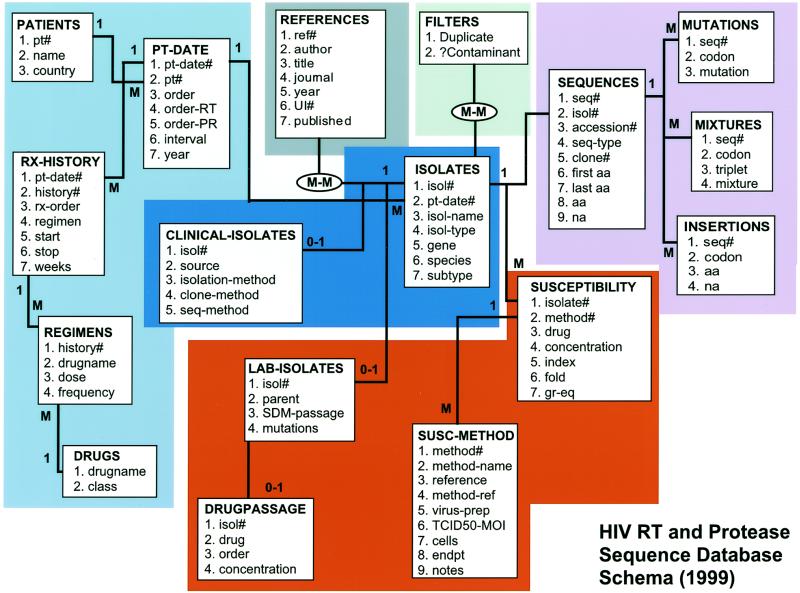
The HIV RT and Protease Sequence Database is an online relational database that catalogs evolutionary and drug-related human immunodeficiency virus (HIV) reverse transcriptase (RT) and protease sequence variation (http://hivdb.stanford.edu). The database contains a compilation of nearly all published HIV RT and protease sequences including International Collaboration database submissions (e.g., GenBank) and sequences published in journal articles. Sequences are linked to data about the source of the sequence sample and the antiretroviral drug treatment history of the individual from whom the isolate was obtained. The database is curated and sequences are annotated with data from >230 literature references. Users can retrieve additional data and view alignments of sequence sets meeting specific criteria (e.g., treatment history, subtype, presence of a particular mutation). A gene-specific sequence analysis program, new user-defined queries and nearly 2000 additional sequences were added in 1999.
Figures
References
-
- Hirsch M.S., Conway,B., D’Aquila,R.T., Johnson,V.A., Brun-Vezinet,F., Clotet,B., Demeter,L.M., Hammer,S.M., Jacobsen,D.M., Kuritzkes,D.R., Loveday,C., Mellors,J.W., Vella,S. and Richman,D.D. (1998) J. Am. Med. Assoc., 279, 1984–1991. - PubMed
-
- Tantillo C., Ding,J., Jacobo-Molina,A., Nanni,R.G., Boyer,P.L., Hughes,S.H., Pauwels,R., Andries,K., Janssen,P.A. and Arnold,E. (1994) J. Mol. Biol., 243, 369–387. - PubMed
-
- Erickson J.W. and Burt,S.K. (1996) Annu. Rev. Pharmacol. Toxicol., 36, 545–571. - PubMed
-
- Coffin J.M. (1995) Science, 267, 483–489. - PubMed
-
- Korber B., Kuiken,C., Foley,B., Hahn,B., McCutchan,F., Mellors,J.W. and Sodroski,J. (eds) (1998) Human Retroviruses and AIDS 1997: A Compilation and Analysis of Nucleic and Amino Acid Sequences. Theoretical Biology and Biophysics Group. Los Alamos National Laboratory, Los Alamos, NM, pp. II-A-20–II-A-31.
MeSH terms
Substances
LinkOut - more resources
Full Text Sources
Other Literature Sources
