Characterisation of patients with primary biliary cirrhosis responding to long term ursodeoxycholic acid treatment
- PMID: 10601067
- PMCID: PMC1727784
- DOI: 10.1136/gut.46.1.121
Characterisation of patients with primary biliary cirrhosis responding to long term ursodeoxycholic acid treatment
Abstract
Background: In some patients with primary biliary cirrhosis, ursodeoxycholic acid causes full biochemical normalisation of laboratory data; in others, indexes improve but do not become normal.
Aims: To characterise complete and incomplete responders.
Methods: Seventy patients with primary biliary cirrhosis were treated with ursodeoxycholic acid 10-15 mg/kg/day and followed up for 6-13 years.
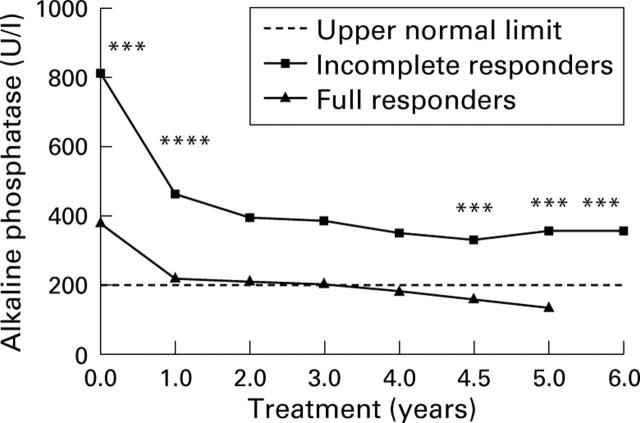
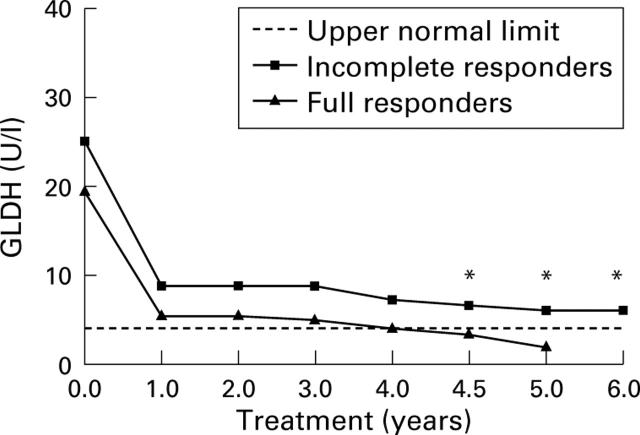
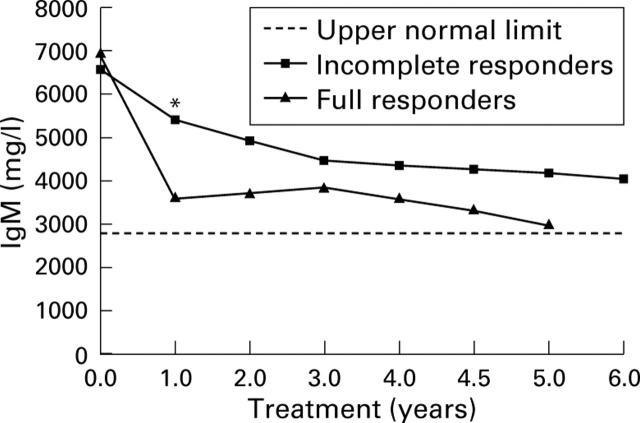
Results: In 23 patients (33%) with mainly stage I or II disease, cholestasis indexes and aminotransferases normalised within 1-5 years, except for antimitochondrial antibodies. Histological findings improved. Indexes were not normalised in 47 patients (67%) although the improvement of their biochemical functions parallelled the trend in the first group. In these incomplete responders histological findings improved to a lesser extent. The only difference between the two groups before treatment was higher levels of alkaline phosphatase and gamma glutamyl transpeptidase in the incomplete responders. At onset of treatment the discriminant value separating responders from incomplete responders was 660 U/l for alkaline phosphatase and 131 U/l for gamma glutamyl transpeptidase. One year later it was 239 and 27 U/l (overall predictive value for responders 92%, for incomplete responders 81%). There were no differences between the two groups concerning immune status, antimitochondrial antibody subtypes, liver histology, or any other data. HLA-B39, DRB1*08, DQB1*04 dominated in both groups.
Conclusions: In patients with mainly early stages of primary biliary cirrhosis, higher values of alkaline phosphatase and gamma glutamyl transpeptidase are the only biochemical indexes which allow discrimination between patients who will completely or incompletely respond to ursodeoxycholic acid treatment.
Figures

Comment in
-
UDCA, PBC and biochemistry: what does normal mean?Gut. 2000 Jan;46(1):8. doi: 10.1136/gut.46.1.8. Gut. 2000. PMID: 10601046 Free PMC article. No abstract available.
References
MeSH terms
Substances
LinkOut - more resources
Full Text Sources
Research Materials