. 1999 Dec 20;190(12):1909-14.
doi: 10.1084/jem.190.12.1909.

Dynamic interactions of macrophages with T cells during antigen presentation

Affiliations

Dynamic interactions of macrophages with T cells during antigen presentation

D M Underhill et al. J Exp Med. .

Abstract

We have established a method for real-time video analysis of the interaction of antigen-presenting cells (APCs) with T cells. Green fluorescent protein expression controlled by a nuclear factor of activated T cells (NFAT)-responsive promoter permits the visualization of productive antigen presentation in single T cells. The readout is rapid (within 2 h) and semiquantitative and allows analysis by video microscopy and flow cytometry. Using this approach, we demonstrate that macrophages have the capacity to simultaneously activate multiple T cells. In addition, the interaction of T cells with macrophages is extraordinarily dynamic: after initial stable contact, the T cells migrate continuously on the surface of the macrophage and from APC to APC during productive antigen presentation. Thus, T cells sum up signals from multiple interactions with macrophages during stimulation.


Figures
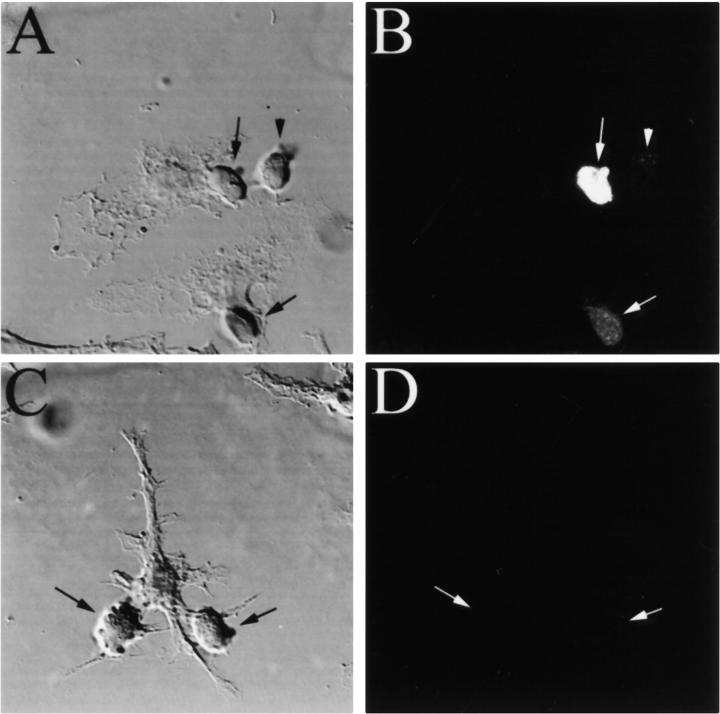
Figure 1
Figure 1
Productive antigen-specific interaction induces GFP expression in a T cell hybridoma. IFN-γ–stimulated RAW 264.7 cells were incubated for 2 h with (A and B) or without (C and D) 100 μg/ml of the OVA 323–339 peptide, and allowed to interact with a fivefold excess of DO11-GFP cells for 6 h. In the presence of peptide, T cells in contact with macrophages express GFP (B, arrows), whereas neighboring T cells not in direct contact with macrophages do not (B, arrowhead). In the absence of peptide, the DO11-GFP cells are not stimulated to express GFP (D, arrows) despite their adhesion to macrophages.
Figure 2
Figure 2
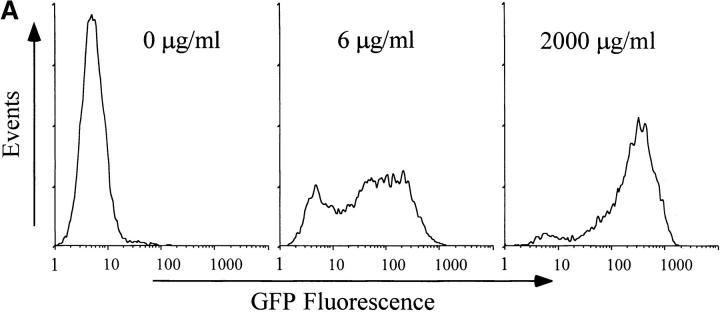
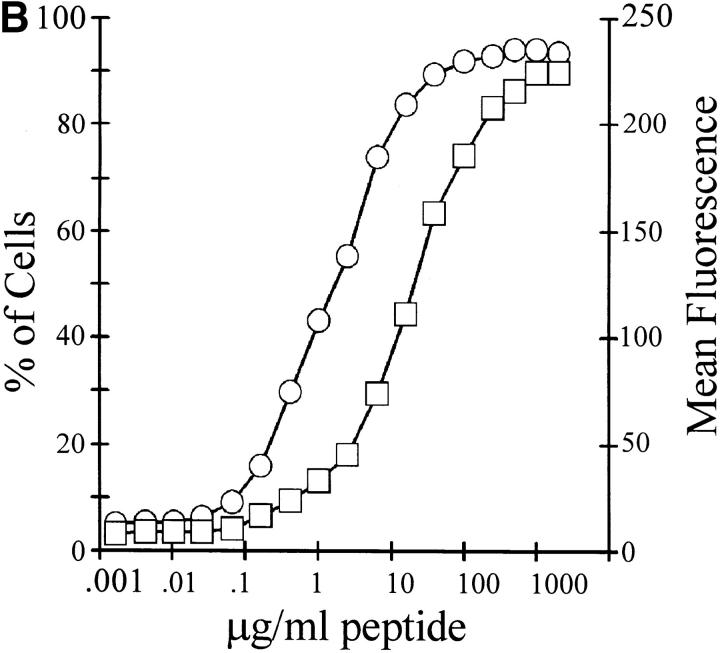
Analysis of antigen-induced GFP expression by flow cytometry. (A) RAW 264.7 cells were labeled with the fluorescent lipid DiI, stimulated for 48 h with IFN-γ, and loaded for 2 h with the indicated concentration of OVA 323–339 peptide. DO11-GFP cells were added at a 1:1 ratio, and the cells were allowed to interact for 6 h. GFP expression in the DO11-GFP cells was analyzed by flow cytometry. (B) IFN-γ–stimulated RAW 264.7 cells were preloaded for 2 h with the indicated dose of antigenic peptide, mixed 1:1 with CTO-labeled DO11-GFP cells, and allowed to interact for 6 h. The cells were harvested, and GFP expression in the T cell hybridoma was analyzed by flow cytometry. The percentage of T cells expressing GFP increased as a function of peptide concentration (○), as did the average fluorescence of the GFP-positive cells (□).
Figure 2
Figure 2
Analysis of antigen-induced GFP expression by flow cytometry. (A) RAW 264.7 cells were labeled with the fluorescent lipid DiI, stimulated for 48 h with IFN-γ, and loaded for 2 h with the indicated concentration of OVA 323–339 peptide. DO11-GFP cells were added at a 1:1 ratio, and the cells were allowed to interact for 6 h. GFP expression in the DO11-GFP cells was analyzed by flow cytometry. (B) IFN-γ–stimulated RAW 264.7 cells were preloaded for 2 h with the indicated dose of antigenic peptide, mixed 1:1 with CTO-labeled DO11-GFP cells, and allowed to interact for 6 h. The cells were harvested, and GFP expression in the T cell hybridoma was analyzed by flow cytometry. The percentage of T cells expressing GFP increased as a function of peptide concentration (○), as did the average fluorescence of the GFP-positive cells (□).
Figure 3
Figure 3
Kinetics of antigen-dependent stimulation of GFP expression in DO11-GFP cells. IFN-γ–stimulated RAW 264.7 cells were loaded overnight with OVA at a final concentration of 25 mg/ml (○), 2 mg/ml (□), or 0.5 mg/ml (▵). Control cells were also IFN-γ stimulated but were not incubated with antigen (▪). CTO-labeled DO11-GFP cells were added at a 1:1 ratio and allowed to interact with the RAW 264.7 cells for the indicated periods. The cells were harvested, and GFP expression in the T cell hybridoma was analyzed by flow cytometry.
Figure 4
Figure 4
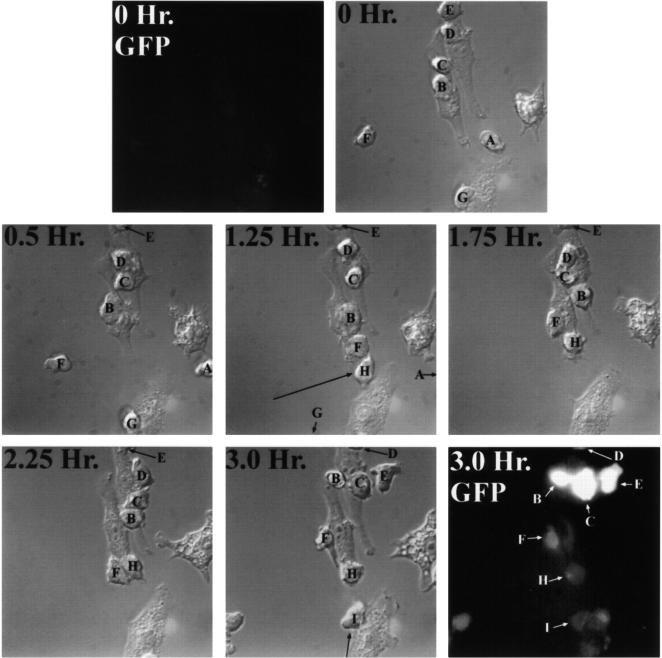
Time-lapse imaging of macrophage–T cell interactions. IFN-γ–stimulated RAW 264.7 cells were loaded overnight with 10 mg/ml OVA. DO11-GFP cells were added at a 5:1 ratio to macrophages, the cells were mounted on a temperature-controlled microscope stage, and cell–cell interactions were continuously observed by video microscopy for 3 h. The panels show selected video images collected at the indicated time intervals after addition of DO11-GFP cells. At the beginning of the experiment (0 Hr.), no cells expressed GFP (top left). After 3 h, many T cells in the field were expressing GFP (bottom right). Individual T cells are labeled alphabetically.

References

    1. Aderem A., Underhill D.M. Mechanisms of phagocytosis in macrophages. Annu. Rev. Immunol. 1999;17:593–623. - PubMed
    1. Davis M.M., Boniface J.J., Reich Z., Lyons D., Hampl J., Arden B., Chien Y. Ligand recognition by alpha beta T cell receptors. Annu. Rev. Immunol. 1998;16:523–544. - PubMed
    1. Monks C.R., Freiberg B.A., Kupfer H., Sciaky N., Kupfer A. Three-dimensional segregation of supramolecular activation clusters in T cells. Nature. 1998;395:82–86. - PubMed
    1. Lanzavecchia A., Lezzi G., Viola A. From TCR engagement to T cell activationa kinetic view of T cell behavior. Cell. 1999;96:1–4. - PubMed
    1. Wulfing C., Davis M.M. A receptor/cytoskeletal movement triggered by costimulation during T cell activation. Science. 1998;282:2266–2269. - PubMed

Publication types