. 2000 Jan 15;28(2):393-401.
doi: 10.1093/nar/28.2.393.

Crystal structure of the human O(6)-alkylguanine-DNA alkyltransferase

Affiliations

Crystal structure of the human O(6)-alkylguanine-DNA alkyltransferase

J E Wibley et al. Nucleic Acids Res. .

Abstract

The mutagenic and carcinogenic effects of simple alkylating agents are mainly due to O(6)-alkylation of guanine in DNA. This lesion results in transition mutations. In both prokaryotic and eukaryotic cells, repair is effected by direct reversal of the damage by a suicide protein, O(6)-alkylguanine-DNA alkyltransferase. The alkyltransferase removes the alkyl group to one of its own cysteine residues. However, this mechanism for preserving genomic integrity limits the effectiveness of certain alkylating anticancer agents. A high level of the alkyltransferase in many tumour cells renders them resistant to such drugs. Here we report the X-ray structure of the human alkyltransferase solved using the technique of multiple wavelength anomalous dispersion. This structure explains the markedly different specificities towards various O(6)-alkyl lesions and inhibitors when compared with the Escherichia coli protein (for which the structure has already been determined). It is also used to interpret the behaviour of certain mutant alkyltransferases to enhance biochemical understanding of the protein. Further examination of the various models proposed for DNA binding is also permitted. This structure may be useful for the design and refinement of drugs as chemoenhancers of alkylating agent chemotherapy.


Figures
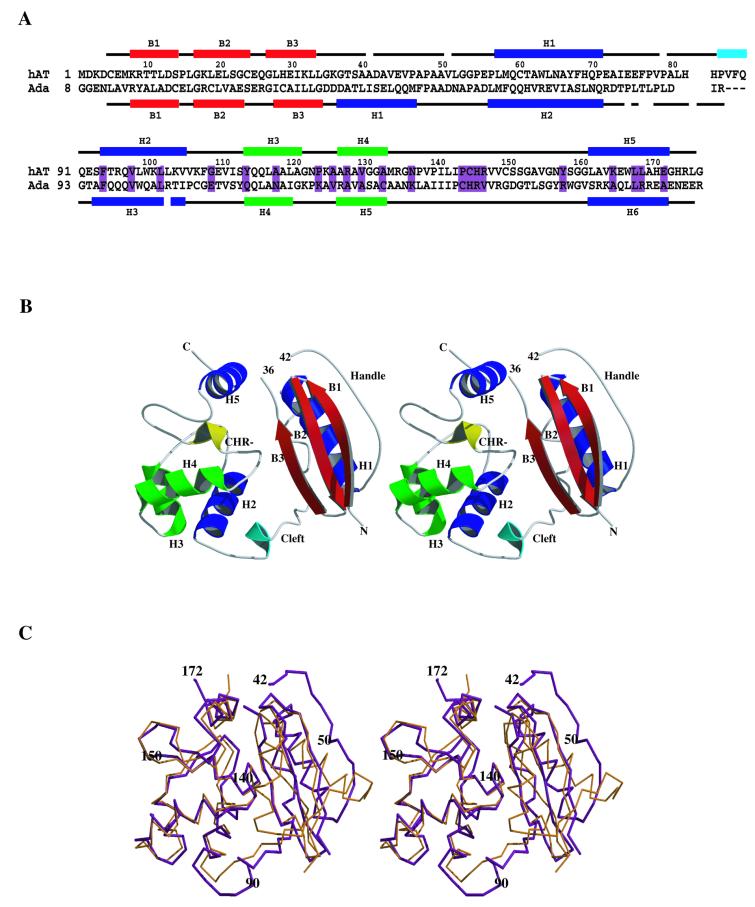
Figure 1
Figure 1
(A) Sequence alignment of hAT (G177stop) with the C-terminal domain of Ada constructed according to topological equivalence. Fully conserved residues in the AT family are shown boxed (purple). Secondary structural elements and their labels as referred to in the text are shown above and below the sequences for hAT and Ada, respectively. These elements are colour coded as follows: α-helices are shown in blue except for H3 and H4 forming the helix–turn–helix element (green), β-sheets in red and a single turn of helix is shown in cyan. The Ada-C sequence is numbered by renaming T176 in the full-length Ada as residue 1. The numbers running above the hAT sequence refer to residue numbering for hAT only. (B) Stereo drawing of the human O6-alkylguanine-DNA alkyltransferase showing the principal secondary structural elements colour coded as in (A). In addition, the four residue turn of the active site residues C145–R148 are shown in yellow and labelled -CHR-. The N- and C-terminal residues are marked, as are the sequence numbers 36 and 42, indicating the undefined loop residues. (C) A stereo representation of the α-carbon coordinates of hAT (magenta) superimposed on those of the Ada-C (gold) crystal structure. This figure illustrates differences in topology between the N-terminal lobes of the two proteins and highlights the similarity of their C-terminal lobes. The residue numbering used to orient the illustration refers to the hAT protein. (B) and (C) were made using Molscript (54) and Raster3D (55).
Figure 2
Figure 2
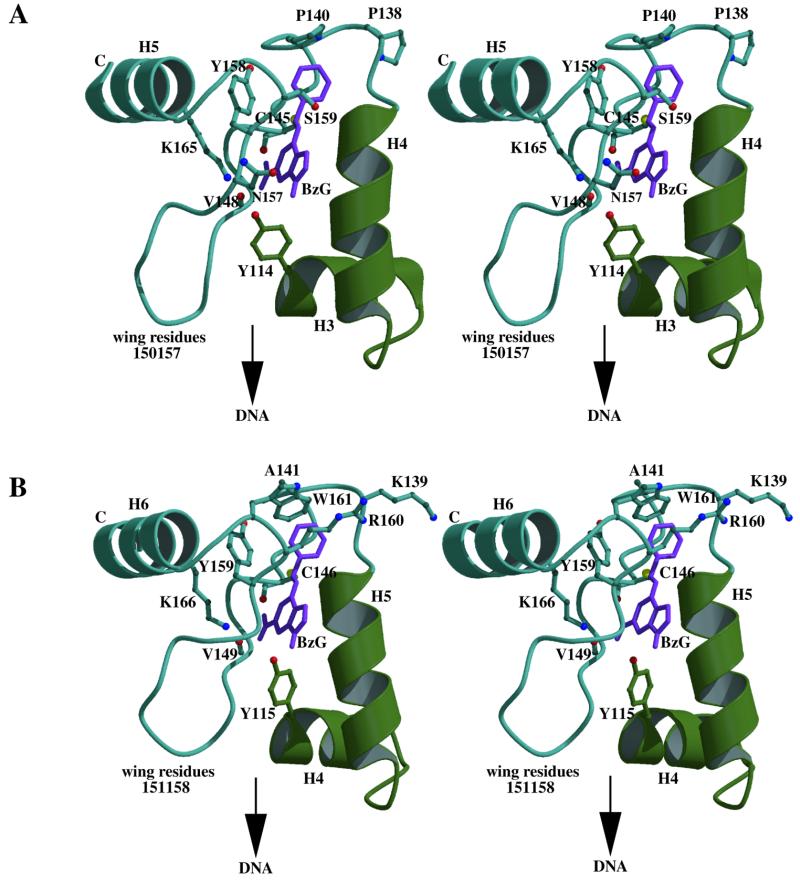
(A) Stereo view of the active site region of hAT to show the position of BzG in the potential binding cleft as defined by a Multiple Copy Simulation Search. (The orientation of this view can be cross-referenced to Fig. 4.) The side chain positions of residues Y114, P138, P140, C145, V148 (main chain carbonyl only), N157, Y158, S159 and K165 with respect to the BzG molecule (magenta) are presented. The α-carbon coordinates of the remaining residues are shown in a coil representation. Side chains and secondary structure are shown in blue apart from Y114 on the HTH element (green). Atom colours are: nitrogen, blue; oxygen, red; sulphur, yellow. The side chain of C145 is in an appropriate position to carry out alkyltransfer by nucleophilic attack on the electron-deficient benzylic carbon. The imino ring of P140 presents a favourable hydrophobic packing surface for the benzyl group. Moreover, some of the experimental observations relating to the preferred attributes of guanine-based inhibitors (10–17) can be accommodated in this binding pocket. These include the preference for: (i) adequate space for p-phenylBzG and a wide variety of N-9 substituents; (ii) the absence of substituents at the 7-position; (iii) the presence of a 2-amino group. Substituents at the O6- and 9-positions of the molecule are directed towards the protein surface such that there is little constraint on the size of group that can be accommodated at these positions. S159 may act as a hydrogen bond donor to N-7 of BzG after a degree of side chain movement on binding. The amide side chain of N157 is also a candidate for this protein–inhibitor interaction. The 2-amino group of BzG is positioned to be able to hydrogen bond to the main chain carbonyl groups of C145 and V148. K165, a fully conserved residue essential for BzG sensitivity (results not shown), may also interact with the 2-amino group. The ability of K165 mutants to repair methylated DNA supports this, as the 2-amino group is of lesser importance for binding MeG in oligonucleotides (39,40). Moreover, it can be seen that the side chain of K165 plays an important role in maintaining the ring position of Y158 (involved here in an aromatic stacking interaction with the phenyl ring of BzG). Mutation of K165 to the majority of amino acids, particularly those with branched side chains, would serve to push the phenyl ring of Y158 into the proposed Bz group-binding pocket, explaining BzG resistance. For the K165A and K165G resistant mutants the absence of an extended side chain underpinning the orientation of Y158 may weaken the favourable packing interaction of the phenyl rings. (B) Stereo presentation of the equivalent view of Ada-C to illustrate factors contributing to BzG resistance in Ada [colour key as for (A)]. The BzG molecule has been imported in the corresponding position as determined for hAT (i.e. relative to the superimposable α-carbon backbones). The side chains of Y115, C146, K166 and V149 (main chain carbonyl only) conserved between hAT and Ada are indicated. The tryptophan side chain of W161, stabilised by aromatic interactions with Y159 and R160, is shown to impinge on the benzyl group-binding pocket proposed for hAT. The side chains of K139 and A141 corresponding to residues P138 and P140 in hAT are also shown. Figure 2 was made using Molscript (54) and Raster3D (55).
Figure 3
Figure 3
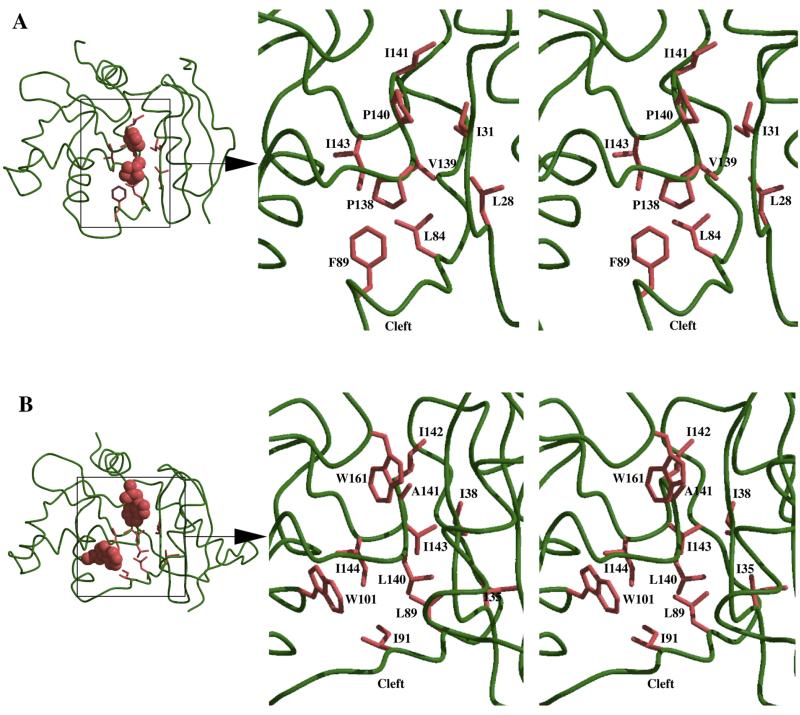
The α-carbon representation (far left in both figures) shows the location of the hydrophobic cores within (A) hAT and (B) Ada with the boxed regions indicating the area enlarged in the respective stereo views. The two proline residues in hAT and two tryptophan residues in Ada, important for maintaining core integrity, are depicted as a Van der Waal’s surface. The stereo views (enlarged area) for (A) hAT and (B) Ada show the principal interacting residues in the hydrophobic core. The protein backbone is shown in a coil representation (green) with the hydrophobic residues of the core shown in orange. Figure 3 was made using Molscript (54) and Raster3D (55).
Figure 4
Figure 4
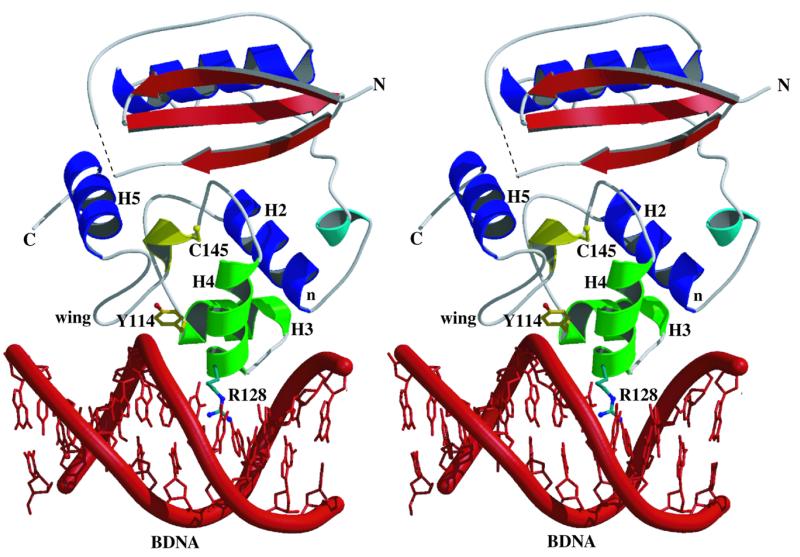
Stereo view of the proposed DNA binding model for hAT. It is probable that alkyl lesions are removed from DNA in a base-flipping manner, but the mechanism of this has yet to be determined. The model here is based on overlaying the helices of the HTH domain of hAT (H2, H3 and H4) onto the counterpart helices in CAP (51), followed by docking into a piece of standard B-DNA (red, with the phosphate backbone emphasised as a thick coil representation). Colour coded as described in Figure 1B, the N-termini of H2, H3 and the recognition helix H4 (denoted by the letter n and the residues Y114 and R128, respectively) can be seen to be oriented towards the phosphodiester backbone. The wing residues (151–157) are also shown to contact DNA (as proposed in 47). The side chains of the two fully conserved residues involved in DNA binding, Y114 (yellow) and R128 (green), are shown in ball and stick fashion. Two other fully conserved residues, A118 and V130 (side chains not shown), are involved in a hydrophobic interface between H3 and H4. The dotted line in the N-terminal lobe is used to represent residues 37–41 lacking interpretable electron density. Figure 4 was made using Molscript (54) and Raster3D (55).

References

    1. Saffhill R., Margison,G.P. and O’Connor,P.J. (1985) Biochim. Biophys. Acta, 823, 111–145. - PubMed
    1. Altschul S.F., Madden,T.L., Schaffer,A.A., Zhang,J., Zhang,Z., Miller,W. and Lipman,D.J. (1997) Nucleic Acids Res., 25, 3389–3402. - PMC - PubMed
    1. Moore M.H., Gulbis,J.M., Dodson,E.J., Demple,B. and Moody,P.C.E. (1994) EMBO J., 13, 1495–1501. - PMC - PubMed
    1. Hashimoto H., Inoue,T., Nishioka,M., Fujiwara,S., Tagaki,M., Imanaka,T. and Kai,Y. (1999) J. Mol. Biol., 292, 707–716. - PubMed
    1. Pegg A.E., Dolan,M.E. and Moschel,R.C. (1995) Prog. Nucleic Acid Res. Mol. Biol., 51, 167–233. - PubMed

Publication types

Substances

Associated data