Comparison of the pharmacokinetics of fosinoprilat with enalaprilat and lisinopril in patients with congestive heart failure and chronic renal insufficiency
- PMID: 10606834
- PMCID: PMC2014892
- DOI: 10.1046/j.1365-2125.2000.00103.x
Comparison of the pharmacokinetics of fosinoprilat with enalaprilat and lisinopril in patients with congestive heart failure and chronic renal insufficiency
Abstract
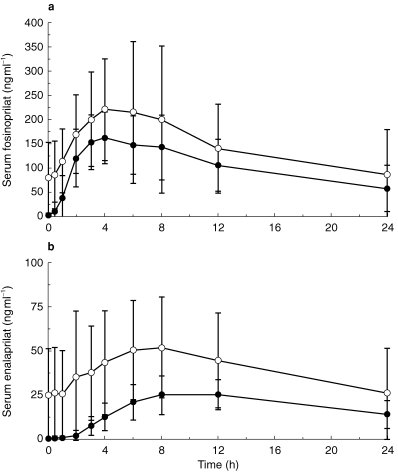
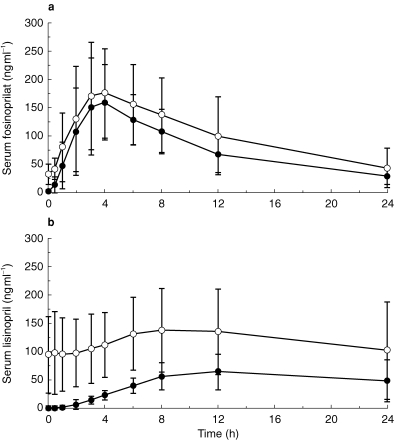
Aims: To compare the serum pharmacokinetics of fosinoprilat with enalaprilat and lisinopril after 1 and 10 days of dosing with fosinopril, enalapril and lisinopril.
Methods: Patients with congestive heart failure (CHF, NYHA Class II-IV) and chronic renal insufficiency (creatinine clearance </=30 ml min-1 ) were randomized to receive fosinopril, enalapril or lisinopril in two parallel-group studies. In the first study 24 patients were treated with 10 mg fosinopril (n=12 patients) or 2.5 mg enalapril (n=12) every morning for 10 consecutive days. In the second study 31 patients were treated with 10 mg fosinopril (n=16 patients) or 5 mg lisinopril (n=15) every morning for 10 consecutive days. Samples of blood were collected for determination of pharmacokinetic parameters. The area under the curve (AUC) between the first and last days of treatment and the accumulation index (AI) were the primary outcome measures.
Results: All three angiotensin converting enzyme (ACE) inhibitors exhibited a significant increase in AUC between the first and last days of treatment in both studies. The difference between the AI for fosinoprilat (1.41) and enalaprilat (1.96) was statistically significant (95% CI: 1.05, 1.84). Similarly, the difference between the AI for fosinoprilat (1.21) and lisinopril (2.76) was statistically significant (95% CI: 1.85, 2.69). All three ACE inhibitors completely inhibited serum ACE for 24 h. All treatments were well tolerated.
Conclusions: Fosinoprilat exhibits significantly less accumulation than enalaprilat or lisinopril in patients with CHF and renal insufficiency, most probably because fosinoprilat is eliminated by both the kidney and liver, and increased hepatic elimination can compensate for reduced renal clearance in patients with kidney dysfunction.
Figures
References
-
- Shammas FV, Dickstein K. Clinical pharmacokinetics in heart failure. An updated review. Clin Pharmacokinet. 1988;15:94–113. - PubMed
-
- Ljungman S, Kjekshus J, Swedberg K. Renal function in severe congestive heart failure during treatment with enalapril (the Cooperative North Scandinavian Enalapril Survival Study [CONSENSUS] Trial) Am J Cardiol. 1992;70:479–487. - PubMed
-
- Massie BM. Angiotensin-converting enzyme inhibition in mild to moderate congestive heart failure: an evolving approach. Am Heart J. 1988;1:402S–409S. - PubMed
-
- Nicholls MG, Ikram H, Fitzpatrick MA, Crozier IG. Converting enzyme inhibitors in heart failure. Eur Heart J. 1988;9(Suppl H):77–83. - PubMed
-
- Zannad F, van den Broek SAJ, Bory M. Comparison of treatment with lisinopril versus enalapril for congestive heart failure. Am J Cardiol. 1992;70:78C–83C. - PubMed
Publication types
MeSH terms
Substances
LinkOut - more resources
Full Text Sources
Medical
Miscellaneous