


The thalidomide analogue CC-3052 inhibits HIV-1 and tumour necrosis factor-alpha (TNF-alpha) expression in acutely and chronically infected cells in vitro
- PMID: 10606973
- PMCID: PMC1905522
- DOI: 10.1046/j.1365-2249.2000.01117.x
The thalidomide analogue CC-3052 inhibits HIV-1 and tumour necrosis factor-alpha (TNF-alpha) expression in acutely and chronically infected cells in vitro
Abstract
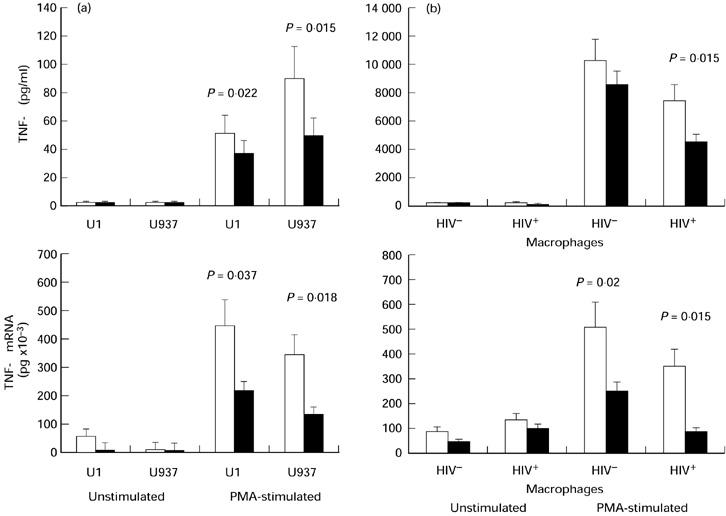
We investigated the in vitro effect of the water-soluble, highly stable thalidomide analogue CC-3052 on HIV-1 expression and TNF-alpha production in latently infected promonocytic U1 cells, acutely infected T cells and monocyte-derived human macrophages (MDM), and in mitogen-stimulated ex vivo cultures from patients with primary acute HIV-1 infection. HIV-1 expression was assessed by Northern blot analysis of RNAs, and ELISA for p24 antigen release and reverse transcriptase (RT) activity. TNF-alpha expression was evaluated by RT-polymerase chain reaction (PCR)-ELISA for mRNA and ELISA for protein secretion. We demonstrated that CC-3052 is able to inhibit HIV-1 expression, as evaluated by mRNA, p24 release and RT activity, in phorbol myristate acetate (PMA)- and cytokine-stimulated U1 cells. Furthermore, CC-3052 inhibited HIV-1 expression, as evaluated by p24 and RT activity, in acutely infected MDM and T cells. As far as TNF-alpha is concerned, CC-3052 significantly reduced TNF-alpha mRNA and protein secretion in PMA-stimulated U937 and U1 cells, and in PMA-stimulated uninfected and acutely infected MDM. Consistently, the addition of CC-3052 reduced TNF-alpha production in phytohaemagglutinin (PHA) and lipopolysaccharide (LPS)-stimulated whole blood cultures from patients during the primary acute phase of HIV-1 infection. Since TNF-alpha is among the most potent enhancers of HIV-1 expression, the effect of CC-3052 on TNF-alpha may account for its inhibitory activity on HIV-1 expression. Given the well documented immunopathological role of TNF-alpha and its correlation with viral load, advanced disease and poor prognosis, CC-3052 could be an interesting drug for the design of therapeutic strategies in association with anti-retroviral agents.
Figures



References
-
- Folks TM, Justement J, Kinter A, Dinarello CA, Fauci AS. Cytokine-induced expression of HIV-1 in a chronically infected promonocyte cell line. Science. 1987;238:800–2. - PubMed
-
- Godfried MH, Van der Poll T, Jansen J, Romijin JA, Schattenkerk JK, Endert E, van Deventer SJ, Sauerwein HP. Soluble receptors for tumor necrosis factor: a putative marker of disease progression in HIV infection. AIDS. 1993;7:33–6. - PubMed
-
- Aukrust P, Liabakk N, Müller F, Lien E, Espevik T, Frøland SS. Serum levels of tumor necrosis factor-α (TNF-α) and soluble TNF receptors in human immunodeficiency virus type 1 infection—correlations to clinical, immunologic, and virologic parameters. J Infect Dis. 1994;169:420–4. - PubMed
Publication types
MeSH terms
Substances
LinkOut - more resources
Full Text Sources
Other Literature Sources
Medical
Research Materials
