


Vascular endothelial growth factor overproduced by tumour cells acts predominantly as a potent angiogenic factor contributing to malignant progression
- PMID: 10607018
- PMCID: PMC2517834
- DOI: 10.1046/j.1365-2613.1999.00122.x
Vascular endothelial growth factor overproduced by tumour cells acts predominantly as a potent angiogenic factor contributing to malignant progression
Abstract
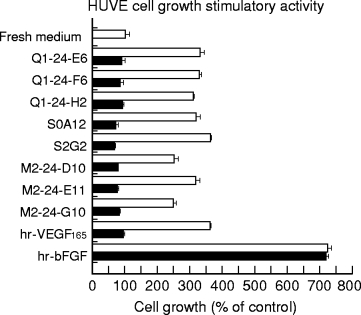
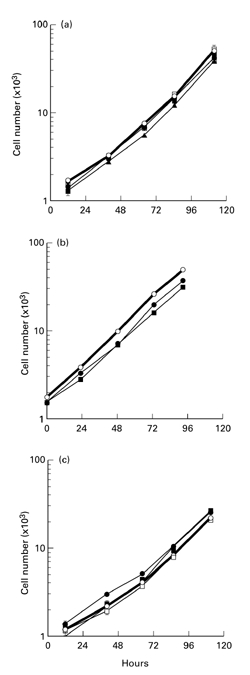
To elucidate the role of vascular endothelial growth factor (VEGF), an endothelial cell-specific mitogen, in tumour angiogenesis and malignant progression, an expression vector harboring human VEGF cDNA was stably transfected into three human cancer cell lines with poor VEGF productivity. Though their in vitro growth rate and intrinsic productivity of another angiogenic factor, basic fibroblast growth factor (bFGF), were not changed by transfection, those clones with higher VEGF production were endowed with tumorigenic and angiogenic potentials as follows: firstly, nontumorigenic, lung carcinoma QG90 cells having lower bFGF productivity acquired tumorigenicity as well as significant in vivo angiogenesis-inducing ability, secondly, tumorigenic colorectal carcinoma RPMI4788 cells having higher potency for bFGF production could form more vascularized solid tumour with faster growth rate and thirdly, oestrogen-dependent breast carcinoma MCF-7 cells, which did not produce detectable bFGF, acquired tumorigenicity even in the absence of oestrogen and the solid tumour growth rate was remarkably enhanced, accompanied with increased vascularization, in the presence of oestrogen. These results suggest that tumour progression closely depends on angiogenesis, and VEGF significantly contributes to malignant progression of a variety of tumour cells through its potent angiogenic activity, independent on the bFGF productivity of tumour cells.
Figures




References
-
- Abraham JA, Mergia A, Whang JL, et al. Nucleotide sequence of a bovine clone encoding the angiogenic protein, basic fibroblast growth factor. Science. 1986;233:545–548. - PubMed
-
- Aonuma M, Iwahana M, Nakayama Y, et al. Tumorigenicity depends on angiogenic potential of tumor cells: dominant role of vascular endothelial growth factor and/or fibroblast growth factors produced by tumor cells. Angiogenesis. 1998;2:57–66. - PubMed
-
- Bosari S, Lee AK, Delellis RA, Wiley BD, Heatley GJ, Silverman ML. Microvessel quantitation and prognosis in invasive breast carcinoma. Hum. Pathol. 1992;23:755–761. - PubMed
-
- Brown L, Berse B, Jackman R, Schnitt S, et al. Expression of vascular permeability factor (vascular endothelial growth factor) and its receptors in breast cancer. Hum. Pathol. 1995;26:86–91. - PubMed
MeSH terms
Substances
LinkOut - more resources
Full Text Sources
