


Direct amplification of rRNA genes in diagnosis of bacterial infections
- PMID: 10618059
- PMCID: PMC86012
- DOI: 10.1128/JCM.38.1.32-39.2000
Direct amplification of rRNA genes in diagnosis of bacterial infections
Abstract
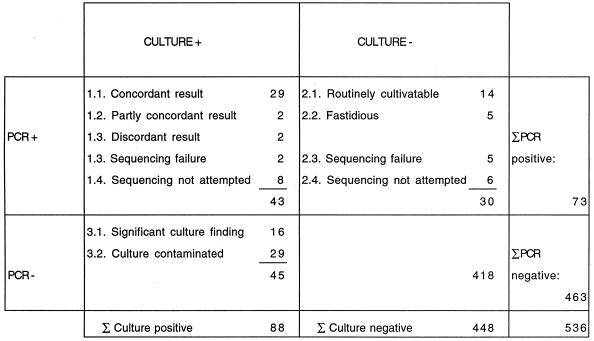
A broad-range bacterial PCR targeting rRNA genes (rDNAs) was used to directly analyze 536 clinical samples obtained from 459 hospitalized patients during a 4-year study period. The molecular diagnosis based on DNA sequencing of the PCR product was compared to that obtained by bacterial culture. The bacteriological diagnosis was concordant for 447 (83%) specimens. Broad-range rDNA PCR was the only method that yielded an etiologic diagnosis for 11 (2.4%) of 459 patients. Compared to culture and clinical assessment, the sensitivity of the PCR method combined with sequencing was 74.2%, and the specificity was between 98.7 and 99.6%. At present, the described molecular approach proved superior to bacterial culture in two clinical situations: infections caused by bacteria with unusual growth requirements and specimens taken during antimicrobial treatment of the patient.
Figures
References
-
- Clayton R A, Sutton G, Hinkle P S, Bult C, Fields C. Intraspecific variation in small-subunit rRNA sequences in GenBank: why single sequences may not adequately represent prokaryotic taxa. Int J Syst Bacteriol. 1995;45:595–599. - PubMed
-
- Fox G E, Stackebrandt E, Hespell R B, Gibson J, Maniloff J, Dyer T A, Wolfe R S, Balch W E, Tanner R S, Magrum L J, Zablen L B, Blakemore R, Gupta R, Bonen L, Lewis B J, Stahl D A, Luehrsen K R, Chen K N, Woese C R. The phylogeny of procaryotes. Science. 1980;209:457–463. - PubMed
-
- Fox G E, Wisotzkey J D, Jurtshuk P. How close is close: 16S rRNA sequence identity may not be sufficient to guarantee species identity. Int J Syst Bacteriol. 1992;42:166–170. - PubMed
Publication types
MeSH terms
Substances
LinkOut - more resources
Full Text Sources
Other Literature Sources
Medical
