


doi: 10.1128/AEM.66.1.443-448.2000.
Homogeneity of Danish environmental and clinical isolates of Shewanella algae
Affiliations
- PMID: 10618264
- PMCID: PMC91846
- DOI: 10.1128/AEM.66.1.443-448.2000
Item in Clipboard
Homogeneity of Danish environmental and clinical isolates of Shewanella algae
Appl Environ Microbiol.
2000 Jan.
Abstract
Danish isolates of Shewanella algae constituted by whole-cell protein profiling a very homogeneous group, and no clear distinction was seen between strains from the marine environment and strains of clinical origin. Although variation between all strains was observed by ribotyping and random amplified polymorphic DNA analysis, no clonal relationship between infective strains was found. From several patients, clonally identical strains of S. algae were reisolated up to 8 months after the primary isolation, indicating that the same strain may be able to maintain the infection.
Figures
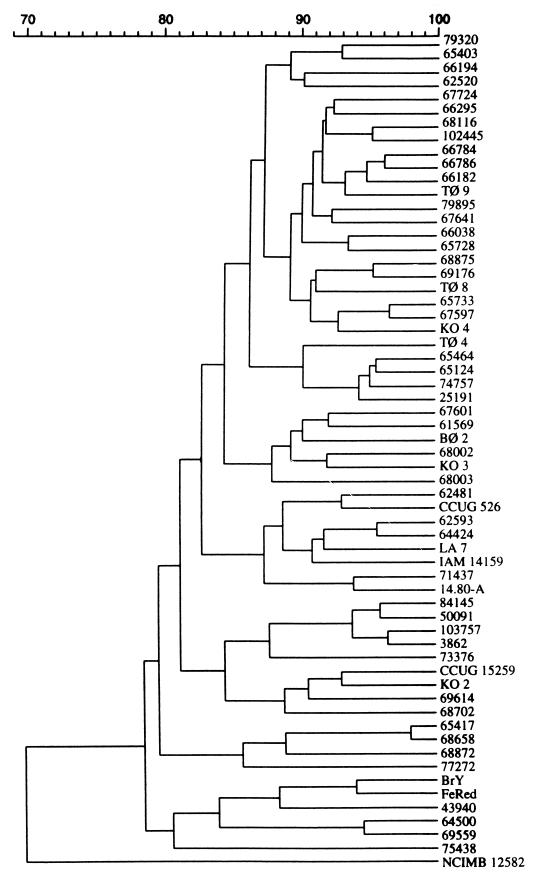
Clustering of SDS-protein electrophoregrams of 57 strains of S. algae listed in Table 1 and the type strain of S. putrefaciens (ATCC 8071) by using the Pearson product-moment correlation coefficient and the UPGMA. The horizontal scale represents the percentage similarities.
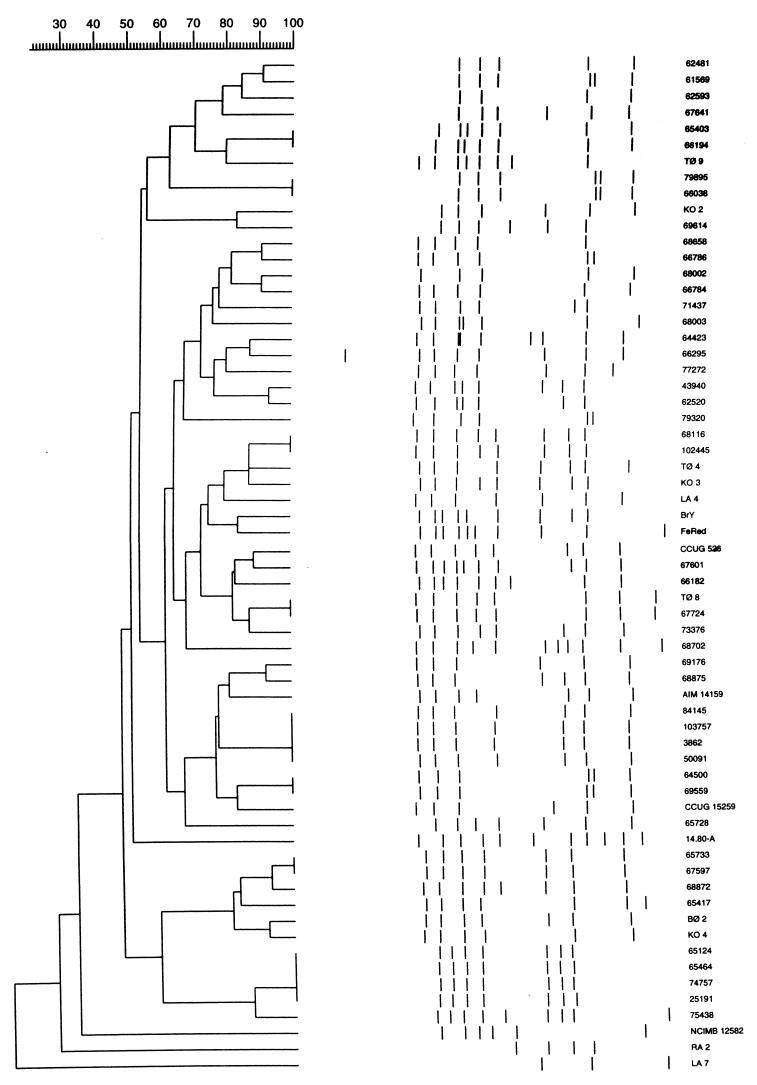
Dendrogram of RAPD patterns generated by primer RAPD1 of the 63 S. algae strains listed in Table 1 obtained after UPGMA analysis of the Dice coefficient (SD). The horizontal numbers represents the percentage similarities.
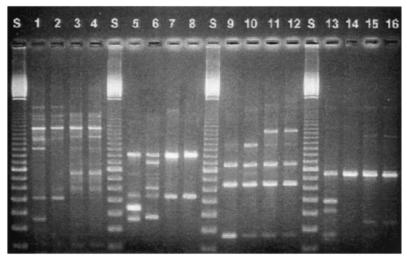
RAPD patterns of four isolates of S. algae from two patients generated with four different primers. Strain 68872 and 71437 from patient 6, strain 74757 and 25191 from patient 7. Lanes 1, 5, 9, and 13, strain 68872; lanes 2, 6, 10, and 14, strain 71437; lanes 3, 7, 11, and 15, strain 74757; lanes 4, 8, 12, and 16, strain 25191; lane S, 100-bp ladder (Pharmacia). Lanes 1 to 4, primer RAPD1; lanes 4 to 8, primer OPA 10; lanes 9 to 12, primer OPA 18; lanes 13 to 16, primer OPA 20.
References
-
- Appelbaum P C, Bowen A J. Opportunistic infection of chronic skin ulcers with Pseudomonas putrefaciens. Br J Dermatol. 1978;98:229–231. - PubMed
-
- Bille J, Rocourt J. WHO international multicenter Listeria monocytogenes subtyping study—rationale and set-up of the study. Int J Food Microbiol. 1996;32:251–262. - PubMed
-
- Brink A J, van Straten A, Rensburg A J. Shewanella (Pseudomonas) putrefaciens bacteremia. Clin Infect Dis. 1995;20:1327–1332. - PubMed
Publication types
MeSH terms
Substances
LinkOut - more resources
Full Text Sources
Medical
Molecular Biology Databases
