


Analysis of microsatellite mutations in the mitochondrial DNA of Saccharomyces cerevisiae
- PMID: 10618404
- PMCID: PMC26649
- DOI: 10.1073/pnas.97.1.250
Analysis of microsatellite mutations in the mitochondrial DNA of Saccharomyces cerevisiae
Abstract
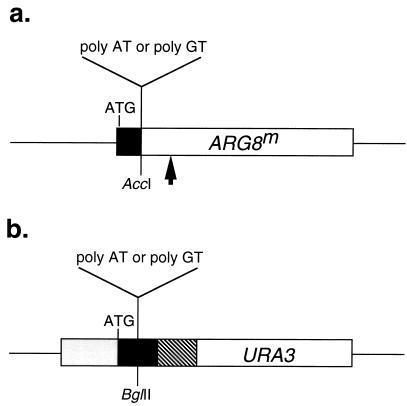
In the nuclear genome of Saccharomyces cerevisiae, simple, repetitive DNA sequences (microsatellites) mutate at rates much higher than nonrepetitive sequences. Most of these mutations are deletions or additions of repeat units. The yeast mitochondrial genome also contains many microsatellites. To examine the stability of these sequences, we constructed a reporter gene (arg8(m)) containing out-of-frame insertions of either poly(AT) or poly(GT) tracts within the coding sequence. Yeast strains with this reporter gene inserted within the mitochondrial genome were constructed. Using these strains, we showed that poly(GT) tracts were considerably less stable than poly(AT) tracts and that alterations usually involved deletions rather than additions of repeat units. In contrast, in the nuclear genome, poly(GT) and poly(AT) tracts had similar stabilities, and alterations usually involved additions rather than deletions. Poly(GT) tracts were more stable in the mitochondria of diploid cells than in haploids. In addition, an msh1 mutation destabilized poly(GT) tracts in the mitochondrial genome.
Figures
References
-
- Sia E A, Jinks-Robertson S, Petes T D. Mutat Res. 1997;383:61–70. - PubMed
-
- Tautz D, Schlotterer C. Genet Dev. 1994;140:965–972.
-
- Streisinger G, Okada Y, Emrich J, Newton J, Tsugita A, Terzaghi E, Inouye M. Cold Spring Harbor Symp Quant Biol. 1966;31:77–84. - PubMed
-
- Kolodner R. Genes Dev. 1996;10:1433–1442. - PubMed
Publication types
MeSH terms
Substances
Grants and funding
LinkOut - more resources
Full Text Sources
Molecular Biology Databases
Miscellaneous
