Review
. 2000 Jan;13(1):35-54, table of contents.
doi: 10.1128/CMR.13.1.35.

Immune response to Giardia duodenalis

Affiliations
Review

Immune response to Giardia duodenalis

G Faubert. Clin Microbiol Rev. 2000 Jan.

Abstract

The intestinal protozoan Giardia duodenalis is a widespread opportunistic parasite of humans and animals. This parasite inhabits the upper part of the small intestine and has a direct life cycle. After ingestion of cysts, which are the infective stage, the trophozoites emerge from the cysts in the duodenum and attach to the small intestinal mucosa of the host. Since the migration of trophozoites from the lumen of the intestine into surrounding tissues is an unusual occurrence, the immune response to Giardia remains localized. The identification of antigens that play a role in acquired immunity has been difficult because of the occurrence of antigenic variation and because, Giardia being an ubiquitous organism, it is possible that the antigenic profiles of isolates from different geographic areas will vary. Innate-immunity mechanisms play a role in the control and/or severity of the infection. Both humoral and cell-mediated immune responses play a role in acquired immunity, but the mechanisms involved are unknown. A variety of serological assays have been used to detect circulating antibodies in serum. Because of the biological characteristics of the parasite and the lack of suitable antigens, the sensitivity of serological assays remains poor. On the other hand, detection of antigens in feces of infected patients has met with success. Commercial kits are available, and they are reported to be more sensitive than microscopic examination for the detection of giardiasis on a single specimen.


Figures
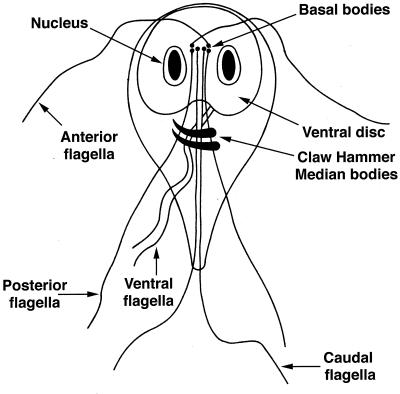
FIG. 1
FIG. 1
Trophozoite of the G. duodenalis type of organism.
FIG. 2
FIG. 2
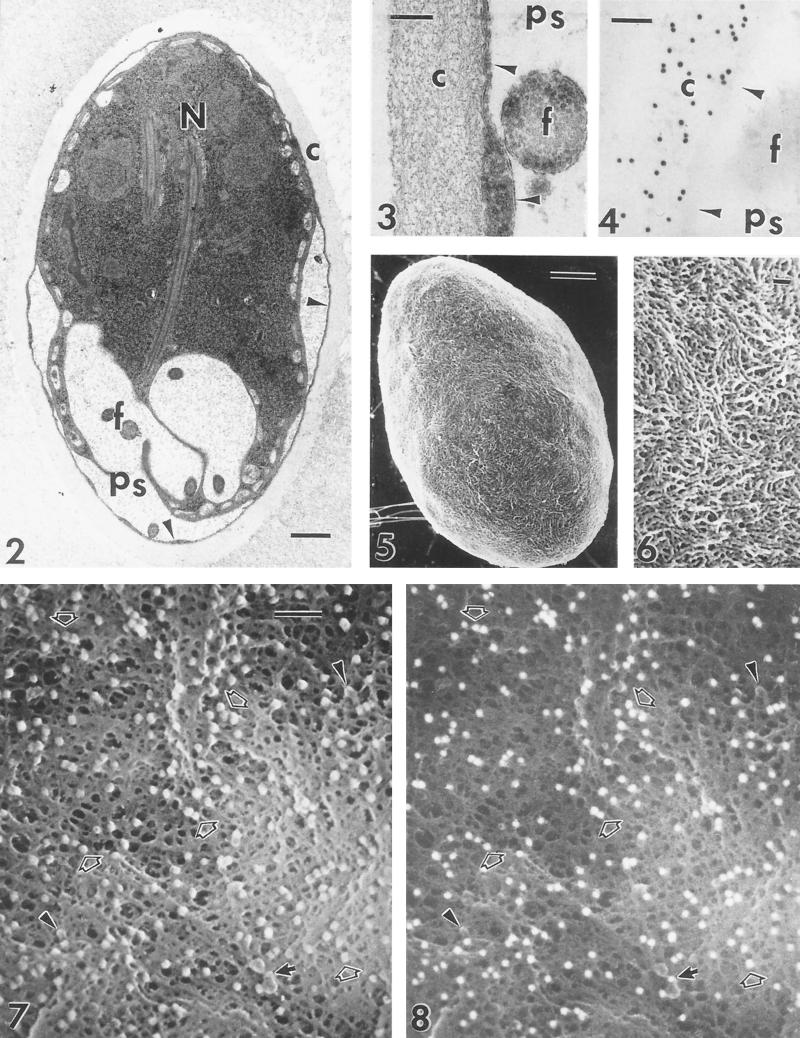
Transmission electron micrograph of a G. muris cyst fixed in the presence of 1% bovine serum albumin. The cyst wall is composed of filamentous (c) and membranous (arrowheads) portions and is separated from the cytoplasm of the trophozoite by the peritrophic space (ps). N, nucleus; f, flagellum. Original magnification, ×16,000. Bar, 0.5 μm. Reprinted from reference with permission of the publisher.
FIG. 9
FIG. 9
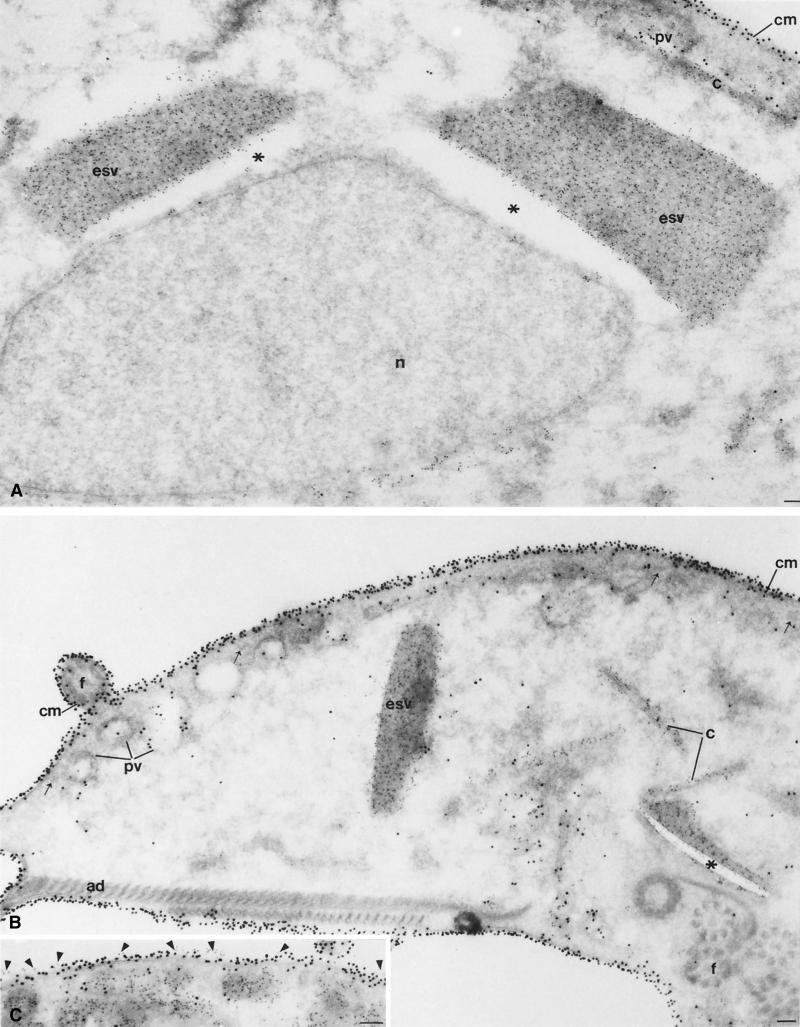
(A to C) Ultrathin cryosections of 15-h encysting cells, doubly immunolabeled with 8C5 (5-nm Au) and TSA 417 (10-nm Au). (A) 8C5 is localized to large encystation specific vesicles (esv), membrane cisternae (c), nuclear envelope, and peripheral vacuoles (pv) and is absent from the cell surface. TSA 417 is found in cisternae, peripheral vacuoles, and cell membrane (cm). The displacement of the ESV from the perinuclear cisternae is probably due to a sectioning artifact. (B and C) At 15 h, TSA 417 still dominates the cell surface and is also present in the peripheral vacuoles and cisternae. 8C5 is concentrated in the ESV, peripheral vacuoles, and cisternae and is just beginning to appear on the cell surface (arrowheads). Note that the external flagellum (f) cell is covered with membrane and TSA 417. Bars, 0.1 μm. Reprinted from reference with permission of the publisher.
FIG. 10
FIG. 10
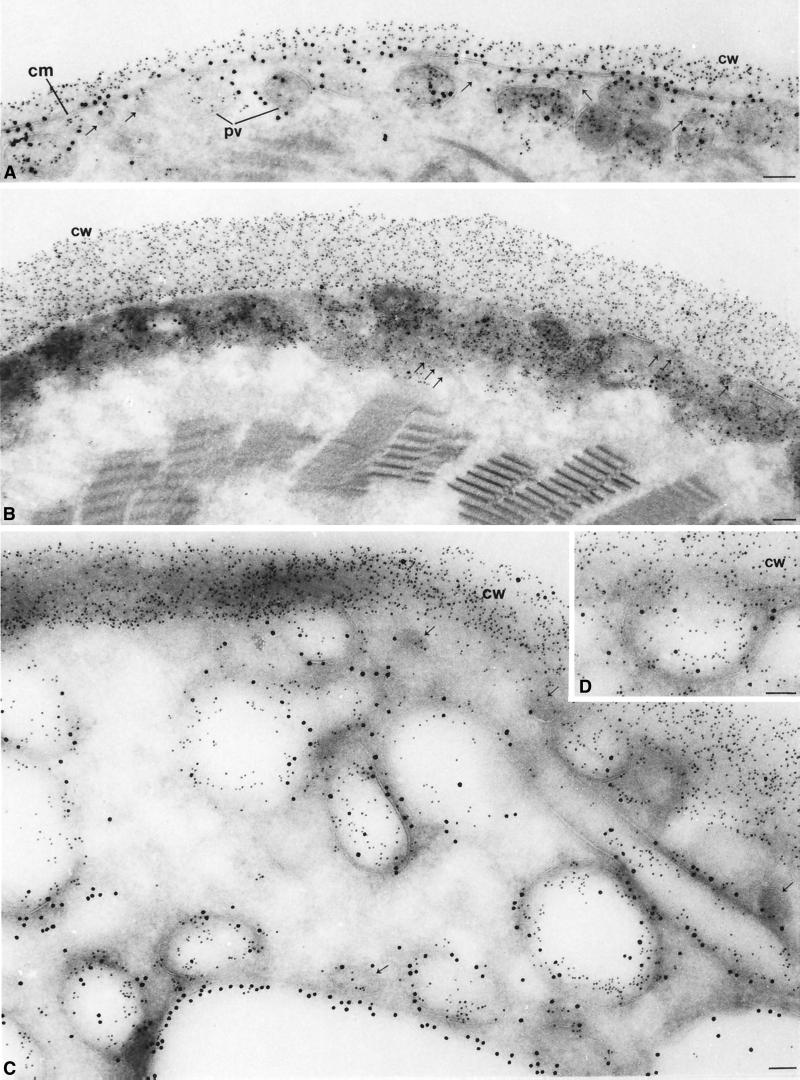
Ultrathin cryosections of 24-, 48-, and 66-h cysts, doubly labeled for 8C5 (5-nm Au) and TSA 417 (10-nm Au). (A) In many 24-h encysting cells, 8C5 is localized to the cyst wall (cw), which has been deposited over the cell membrane (cm), which is decorated with TSA 417. 8C5 and TSA are both found in peripheral vacuoles (pv). The amount of TSA 417 on the cell membrane seems somewhat reduced. (B) In 48-h cysts, the cyst wall (cw) containing 8C5 has markedly increased in thickness and TSA 417 is completely absent from the cell membrane (cm). Note the small transport vesicles (small arrows). (C and D) In 66-h water-resistant cysts, TSA 417 is localized exclusively to the peripheral vacuoles and large internal vesicles and vacuoles, resembling the endosomal and prelysosomal compartments of higher eukaryotes. 8C5 is also present in many of these vesicles. Bars, 0.1 μm. Reprinted from reference with permission of the publisher.

References

    1. Abdul Amid M Y, Mailed K M, Kamal A M, Mentally D M, Abab M E. Serodiagnosis of giardiasis by counterimmunoelectrophoresis and indirect immunofluorescence tests. J Egypt Soc Parasitol. 1993;23:603–608. - PubMed
    1. Adam R D, Yang Y M, Nash T E. The cysteine-rich protein gene family of Giardia lamblia: loss of the CPR170 gene in an antigenic variant. Mol Cell Biol. 1992;12:1194–1201. - PMC - PubMed
    1. Adam R D, Aggarwal A, Lal A A, de la Cruz V F, McCutchan T, Nash T E. Antigenic variation of a cysteine-rich protein in Giardia lamblia. J Exp Med. 1988;167:109–118. - PMC - PubMed
    1. Adam R D. The biology of Giardia spp. Microbiol Rev. 1991;55:706–732. - PMC - PubMed
    1. Addiss D G, Mathews H M, Stewart J M, Wahlquist S P, Williams R M, Finton R J, Spencer H C, Juranek D D. Evaluation of a commercially available enzyme-linked immunosorbent assay for Giardia lamblia antigen in stool. J Clin Microbiol. 1991;29:1137–1142. - PMC - PubMed

Publication types

Substances