


Repeat transduction in the mouse lung by using adeno-associated virus vectors with different serotypes
- PMID: 10627564
- PMCID: PMC111488
- DOI: 10.1128/jvi.74.3.1524-1532.2000
Repeat transduction in the mouse lung by using adeno-associated virus vectors with different serotypes
Abstract
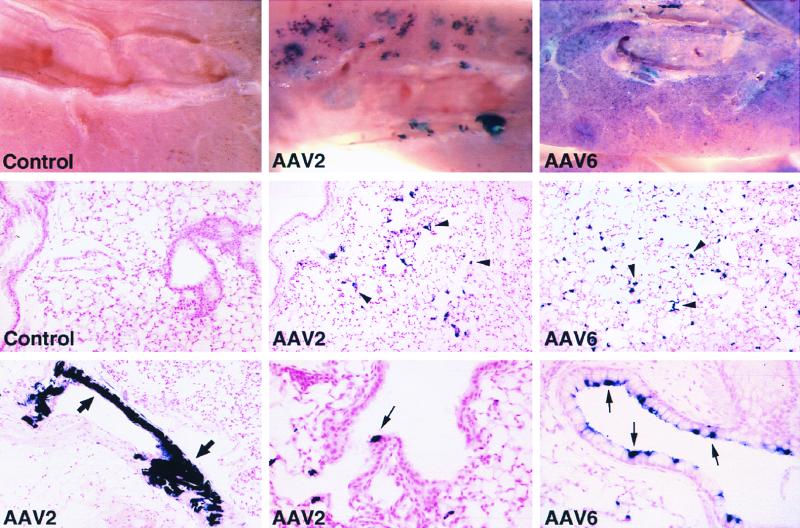
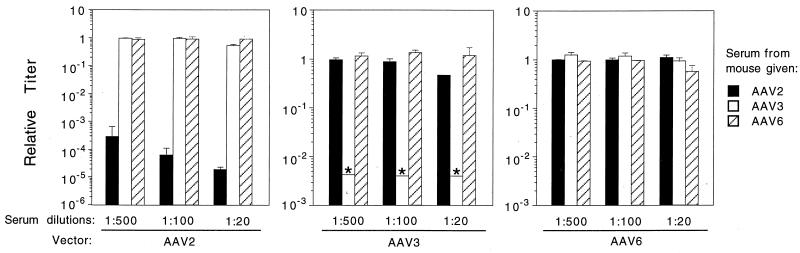
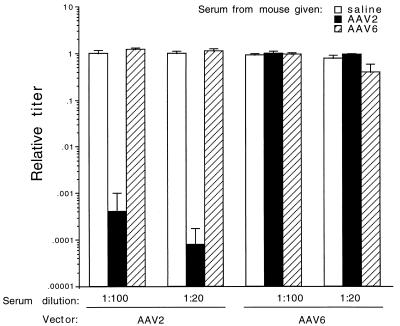
Vectors derived from adeno-associated virus type 2 (AAV2) promote gene transfer and expression in the lung; however, we have found that while gene expression can persist for at least 8 months in mice, it was reduced dramatically in rabbits over a period of 2 months. The efficiency and persistence of AAV2-mediated gene expression in the human lung have yet to be determined, but it seems likely that readministration will be necessary over the lifetime of an individual. Unfortunately, we have found that transduction by a second administration of an AAV2 vector is blocked, presumably due to neutralizing antibodies generated in response to the primary vector exposure. Here, we have explored the use of AAV2 vectors pseudotyped with capsid proteins from AAV serotypes 2, 3, and 6 for readministration in the mouse lung. We found that an AAV6 vector transduced airway epithelial and alveolar cells in the lung at rates that were at least as high as those of AAV2 pseudotype vectors, while transduction rates mediated by AAV3 were much lower. AAV6 pseudotype vector transduction was unaffected by prior administration of an AAV2 or AAV3 vector, and transduction by an AAV2 pseudotype vector was unaffected by prior AAV6 vector administration, showing that cross-reactive neutralizing antibodies against AAV2 and AAV6 are not generated in mice. Interestingly, while prior administration of an AAV2 vector completely blocked transduction by a second AAV2 pseudotype vector, prior administration of an AAV6 vector only partially inhibited transduction by a second administration of an AAV6 pseudotype vector. Analysis of sera obtained from mice and humans showed that AAV6 is less immunogenic than AAV2, which helps explain this finding. These results support the development of AAV6 vectors for lung gene therapy both alone and in combination with AAV2 vectors.
Figures
References
-
- Bantel-Schaal U, zur Hausen H. Characterization of the DNA of a defective human parvovirus isolated from a genital site. Virology. 1984;134:52–63. - PubMed
-
- Bar D, Tubb J, Ferguson D, Scaria A, Lieber A, Wilson C, Perkins J, Kay M A. Strain related variation in adenovirally mediated transgene expression from mouse hepatocytes in vivo: comparisons between immunocompetent and immunodeficient inbred strains. Gene Ther. 1995;2:151–155. - PubMed
-
- Blacklow N R, Hoggan M D, Kapikian A Z, Austin J B, Rowe W P. Epidemiology of adenovirus-associated virus infection in a nursery population. Am J Epidemiol. 1968;88:363–378. - PubMed
-
- Blacklow N R, Hoggan M D, Rowe W P. Serologic evidence for human infection with adenovirus-associated viruses. J Natl Cancer Inst. 1968;40:319–327. - PubMed
Publication types
MeSH terms
Substances
Grants and funding
LinkOut - more resources
Full Text Sources
Other Literature Sources
