


RIM101-dependent and-independent pathways govern pH responses in Candida albicans
- PMID: 10629054
- PMCID: PMC85214
- DOI: 10.1128/MCB.20.3.971-978.2000
RIM101-dependent and-independent pathways govern pH responses in Candida albicans
Abstract
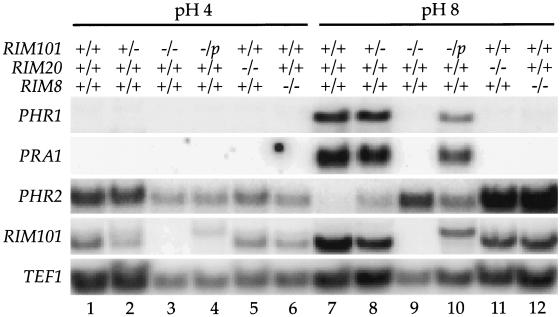
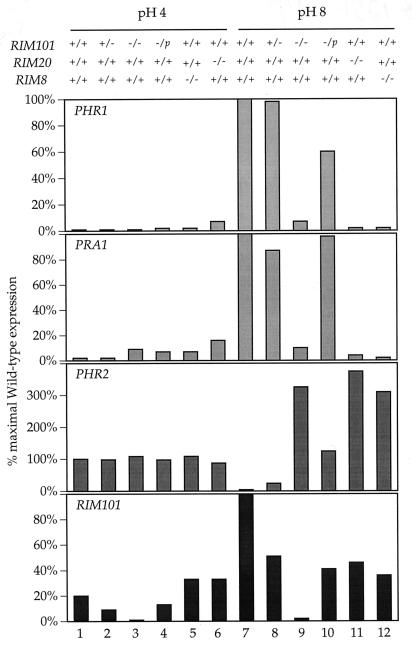
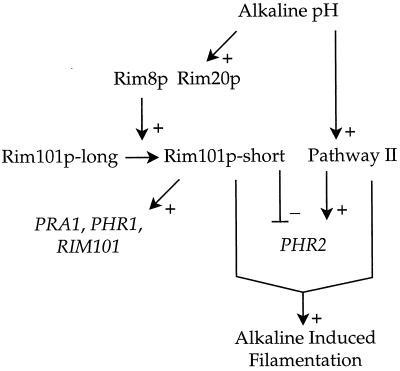
Growth and differentiation of Candida albicans over a broad pH range underlie its ability to infect an array of tissues in susceptible hosts. We identified C. albicans RIM101, RIM20, and RIM8 based on their homology to components of the one known fungal pH response pathway. PCR product-disruption mutations in each gene cause defects in three responses to alkaline pH: filamentation, induction of PRA1 and PHR1, and repression of PHR2. We find that RIM101 itself is an alkaline-induced gene that also depends on Rim20p and Rim8p for induction. Two observations indicate that a novel pH response pathway also exists. First, PHR2 becomes an alkaline-induced gene in the absence of Rim101p, Rim20p, or Rim8p. Second, we created strains in which Rim101p activity is independent of Rim20p and Rim8p; in these strains, filamentation remains pH dependent. Thus, pH governs gene expression and cellular differentiation in C. albicans through both RIM101-dependent and RIM101-independent pathways.
Figures
References
-
- Adams A, Gotschling D E, Kaiser C A, Stearns T. Methods in yeast genetics. Plainview, N.Y: Cold Spring Harbor Laboratory Press; 1997.
-
- Bogengruber E, Eichberger T, Briza P, Dawes I W, Breitenbach M, Schricker R. Sporulation-specific expression of the yeast DIT1/DIT2 promoter is controlled by a newly identified repressor element and the short form of Rim101p. Eur J Biochem. 1998;258:430–436. - PubMed
-
- Braun B R, Johnson A D. Control of filament formation in Candida albicans by the transcriptional repressor TUP1. Science. 1997;277:105–109. - PubMed
-
- Denison S H, Negret-Urtasun S, Mingot J M, Tilburn J, Mayer W A, Goel A, Espeso E A, Penalva M A, Arnst H N. Putative membrane components of signal transduction pathways for ambient pH regulation in Aspergillus and meiosis in Saccharomyces are homologous. Mol Microbiol. 1998;30:259–264. - PubMed
Publication types
MeSH terms
Substances
Grants and funding
LinkOut - more resources
Full Text Sources
Molecular Biology Databases
