. 2000 Jan;122(1):169-80.
doi: 10.1104/pp.122.1.169.

Identification of BFN1, a bifunctional nuclease induced during leaf and stem senescence in Arabidopsis

Affiliations

Identification of BFN1, a bifunctional nuclease induced during leaf and stem senescence in Arabidopsis

M A Pérez-Amador et al. Plant Physiol. 2000 Jan.

Abstract

Nuclease I enzymes are responsible for the degradation of RNA and single-stranded DNA during several plant growth and developmental processes, including senescence. However, in the case of senescence the corresponding genes have not been reported. We describe the identification and characterization of BFN1 of Arabidopsis, and demonstrate that it is a senescence-associated nuclease I gene. BFN1 nuclease shows high similarity to the sequence of a barley nuclease induced during germination and a zinnia (Zinnia elegans) nuclease induced during xylogenesis. In transgenic plants overexpressing the BFN1 cDNA, a nuclease activity of about 38 kD was detected on both RNase and DNase activity gels. Levels of BFN1 mRNA were extremely low or undetectable in roots, leaves, and stems. In contrast, relatively high BFN1 mRNA levels were detected in flowers and during leaf and stem senescence. BFN1 nuclease activity was also induced during leaf and stem senescence. The strong response of the BFN1 gene to senescence indicated that it would be an excellent tool with which to study the mechanisms of senescence induction, as well as the role of the BFN1 enzyme in senescence using reverse genetic approaches in Arabidopsis.


Figures
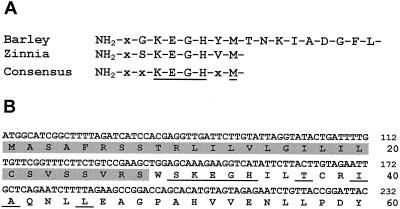
Figure 1
Figure 1
A, Known peptide sequences used to clone BFN1. N-terminal sequences determined via peptide microsequencing of barley and zinnia nuclease I proteins are shown (Brown and Ho, 1986, 1987; Thelen and Northcote, 1989). Sequences were aligned and a consensus sequence was determined. B, Nucleotide and peptide sequence corresponding to the first 60 amino acid residues of Arabidopsis BFN1. The putative signal peptide (28 amino acids) is shaded. Amino acid residues identical to barley and/or zinnia nucleases are underlined.
Figure 2
Figure 2
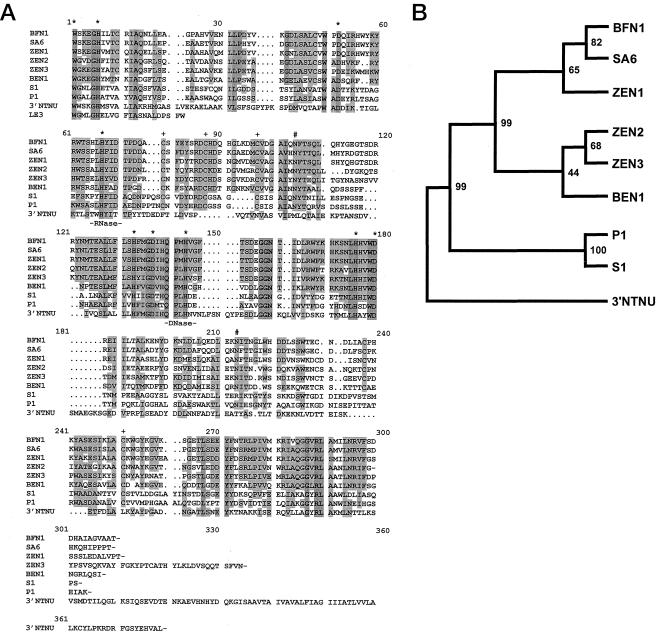
Alignment of the deduced amino acid sequences of nuclease I enzymes. A, Nuclease BFN1 from Arabidopsis (accession no. U90264) and ZEN2 and ZEN3 (accession nos. U90265, and U90266, respectively) from zinnia, are compared with the deduced amino acid sequences from nuclease SA6 from daylily (accession no. AF082031), nuclease ZEN1 from zinnia (accession no. AB003131) (Aoyagi et al., 1998), nuclease BEN1 from barley (accession no. D83178) (Aoyagi et al., 1998), nuclease S1 from A. oryzae (accession no. P24021) (Iwamatsu et al., 1991), nuclease P1 from P. citrinum (accession no. P24289) (Maekawa et al., 1991), 3′nucleotidase/nuclease (3′NTNU) from L. donovani (accession no. L35078) (Debrabant et al., 1995), and the N-terminal amino acid sequence of nuclease LE3 from L. edodes (accession no. PC4030) (Kobayashi et al., 1995). Sequences were aligned using the PileUp program (Genetics Computer Group) with default settings. Dark gray shading, Residues that are identical in all sequences; light gray shading, residues that are functionally identical (A,S,T; N,Q; D,E; I,L,M,V; H,K,R; and F,W,Y) in at least five of the nine full-length sequences; periods, gaps introduced to produce the alignment; asterisks (*), residues involved in the binding of zinc atoms in nuclease P1; plus signs (+), residues involved in forming disulfide bonds in nuclease P1; number symbols (#), structurally important glycosylation sites in nuclease P1. Active sites for RNase and DNase activities in nucleases P1 and S1 are also indicated under the alignment. Not shown are putative signal peptides of BFN1, SA6, ZEN1, ZEN2, ZEN3, and BEN1, and the first 125 amino acid residues of the 3′NTNU. B, Gene genealogy of the nuclease I family. The consensus tree was generated with the PROTDIST and NIGHBOR programs of the Phylogeny Inference Package using 2,000 bootstrapped data sets. Numbers in branches are bootstrap values and indicate the percentage of trees in which the proteins in the branch cluster together. Designations for each nuclease are as in Figure 2A.
Figure 3
Figure 3
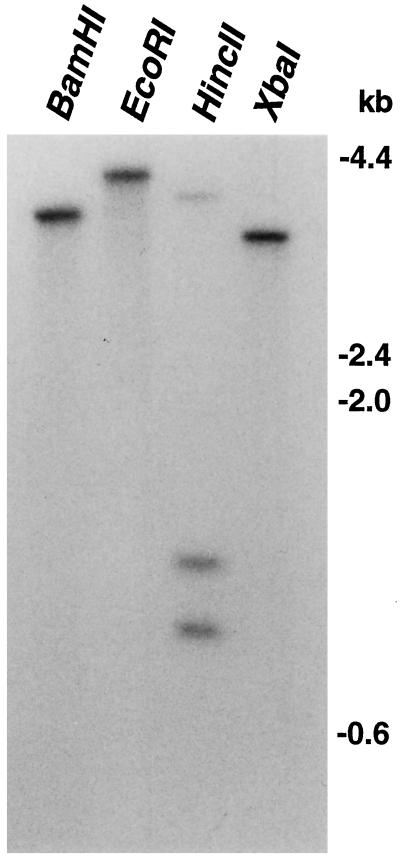
Genomic DNA gel-blot analysis of the BFN1 gene. Genomic DNA (20 μg per lane) from Arabidopsis was digested with BamHI, EcoRI, HincII, or XbaI, electrophoresed in agarose gels, blotted, and probe with 32P-labeled BFN1 cDNA. DNA marker sizes are indicated on the right (in kb).
Figure 4
Figure 4
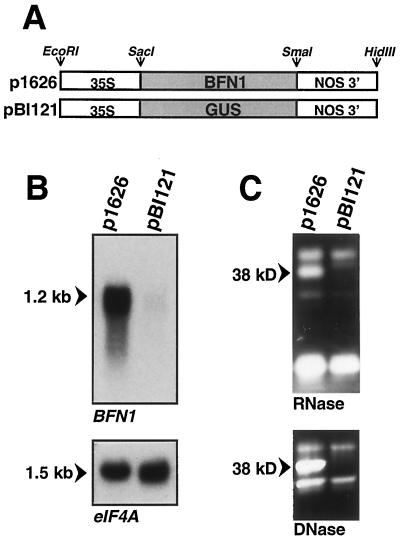
Overexpression of the BFN1 cDNA in Arabidopsis. A, BFN1 expression construct and GUS control construct in plant transformation vectors p1626 and pBI121, respectively. 35S, 35S promoter from cauliflower mosaic virus; NOS 3′, 3′-UTR from the nopaline synthase gene. B, RNA gel-blot analysis. Total RNA (10 μg) from T2 plants transformed with p1626 (BFN1) or pBI121 (control) was hybridized sequentially with 32P-labeled BFN1 (top) and Arabidopsis translation initiation factor eIF4A (bottom). Transcript size is indicated. C, RNase (top) and DNase (bottom) activity gels. Lanes contain protein extracts (100 μg) from T2 plants transformed with p1626 or pBI121. Enzyme activities that degrade the RNA or single-stranded DNA substrate in the gel appear as clear bands on a dark background.
Figure 5
Figure 5
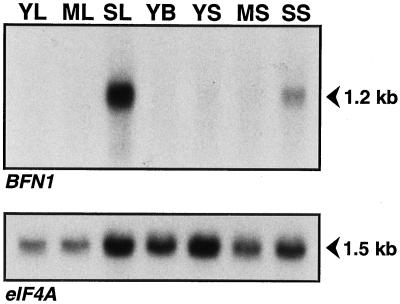
RNA gel-blot analysis of BFN1 expression during leaf and stem growth and senescence. Lanes contain 10 μg of total RNA extracted from young leaves (YL), mature green leaves (ML), senescent leaves (SL), young bolts (stems 1–3 cm long) (YB), young stems (4–6 cm long) (YS), mature stems (MS), and senescent stems (SS) of Arabidopsis. The blot was hybridized sequentially with 32P-labeled BFN1 (top) and eIF4A (bottom).
Figure 6
Figure 6
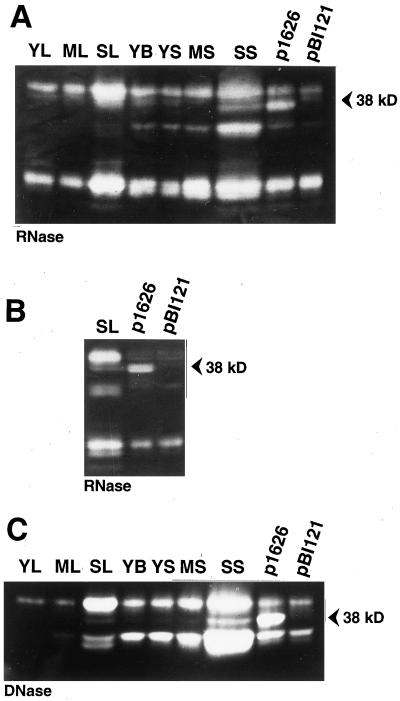
Examination of RNase and DNase activities during leaf and stem growth and senescence. Protein extracts from leaves and stems of wild-type plants at the same stages as in Figure 5 are compared. Protein extracts from transgenic T2 plants transformed with the control plasmid pBI121 or the BFN1 overexpression construct p1626 are also shown. A, RNase activity gel with 100 μg of total protein per lane. B, RNase activity gel with 40 μg of total protein per lane. C, DNase activity gel with 100 μg of total protein per lane. Abbreviations are as in Figure 5.
Figure 7
Figure 7
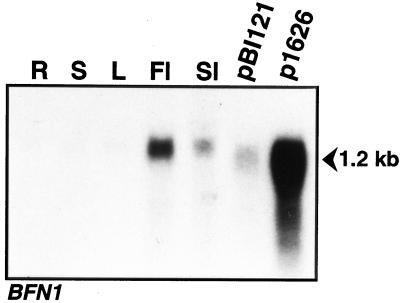
BFN1 expression in organs of Arabidopsis. Total RNA (10 μg) from roots (R), stems (S), leaves (L), flowers (Fl), and green siliques (Sl) of wild-type plants and from seedlings transgenic for pBI121 or p1626 were subjected to RNA gel-blot analysis. The blot was hybridized with 32P-labeled BFN1.

References

    1. Altschul SF, Madden TL, Schaffer AA, Zhang J, Zhang Z, Miller W, Lipman DJ. Gapped BLAST and PSI-BLAST: a new generation of protein database search programs. Nucleic Acids Res. 1997;25:3389–3402. - PMC - PubMed
    1. Aoyagi S, Sugiyama M, Fukuda H. BEN1 and ZEN1 cDNAs encoding S1-type DNase that are associated with programmed cell death in plants. FEBS Lett. 1998;429:134–138. - PubMed
    1. Bariola P, Green PJ. Plant ribonucleases. In: D'Alessio G, Riordan JF, editors. Ribonucleases: Structure and Function. New York: Academic Press; 1997. pp. 163–190.
    1. Bariola P, Howard CJ, Taylor CB, Verburg MT, Jaglan VD, Green PJ. The Arabidopsis ribonuclease gene RNS1 is tightly controlled in response to phosphate limitation. Plant J. 1994;6:673–685. - PubMed
    1. Bar-Peled M, Bassham CD, Raikhel NV. Transport of proteins in eukaryotic cells: more questions ahead. Plant Mol Biol. 1996;32:223–249. - PubMed

Publication types

MeSH terms

Associated data