. 2000 Feb;182(3):581-8.
doi: 10.1128/JB.182.3.581-588.2000.

Ralstonia eutropha TF93 is blocked in tat-mediated protein export

Affiliations

Ralstonia eutropha TF93 is blocked in tat-mediated protein export

M Bernhard et al. J Bacteriol. 2000 Feb.

Abstract

Ralstonia eutropha (formerly Alcaligenes eutrophus) TF93 is pleiotropically affected in the translocation of redox enzymes synthesized with an N-terminal signal peptide bearing a twin arginine (S/T-R-R-X-F-L-K) motif. Immunoblot analyses showed that the catalytic subunits of the membrane-bound [NiFe] hydrogenase (MBH) and the molybdenum cofactor-binding periplasmic nitrate reductase (Nap) are mislocalized to the cytoplasm and to the inner membrane, respectively. Moreover, physiological studies showed that the copper-containing nitrous oxide reductase (NosZ) was also not translocated to the periplasm in strain TF93. The cellular localization of enzymes exported by the general secretion system was unaffected. The translocation-arrested MBH and Nap proteins were enzymatically active, suggesting that twin-arginine signal peptide-dependent redox enzymes may have their cofactors inserted prior to transmembrane export. The periplasmic destination of MBH, Nap, and NosZ was restored by heterologous expression of Azotobacter chroococcum tatA mobilized into TF93. tatA encodes a bacterial Hcf106-like protein, a component of a novel protein transport system that has been characterized in thylakoids and shown to translocate folded proteins across the membrane.


Figures
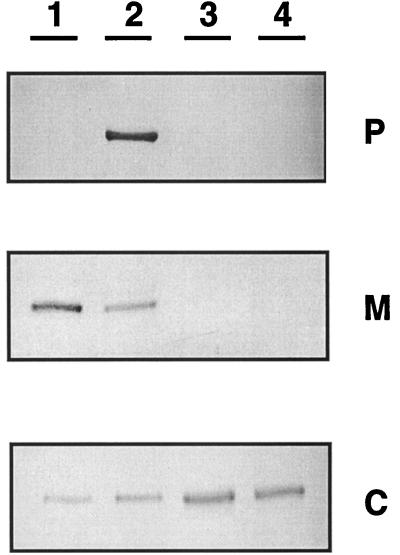
FIG. 1
FIG. 1
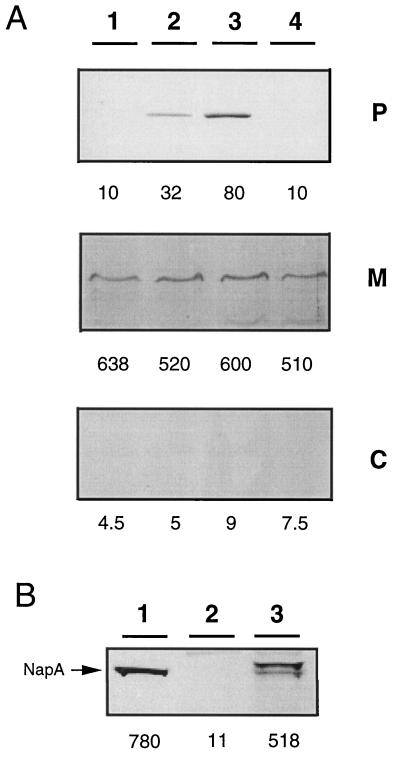
Cellular localization of the [NiFe] center-bearing subunit (HoxG) of MBH in strains of R. eutropha. Equal amounts of protein (25 μg) were loaded onto the gel except for the periplasmic fractions (100 μl each), because they contained high concentrations of lysozyme protein. The subcellular fractions are indicated: P, periplasm; M, membrane; C, cytoplasm. The strains tested are as follows: lane 1, H16 (harboring pHG1); lane 2, HF405, carrying ΔhoxZ in pHG1; lane 3, TF93 (harboring pHG2); lane 4, TF140 (harboring pHG1).
FIG. 2
FIG. 2
Mislocalization of NapA in TF140 and restoration of NapA export by tat genes (A) and specificity of the NapA detection system (B). The subcellular fractions are indicated: P, periplasm; M, membrane; C, cytoplasm. Nap activity (milliunits per milligram of protein) is given below the immunoblot. Note, the Nap activity in the periplasm is given as milliunits per gram (wet weight) of cells. (A) Lane 1, TF140; lane 2, TF140 harboring tatAB on pGE600; lane 3, TF140 harboring tatA on pGE601; lane 4, TF140 harboring tatB on pGE602. (B) Lane 1, partially purified NapA (arrow); lane 2, membrane of TF100 cells; lane 3, membrane of TF100 cells harboring the complete nap genes on pGE144 (35).
FIG. 3
FIG. 3
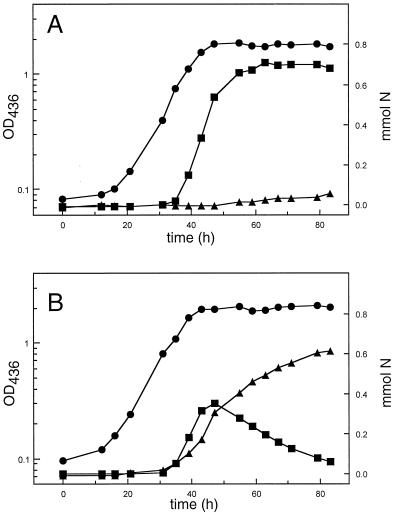
Blocked nitrous oxide reduction in R. eutropha TF140 (A), which was restored by the expression of A. chroococcum tatA on pGE601 (B). Growth was performed anaerobically on fructose containing 10 mM nitrate, and the gaseous denitrification products were monitored by gas chromatography. ●, growth of R. eutropha culture at 436 nm; ■, nitrous oxide; ▴, dinitrogen. OD, optical density.
FIG. 4
FIG. 4
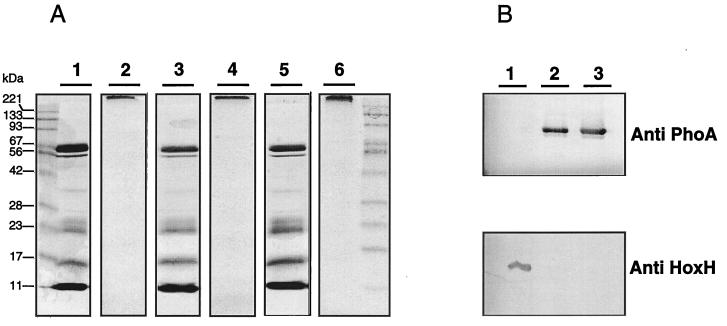
Periplasmic c-type cytochromes (A) and export of heterologously expressed E. coli PhoA to the periplasm (B) in R. eutropha strains. (A) Cytochrome c was visualized by heme staining of periplasmic (lanes 1, 3, and 5) and cytoplasmic (lanes 2, 4, and 6; loaded with 100 μg of protein each) fractions of TF140 cells grown anaerobically on nitrate. The proteins were separated on SDS–15% (vol/vol) polyacrylamide gels. Lanes 1 and 2, TF140; lanes 3 and 4, TF140 harboring tatAB on pGE600; lanes 5 and 6, TF140 harboring tatA on pGE601. Prestained protein markers are on the left and right of the stain. The nature of the staining at the border of the stacking and the running gel in the cytoplasmic fractions (lanes 2, 4, and 6) is unclear. (B) Immunoblot analysis of the periplasmic fractions of autotrophically grown R. eutropha strains with antiserum directed against E. coli PhoA (upper panel) and a purity control with antiserum raised against the SH protein (anti-HoxH) as a cytoplasmic marker (4) (lower panel). Lane 1, 1 μg of purified SH; lane 2, periplasm of TF140 expressing a copy of E. coli phoA on pGE603; lane 3, periplasm of H16 derivative (HF405) expressing a copy of E. coli phoA on pGE603.
FIG. 5
FIG. 5
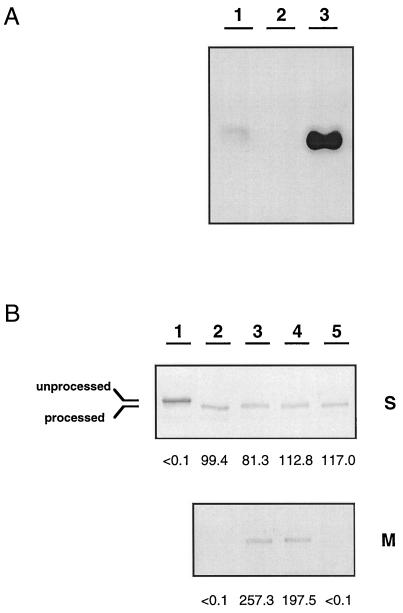
In-gel detection of MBH-dependent hydrogenase activity in the cytoplasmic fraction of TF140 (A) and the restoration of MBH targeting to the membrane by tat genes (B). (A) Lane 1, H16; lane 2, HF359, defective in the [NiFe]-containing subunit of MBH (ΔhoxG in pHG1); lane 3, TF140. (B) Analysis of restoration of MBH translocation was carried out by immunoblot analysis. S, the soluble extract consisting of the periplasmic and cytoplasmic fractions; M, the membrane fraction. MBH activity (milliunits per milligram of protein) is given below the blot. Lane 1, HF345, defective in the MBH-specific protease (ΔhoxM in pHG1); lane 2, TF140; lane 3, TF140 with tatAB (pGE600); lane 4, TF140 with tatA (pGE601); lane 5, TF140 with tatB (pGE602).
FIG. 6
FIG. 6
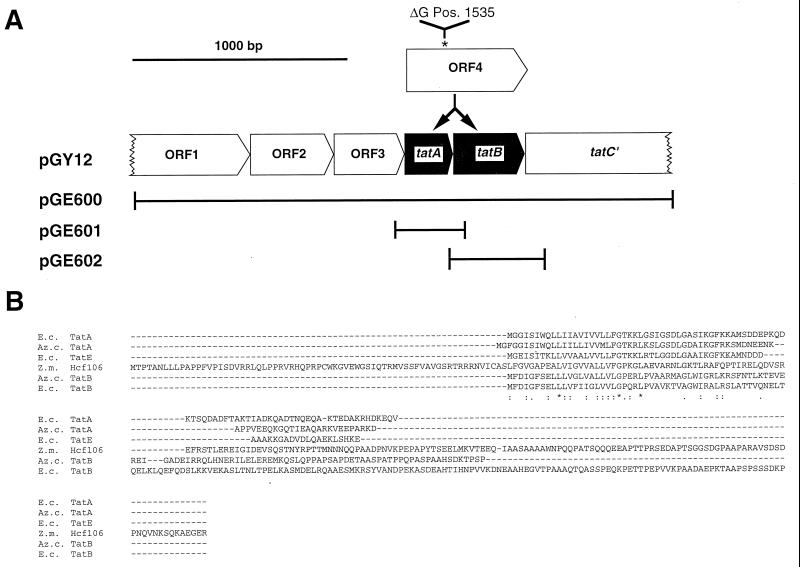
The tat locus on pGY12 of A. chroococcum according to GenBank accession no. ACU48404, with the nucleotide sequence correction. (A) The newly annotated genes are in black. The fragments used for complementation analysis are shown below with bars, and the corresponding plasmid designations are given at the left. (B) Alignment of the deduced A. chroococcum TatA and TatB amino acid sequences, with Hcf106 and Hcf106 analogs from E. coli. Az. c., A. chroococcum; E. c., E. coli; Z. m., Zea mays. Perfect matches are indicated by asterisks and high and low similarities are indicated by double and single dots, respectively.

References

    1. Bedzyk L, Wang T, Ye R W. The periplasmic nitrate reductase in Pseudomonas sp. strain G-179 catalyzes the first step of denitrification. J Bacteriol. 1999;181:2802–2806. - PMC - PubMed
    1. Berks B C. A common export pathway for proteins binding complex redox cofactors? Mol Microbiol. 1996;22:393–404. - PubMed
    1. Bernhard M, Schwartz E, Rietdorf J, Friedrich B. The Alcaligenes eutrophus membrane-bound hydrogenase gene locus encodes functions involved in maturation and electron transport coupling. J Bacteriol. 1996;178:4522–4529. - PMC - PubMed
    1. Bernhard M, Benelli B, Hochkoeppler A, Zannoni D, Friedrich B. Functional and structural role of the cytochrome b subunit of the membrane-bound hydrogenase complex of Alcaligenes eutrophus H16. Eur J Biochem. 1997;248:179–186. - PubMed
    1. Bogsch E, Brink S, Robinson C. Pathway specificity for a ΔpH-dependent precursor thylakoid lumen protein is governed by a ‘Sec-avoidance’ motif in the transfer peptide and a ‘Sec-incompatible’ mature protein. EMBO J. 1997;16:3851–3859. - PMC - PubMed

Publication types

MeSH terms

LinkOut - more resources