. 2000 Jan;11(1):277-86.
doi: 10.1091/mbc.11.1.277.

The N terminus of the transmembrane protein BP180 interacts with the N-terminal domain of BP230, thereby mediating keratin cytoskeleton anchorage to the cell surface at the site of the hemidesmosome

Affiliations
Free PMC article

The N terminus of the transmembrane protein BP180 interacts with the N-terminal domain of BP230, thereby mediating keratin cytoskeleton anchorage to the cell surface at the site of the hemidesmosome

S B Hopkinson et al. Mol Biol Cell. 2000 Jan.
Free PMC article

Abstract

In epidermal cells, the keratin cytoskeleton interacts with the elements in the basement membrane via a multimolecular junction called the hemidesmosome. A major component of the hemidesmosome plaque is the 230-kDa bullous pemphigoid autoantigen (BP230/BPAG1), which connects directly to the keratin-containing intermediate filaments of the cytoskeleton via its C terminus. A second bullous pemphigoid antigen of 180 kDa (BP180/BPAG2) is a type II transmembrane component of the hemidesmosome. Using yeast two-hybrid technology and recombinant proteins, we show that an N-terminal fragment of BP230 can bind directly to an N-terminal fragment of BP180. We have also explored the consequences of expression of the BP230 N terminus in 804G cells that assemble hemidesmosomes in vitro. Unexpectedly, this fragment disrupts the distribution of BP180 in transfected cells but has no apparent impact on the organization of endogenous BP230 and alpha6beta4 integrin. We propose that the BP230 N terminus competes with endogenous BP230 protein for BP180 binding and inhibits incorporation of BP180 into the cell surface at the site of the hemidesmosome. These data provide new insight into those interactions of the molecules of the hemidesmosome that are necessary for its function in integrating epithelial and connective tissue types.


Figures
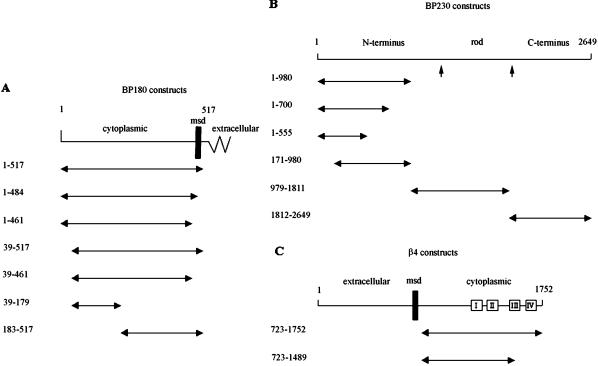
Figure 1
Figure 1
Scheme of the protein fragments encoded by cDNAs that are used in yeast two-hybrid, recombinant protein, and transfection assays. The amino acid residue numbers of each fragment are displayed along the left, and a double-ended arrow depicts the location of each within the hemidesmosome molecule under assay. (A) BP180 is shown minus most of its large extracellular domain. The cytoplasmic and membrane-spanning domains (msd) and a small region of the extracellular domain are marked. (B) Arrowheads demarcate the boundaries of the N terminus, rod, and C terminus (keratin-binding domain) of BP230. (C) The complete β4 protein is shown. Boxes represent its four fibronectin type III repeats (I–IV). The extracellular, membrane-spanning (msd), and cytoplasmic domains are marked.
Figure 2
Figure 2
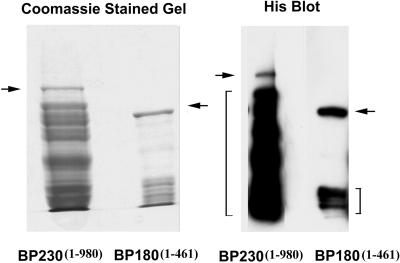
Purification of recombinant BP180 and BP230 fragments. cDNAs encoding the entire cytoplasmic region of BP180 (residues 1–461) and the N terminus of BP230 (residues 1–980 with an HA epitope tag at the N terminus) were cloned into expression vectors that also contained sequences for a 6X His tag. Both fragments were expressed in bacteria and purified from bacterial extracts over His-Bind resin (Novagen). An aliquot of each purified protein was diluted in sample buffer and examined by SDS-PAGE. One such gel was stained with Coomassie to visualize the isolated polypeptides, as indicated. Arrows mark the BP180 fragment of 75 kDa and the BP230 protein fragment of 110 kDa. There are several other lower-molecular-mass polypeptides in both preparations that copurify with the BP180 and BP230 fragments (brackets). These appear to be proteolytic breakdown products because they are recognized by the His probe.
Figure 3
Figure 3
Immunoprecipitation assays. Approximately 1 μg each of the purified BP180 and HA-tagged BP230 fragments shown in Figure 2 were incubated either together or separately in a 10 mM Tris buffer with 0.1% Tween-20 at 4°C for 2 h. A polyclonal antibody directed against the BP180 cytoplasmic domain was added to the protein mixture for 2 h, followed by the addition of protein G–agarose beads (Life Technologies/BRL). The precipitated proteins were subjected to SDS-PAGE and transferred to nitrocellulose. The latter was either incubated in antibody HA11 directed against the HA tag or rabbit antiserum J17, which recognizes BP180 (as indicated). In lane 1, the HA antibody recognizes the BP230 recombinant polypeptide, indicating that it has been precipitated with BP180. Lanes 2 and 3 show no reactivity with this antibody. The BP180 antibody reacts with the BP180 protein fragment in lanes 1 and 3.
Figure 4
Figure 4
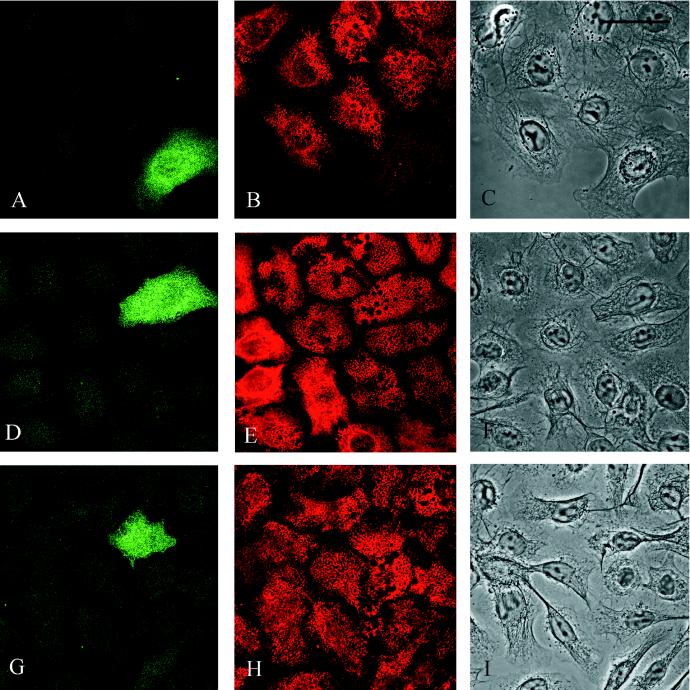
A GFP-tagged BP230 N-terminal fragment (BP230GFP1–980) was expressed in 804G cells. Expression of the transgene is shown in A, D, and G. The fragment shows a diffuse distribution throughout the cytoplasm of the transfected cells. The same transfected cell populations were processed for immunofluorescence with the use of a mAb preparation against BP180 (B), 5E mAbs against BP230 (E), and a rabbit anti-β4 integrin serum (H). BP230 and β4 in E and H show a normal punctate, basal localization in the transfected and nontransfected cells, whereas there is little obvious basal staining for BP180 in the cell expressing BP230GFP1–980 in B. It should be noted that BP180 shows a normal basal localization in cells that fail to express BP230GFP1–980 in B. Cells were viewed in a confocal microscope with the focal plane being at the site of cell–substrate interaction. C, F, and I show phase images of the cells. Bar, 25 μm.
Figure 5
Figure 5
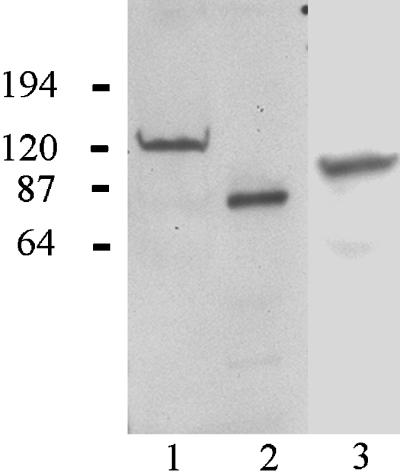
Extracts of 804G cells transfected with vectors encoding BP230GFP1–980 (lane 1), BP180GFP1–517 (lane 2), and BP230HA979–1811 (lane 3) were subjected to SDS-PAGE and then transferred to nitrocellulose. The nitrocellulose was then processed for immunoblotting with the use of either an antibody against GFP (lanes 1 and 2) or an antibody against the HA epitope tag (lane 3).
Figure 6
Figure 6
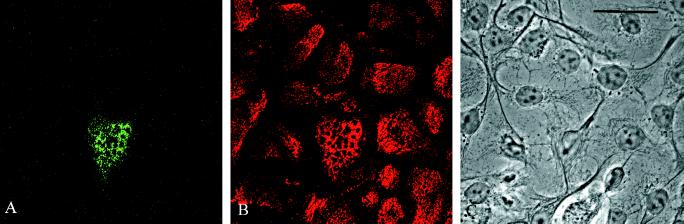
A GFP-tagged BP180 fragment (BP180GFP1–517) was expressed in 804G cells. The cells were subsequently processed for immunofluorescence microscopy with the use of 5E antibodies against BP230. Expression of the transgene is shown in A. The fragment shows a basal, punctate localization and codistributes with staining generated by the BP230 mAb probe in B. Cells were viewed in a confocal microscope with the focal plane being at the site of cell–substrate interaction. C shows a phase image of the cells. Bar, 25 μm.
Figure 7
Figure 7
An HA epitope–tagged BP230 rod domain fragment (BP230HA979–1811) was expressed in 804G cells. The cells were prepared for double-label indirect immunofluorescence microscopy with the use of HA11 antibody (A and D) in combination with either antibody 5E against BP230 (B) or a mAb against BP180 (E). The BP230HA979–1811 fragment shows a diffuse distribution throughout the cytoplasm of the transfected cells (A and D), whereas both BP180 and BP230 show a basal, punctate stain in transfected and nontransfected cells (B and E). Cells were viewed in a confocal microscope with the focal plane being at the site of cell–substrate interaction. C and F show phase images of the cells. Bar, 25 μm.

References

    1. Aho S, Uitto J. Direct interaction between the intracellular domains of bullous pemphigoid antigen 2 (BP180) and β4 integrin, hemidesmosomal components of basal keratinocytes. Biochem Biophys Res Commun. 1998;243:694–699. - PubMed
    1. Borradori L, Chavanas S, Schaapveld RQJ, Gagnoux-Placacios L, Calafat J, Meneguzzi G, Sonnenberg A. Role of the bullous pemphigoid antigen 180 (BP180) in the assembly of hemidesmosomes and cell adhesion: reexpression of BP180 in generalized atrophic benign epidermolysis bullosa keratinocytes. Exp Cell Res. 1998;239:463–476. - PubMed
    1. Borradori L, Koch PJ, Niessen CM, Erkeland S, van Leusden MR, Sonnenberg A. The localization of bullous pemphigoid antigen 180 (BP180) in hemidesmosomes is mediated by its cytoplasmic domain and seems to be regulated by the β4 integrin subunit. J Cell Biol. 1997;136:1333–1349. - PMC - PubMed
    1. Borradori L, Sonnenberg A. Structure and function of hemidesmosomes: more than simple adhesion complexes. J Invest Dermatol. 1999;112:411–418. - PubMed
    1. Chavanas S, Gache Y, Tadini G, Pulkkinen L, Uitto J, Ortonne JP, Meneguzzi G. A homozygous in-frame deletion in the collagenous domain of bullous pemphigoid antigen BP180 (type XVII collagen) causes generalized atrophic benign epidermolysis bullosa. J Invest Dermatol. 1997;109:74–78. - PubMed

Publication types