. 2000 Jan 18;97(2):599-604.
doi: 10.1073/pnas.97.2.599.

NifS-directed assembly of a transient [2Fe-2S] cluster within the NifU protein

Affiliations

NifS-directed assembly of a transient [2Fe-2S] cluster within the NifU protein

P Yuvaniyama et al. Proc Natl Acad Sci U S A. .

Abstract

The NifS and NifU proteins from Azotobacter vinelandii are required for the full activation of nitrogenase. NifS is a homodimeric cysteine desulfurase that supplies the inorganic sulfide necessary for formation of the Fe-S clusters contained within the nitrogenase component proteins. NifU has been suggested to complement NifS either by mobilizing the Fe necessary for nitrogenase Fe-S cluster formation or by providing an intermediate Fe-S cluster assembly site. As isolated, the homodimeric NifU protein contains one [2Fe-2S](2+, +) cluster per subunit, which is referred to as the permanent cluster. In this report, we show that NifU is able to interact with NifS and that a second, transient [2Fe-2S] cluster can be assembled within NifU in vitro when incubated in the presence of ferric ion, L-cysteine, and catalytic amounts of NifS. Approximately one transient [2Fe-2S] cluster is assembled per homodimer. The transient [2Fe-2S] cluster species is labile and rapidly released on reduction. We propose that transient [2Fe-2S] cluster units are formed on NifU and then released to supply the inorganic iron and sulfur necessary for maturation of the nitrogenase component proteins. The role of the permanent [2Fe-2S] clusters contained within NifU is not yet known, but they could have a redox function involving either the formation or release of transient [2Fe-2S] cluster units assembled on NifU. Because homologs to both NifU and NifS, respectively designated IscU and IscS, are found in non-nitrogen fixing organisms, it is possible that the function of NifU proposed here could represent a general mechanism for the maturation of Fe-S cluster-containing proteins.


Figures
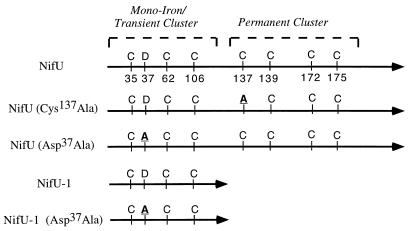
Figure 1
Figure 1
Schematic representation of NifU and different forms of NifU. The uppermost line represents full-length NifU. Above the line are indicated the cysteine (C) and aspartate (D) residues relevant to the present work. The numerical residue positions are indicated below the line. Substituting residues present in altered forms of NifU or NifU-1 are indicated by a bold, underlined letter at the appropriate position. Dashed brackets at the top of the figure indicate the respective mononuclear iron/transient [2Fe-2S] cluster domain and permanent [2Fe-2S] cluster domain within the NifU primary sequence.
Figure 2
Figure 2
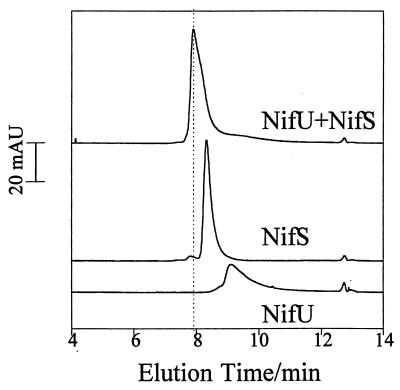
Complex formation between NifU and NifS. The figure shows the elution profiles of NifS, NifU, or an equimolar mixture of NifU and NifS, by using size exclusion chromatography. Conditions used are described in Materials and Methods.
Figure 3
Figure 3
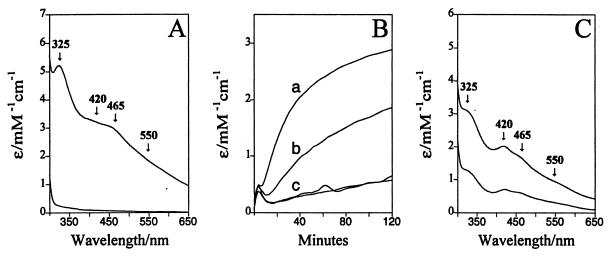
NifS-dependent in vitro Fe-S cluster assembly. (A) UV-visible spectrum of NifU-1 before in vitro Fe-S cluster assembly [before l-cysteine was added to initiate assembly (lower spectrum) and after 140 min of in vitro cluster assembly (upper spectrum)]. The postassembly spectrum shown in A is the maximum that could be obtained. (C) UV-visible spectrum of NifU-1(Asp37Ala) before in vitro cluster assembly (lower spectrum) and after 80 min of in vitro Fe-S cluster assembly (upper spectrum). The postassembly spectrum shown in C represents approximately 60% of the maximum that could be obtained. (B) Time dependence of Fe-S cluster assembly as monitored by the change in extinction coefficient at 465 nm vs. time after initiation of the Fe-S cluster assembly reaction. The time dependence for cluster assembly shown in line a of panel B corresponds to the same sample shown in panel A. Line b of panel B shows cluster assembly under the same conditions as for line a, except that half of the amount of NifS was added to the assembly cocktail. Data shown in the lines labeled c are controls. One data set corresponds to conditions that are the same as for line a except that an altered form of NifS having the active-site Cys325 residue substituted by alanine was used. The other data set in C corresponds to conditions that are the same as used for line a, except that an altered form of NifU-1 having the Cys62 residue substituted for by alanine was used. Conditions for Fe-S cluster assembly are described in Materials and Methods.
Figure 4
Figure 4
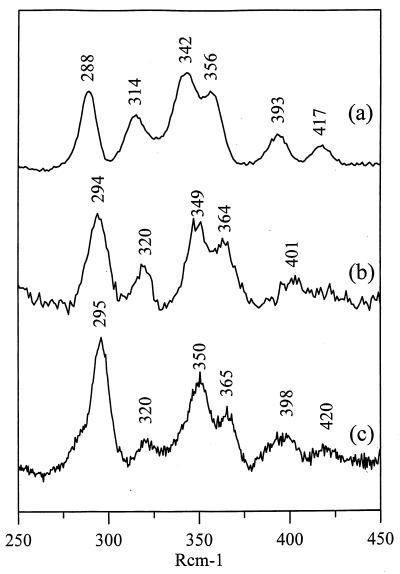
Comparison of the low-temperature resonance Raman spectra of the [2Fe-2S]2+ clusters in as-isolated NifU (a), reconstituted NifU-1 (b), and human ferrochelatase (c). All samples (2–4 mM in 100 mM Tris·HCl, pH 7.8, buffer) were in the form of concentrated frozen droplets maintained at 18 K. The spectra were recorded by using 488-nm excitation with 70-mW of laser power at the sample and are the sum of 19, 90, and 80 scans for a, b, and c, respectively. Each scan involved advancing the spectrometer in 1 cm−1 increments (0.5 cm−1 for c) and photon counting for 1 s/point with 6-cm−1 resolution.
Figure 5
Figure 5
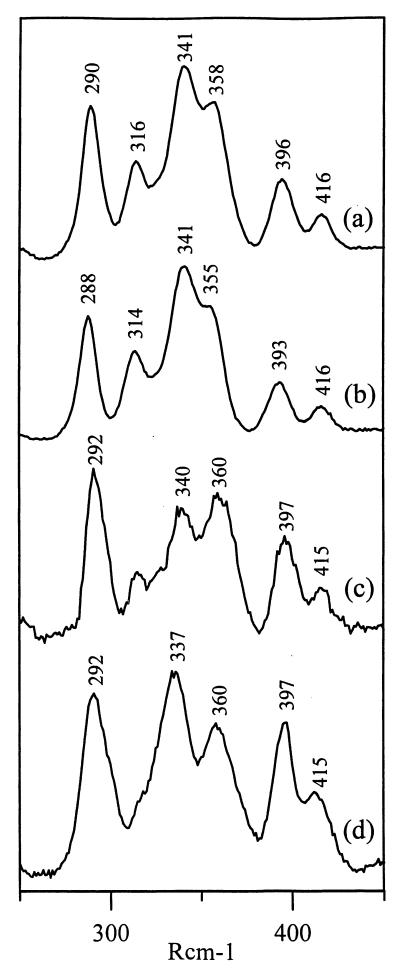
Low-temperature resonance Raman spectra of transient [2Fe-2S]2+ clusters. (a) NifU(Asp37Ala) after treatment by the cluster biosynthetic system; (b) as-isolated NifU(Asp37Ala); (c) difference spectrum (spectrum a minus spectrum b); (d) NifU-1(Asp37Ala) after treatment with the cluster biosynthetic system. The conditions used are the same as those described in Fig. 4, and each spectrum is the sum of 33 scans.

References

    1. Beinert H, Holm R H, Munck E. Science. 1997;277:653–659. - PubMed
    1. Malkin R, Rabinowitz J. Biochem Biophys Res Commun. 1966;23:822–827. - PubMed
    1. Dean D R, Bolin J T, Zheng L. J Bacteriol. 1993;175:6737–6744. - PMC - PubMed
    1. Zheng L, White R, Cash V L, Jack R F, Dean D R. Proc Natl Acad Sci USA. 1993;90:2754–2758. - PMC - PubMed
    1. Zheng L, White R H, Dean D R. Biochemistry. 1994;33:4714–4720. - PubMed

Publication types

MeSH terms