. 2000 Jan 18;97(2):734-9.
doi: 10.1073/pnas.97.2.734.

IL-18 regulates IL-1beta-dependent hepatic melanoma metastasis via vascular cell adhesion molecule-1

Affiliations

IL-18 regulates IL-1beta-dependent hepatic melanoma metastasis via vascular cell adhesion molecule-1

F Vidal-Vanaclocha et al. Proc Natl Acad Sci U S A. .

Abstract

Proinflammatory cytokines, including IL-1beta and tumor necrosis factor-alpha (TNF-alpha), promote cancer cell adhesion and liver metastases by up-regulating the expression of vascular cell adhesion molecule-1 (VCAM-1) on hepatic sinusoidal endothelium (HSE). In this study, hepatic metastasis after intrasplenically injected mouse B16 melanoma (B16M) cells was reduced 84-95% in mice with null mutations for either IL-1beta or the IL-1beta-converting enzyme (ICE, caspase-1) compared with wild-type mice. On day 12, 47% of wild-type mice were dead compared with 19% of either IL-1beta or ICE-deficient mice. In vitro, conditioned medium from B16M cells (B16M-CM) induced the release of TNF-alpha and IL-1beta from cultures of primary murine HSE. The effect of B16M-CM on HSE resulted in increased numbers of B16M cells adhering to HSE, which was completely abrogated by a specific inhibitor of ICE, anti-IL-18 or IL-18-binding protein. Exogenous IL-18 added to HSE also increased the number of adhering melanoma cells; however, this was not affected by IL-1 receptor blockade or TNF neutralization but rather by anti-VCAM-1. These results demonstrate a role for IL-1beta and IL-18 in the development of hepatic metastases of B16M in vivo. In vitro, soluble products from B16M cells stimulate HSE to sequentially release TNF-alpha, IL-1beta, and IL-18. The IL-18 cytokine increases expression of VCAM-1 and the adherence of melanoma cells.


Figures
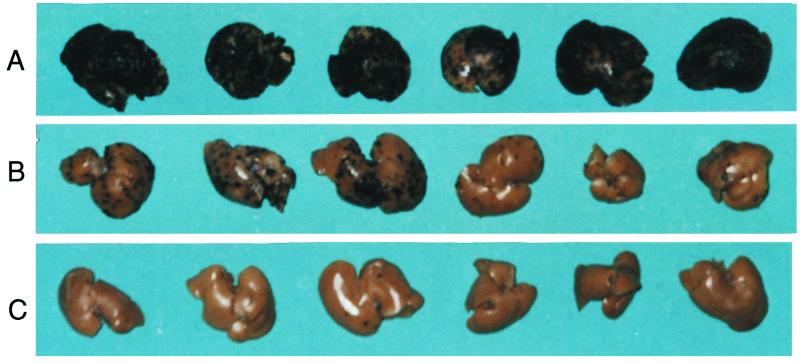
Figure 1
Figure 1
Experimental hepatic colonization after intrasplenic injection of B16M cells into WT (A), IL-1β−/− (B), or ICE−/− (C) mice. Livers were removed on day 10 after injection of melanoma cells, fixed, and photographed. Metastases can be identified by black melanotic nodules. These livers are taken from mice depicted in Table 1, Experiment I.
Figure 2
Figure 2
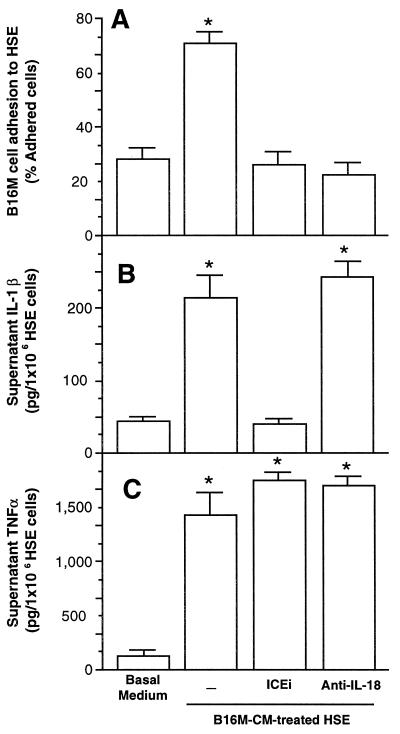
Effect of B16M-CM on adhesion of B16M cells to HSE. Cultured HSE cells were incubated in the presence of B16M-CM for 10 h. (A) Percent of adhering B16M cells to HSE incubated with B16M-CM in the presence of ICEi (10 μM) or anti-IL-18 (10 μg/ml). (B) Level of IL-1β in HSE supernatants before adhesion assay. (C) Level of TNF-α in HSE supernatants before adhesion assay. After the removal of the HSE supernatants, the adhesion cell assay was performed as described in Materials and Methods. Data represent the means ± SD of four separate experiments performed by using four different preparations of HSE cells, each in six replicates (n = 24). ∗, P < 0.01 for the percentage of B16M cells adhering to B16M-CM-treated HSE and of IL-1β and TNF-α production with respect to the basal medium. The Student's two-tailed, unpaired t test was used.
Figure 3
Figure 3
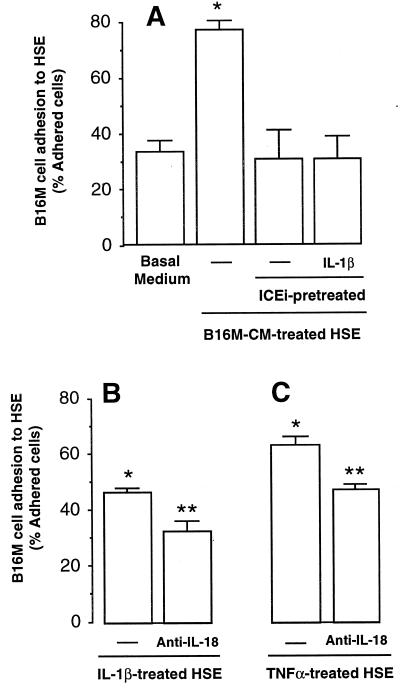
B16M cell adhesion to cytokine-activated HSE. (A) HSE cells were incubated with basal medium or stimulated with B16M-CM for 8 h. ICEi (10 μM) was added to some wells 18 h before stimulation with B16M-CM. Recombinant murine IL-1β (1 ng/ml) was added together with B16M-CM. (B) The HSE was stimulated with 1 ng/ml murine IL-1β for 6 h with and without antimurine IL-18 IgG (10 μg/ml) added 1 h before the IL-1β. (C) The HSE was stimulated with 100 pg/ml murine TNF-α for 6 h with and without antimurine IL-18 IgG (10 μg/ml) added 1 h before the TNF-α. After each of the indicated incubation times, the adherence cell assay was performed as described in Materials and Methods. The results represent the means ± SD of three separate experiments, each in six replicates (n = 18). Differences in the percent of adhering cells with respect to untreated HSE (∗) and IL-1β- or TNF-α-treated HSE (∗∗) were statistically significant (P < 0.01) by the Student's two-tailed, unpaired t test.
Figure 4
Figure 4
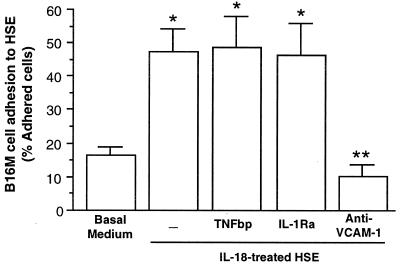
Effect of anti-VCAM-1 on B16M cell adhesion to IL-18-treated HSE. HSE cells were incubated with 1 ng/ml recombinant murine IL-18 for 6 h. In some wells, 1 μg/ml TNFbp or 100 ng/ml IL-1Ra were added 10 min before IL-18. In other wells, 10 μg/ml anti-VCAM-1 antibody or 10 μg/ml anti-mouse IgG was added to HSE cells 30 min before the B16M cell adhesion assay. The percent of adhering B16M cells was determined as described in Materials and Methods. The results represent the means ± SD of three separate experiments, each in six replicates (n = 18). Differences in the percent of adhering cells with respect to basal medium-treated HSE (∗) or IL-18-treated HSE (∗∗) were statistically significant (P < 0.01 by the Student's two-tailed, unpaired t test).
Figure 5
Figure 5
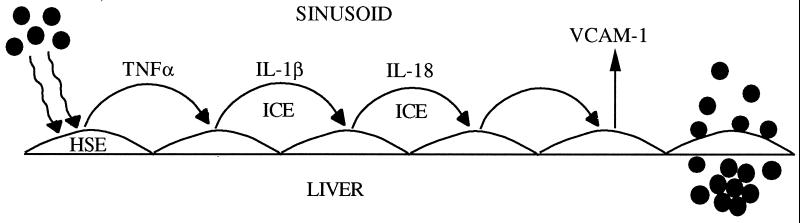
Proposed mechanism for B16M adhesion to HSE. From left, melanoma cells (●) release a prometastatic substance(s) that increases TNF-α production in HSE. TNF-α in turn stimulates IL-1β release via ICE and mature IL-1β stimulates IL-18 release, also via an ICE-dependent pathway. Mature IL-18 induces VCAM-1, which facilitates the adhesion of melanoma cells to HSE.

References

    1. Nicolson G L, Winkelhake J L. Nature (London) 1975;255:230–232. - PubMed
    1. Rice G E, Bevilacqua M P. Science. 1989;246:1303–1306. - PubMed
    1. Okahara H, Yagita H, Miyake K, Okumura K. Cancer Res. 1994;54:3233–3236. - PubMed
    1. Garofalo A, Chirivi R G S, Foglieni C, Pigot R, Mortarini R, Martin-Padura I, Anichini A, Gearing A J, Sanchez-Madrid F, Dejana E, et al. Cancer Res. 1995;55:414–419. - PubMed
    1. Vidal-Vanaclocha F, Alvarez A, Asumendi A, Urcelay B, Tonino P, Dinarello C A. J Natl Cancer Inst. 1996;88:198–205. - PubMed

Publication types

MeSH terms