. 2000 Feb;68(2):999-1003.
doi: 10.1128/IAI.68.2.999-1003.2000.

Role of listeriolysin O in cell-to-cell spread of Listeria monocytogenes

Affiliations

Role of listeriolysin O in cell-to-cell spread of Listeria monocytogenes

M M Gedde et al. Infect Immun. 2000 Feb.

Abstract

Listeria monocytogenes is a facultative intracellular bacterial pathogen that escapes from a host vacuolar compartment and grows rapidly in the cytosol. Listeriolysin O (LLO) is a secreted pore-forming protein essential for the escape of L. monocytogenes from the vacuole formed upon initial internalization. However, its role in intracellular growth and cell-to-cell spread events has not been testable by a genetic approach. In this study, purified six-His-tagged LLO (HisLLO) was noncovalently coupled to the surface of nickel-treated LLO-negative mutants. Bound LLO mediated vacuolar escape in approximately 2% of the mutants. After 5.5 h of growth, cytosolic bacteria were indistinguishable from wild-type bacteria with regard to formation of pseudopod-like extensions, here termed listeriopods, and spread to adjacent cells. However, bacteria in adjacent cells failed to multiply and were found in double-membrane vacuoles. Addition of bound LLO to mutants lacking LLO and two distinct phospholipases C (PLCs) also resulted in spread to adjacent cells, but these triple mutants became trapped in multiple-membrane vacuoles that are reminiscent of autophagocytic vacuoles. These studies show that neither LLO nor the PLCs are necessary for listeriopod formation and uptake of bacteria into neighboring cells but that LLO is required for the escape of L. monocytogenes from the double-membrane vacuole that forms upon cell-to-cell spread.


Figures
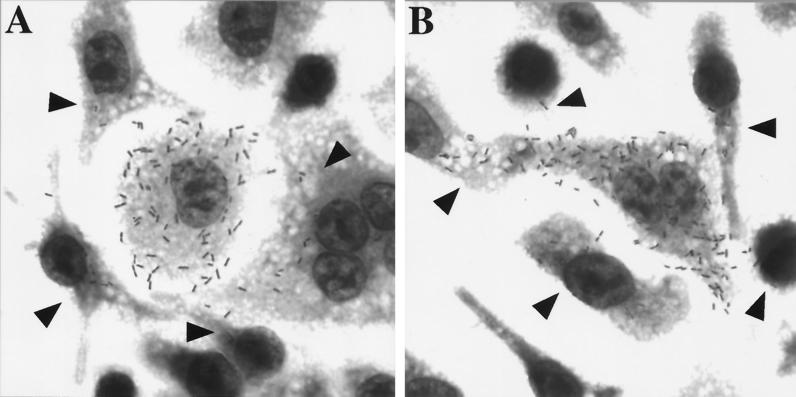
FIG. 1
FIG. 1
Growth and spread of wild-type and HisLLO-treated LLO-negative bacteria after 5.5 h of infection. J774 cells were infected for 5.5 h with wild-type (A) or HisLLO-treated LLO-negative (B) bacteria. Arrowheads indicate cells containing bacteria that have spread from the primary cell.
FIG. 2
FIG. 2
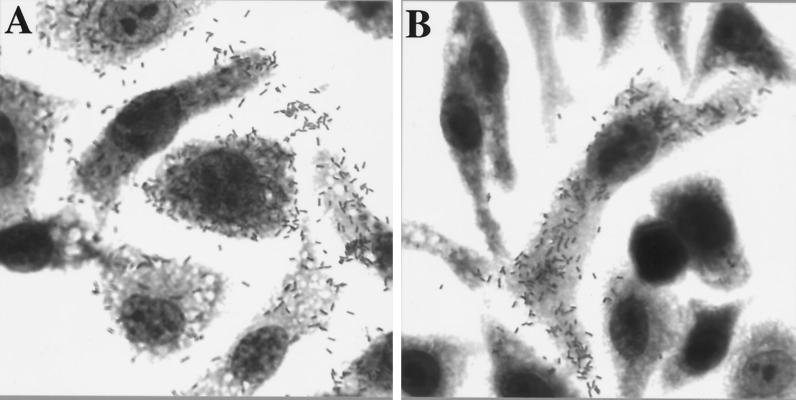
Cell-to-cell spread of wild-type and LLO-negative bacteria. J774 cells were infected for 8 h with wild-type (A) or HisLLO-treated LLO-negative (B) bacteria.
FIG. 3
FIG. 3
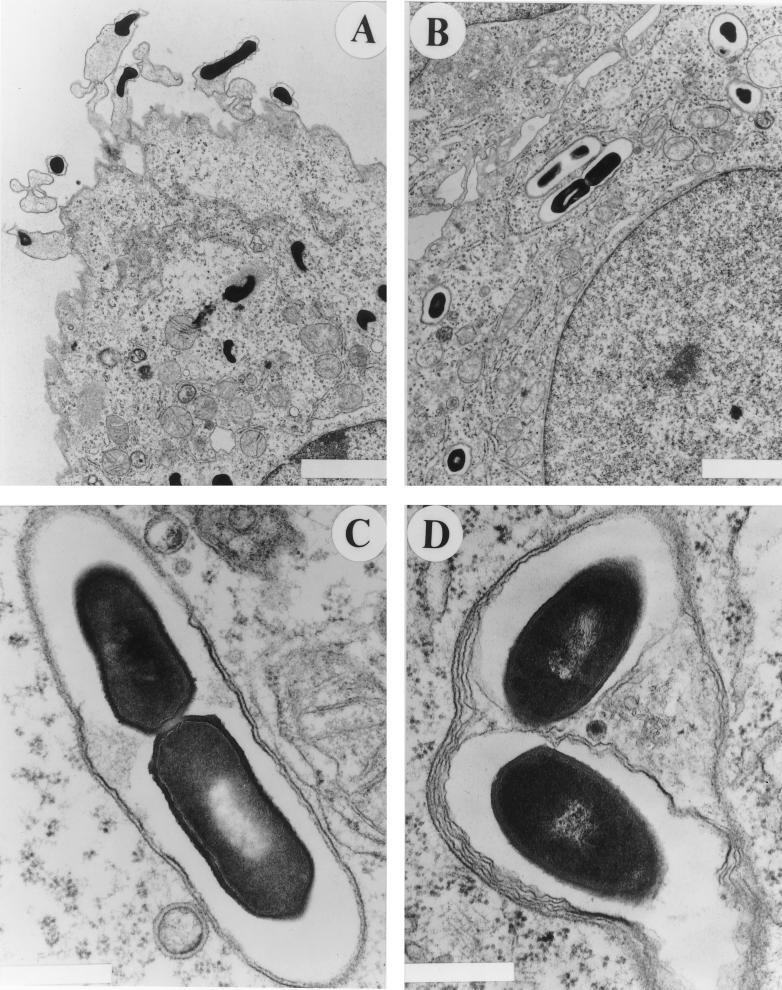
Electron microscopy of LLO-negative bacteria 8 h after infection. J774 cells were infected for 8 h with HisLLO-treated LLO-negative bacteria and were prepared for electron microscopy as previously described (14). (A and B) Low magnification. (A) Primary infected cell with bacteria free in the cytosol; (B) secondary cell with bacteria in double-membrane vacuoles. Size bars = 2 μm. (C and D) High magnification. (C) LLO-negative bacterium in a double-membrane vacuole; (D) LLO-, PlcA-, PlcB-negative bacterium in a multiple-membrane vacuole. Size bars = 0.5 μm. A minority of both double- and multiple-membrane vacuoles contained more than one bacterium. Their appearance suggested that they originated from separate listeriopods that had spread together into the same secondary vacuole, or that had spread into separate secondary vacuoles that subsequently fused. It is also possible that some bacterial growth can occur in host vacuoles. The maximum number of bacteria seen within a vacuole was two.

References

    1. Bayley H. Toxin structure: part of a hole? Curr Biol. 1997;7:R763–R767. - PubMed
    1. Braun L, Dramsi S, Dehoux P, Bierne H, Lindahl G, Cossart P. InlB: an invasion protein of Listeria monocytogenes with a novel type of surface association. Mol Microbiol. 1997;25:285–294. - PubMed
    1. Camilli A, Tilney L G, Portnoy D A. Dual roles of plcA in Listeria monocytogenes pathogenesis. Mol Microbiol. 1993;8:143–157. - PMC - PubMed
    1. Dabiri G A, Sanger J M, Portnoy D A, Southwick F S. Listeria monocytogenes moves rapidly through the host cytoplasm by inducing directional actin assembly. Proc Natl Acad Sci USA. 1990;87:6068–6072. - PMC - PubMed
    1. Farber J M, Peterkin P I. Listeria monocytogenes, a food-borne pathogen. Microbiol Rev. 1991;55:476–511. - PMC - PubMed

Publication types

LinkOut - more resources