


Two time windows of anisomycin-induced amnesia for inhibitory avoidance training in rats: protection from amnesia by pretraining but not pre-exposure to the task apparatus
- PMID: 10641764
- PMCID: PMC311311
- DOI: 10.1101/lm.6.6.600
Two time windows of anisomycin-induced amnesia for inhibitory avoidance training in rats: protection from amnesia by pretraining but not pre-exposure to the task apparatus
Abstract
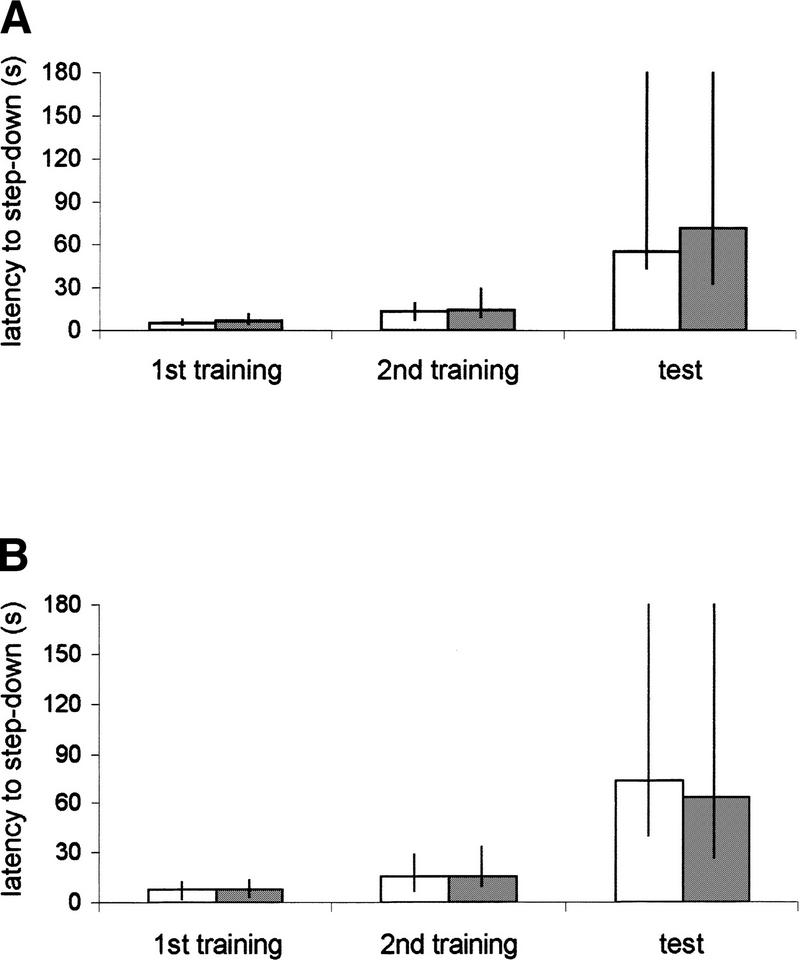
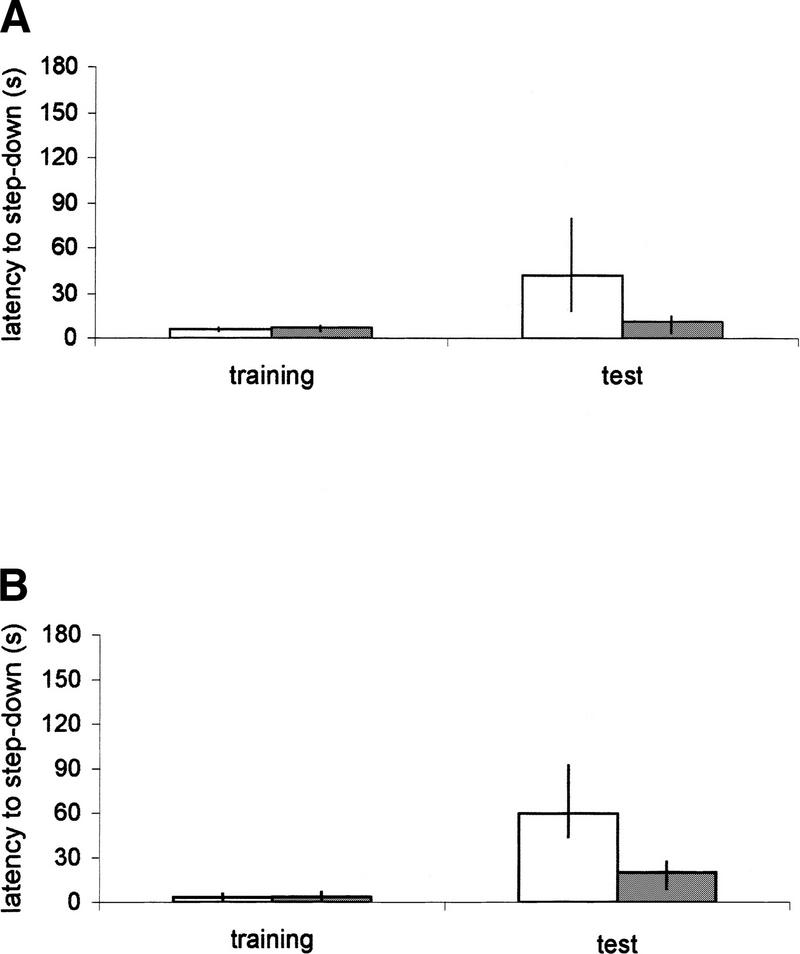
We have studied the effect of training conditions on hippocampal protein synthesis-dependent processes in consolidation of the inhibitory avoidance task. Adult male Wistar rats were trained and tested in a step-down inhibitory avoidance task (0.4 mA foot shock, 24 hr training-test interval). Fifteen minutes before or 0, 3, or 6 hr after training, animals received a 0.8-microl intrahippocampal infusion of the protein-synthesis inhibitor anisomycin (80 microg) or vehicle (PBS, pH 7.4). The infusion of anisomycin impaired retention test performance in animals injected 15 min before and 3 hr after the training session, but not at 0 or 6 h post-training. Pretraining with a low foot shock intensity (0.2 mA) 24 hr before training, prevented the amnestic effect of anisomycin injected at 15 min before or 3 hr after training. However, simple pre-exposure to the inhibitory avoidance apparatus did not alter the amestic effects of anisomycin. The results suggest that hippocampal protein synthesis is critical in two periods, around the time of, and 3 hr after training. A prior weak training session, however, which does not itself alter step-down latencies, is sufficient to prevent the amnestic effect of anisomycin, suggesting that even if not behaviorally detectable, weak training must be sufficient to produce some lasting cellular expression of the experience.
Figures


References
-
- Abraham WC, Mason SE, Demmer J, Williams JM, Richardson C, Tate W, Lawlor PA, Dragunow M. Correlation between immediate early gene induction and the persistence of long-term potentiation. Neuroscience. 1993;56:717–727. - PubMed
-
- Anokhin KV, Mileusnic R, Shamakina IY, Rose SP. Effects of early experience on c-fos gene expression in the chick forebrain. Brain Res. 1991;544:101–107. - PubMed
-
- Bannerman DM, Good MA, Butcher SP, Ramsay M, Morris RGM. Distinct components of spatial learning revealed by prior training and NMDA receptor blockade. Nature. 1995;378:182–186. - PubMed
-
- Barraco RA, Stettner LJ. Antibiotics and memory. Psychol Bull. 1976;83:242–302. - PubMed
-
- Barzilai A, Kennedy TE, Sweat JD, Kandel ER. 5-HT modulates protein synthesis and the expression of specific proteins during long-term facilitation in Aplysia sensory neurons. Neuron. 1989;2:1577–1586. - PubMed
Publication types
MeSH terms
Substances
LinkOut - more resources
Full Text Sources