


doi: 10.1128/jvi.74.4.2023-2028.2000.
Resistance to replication of human immunodeficiency virus challenge in SCID-Hu mice engrafted with peripheral blood mononuclear cells of nonprogressors is mediated by CD8(+) T cells and associated with a proliferative response to p24 antigen
Affiliations
- PMID: 10644376
- PMCID: PMC111681
- DOI: 10.1128/jvi.74.4.2023-2028.2000
Item in Clipboard
Resistance to replication of human immunodeficiency virus challenge in SCID-Hu mice engrafted with peripheral blood mononuclear cells of nonprogressors is mediated by CD8(+) T cells and associated with a proliferative response to p24 antigen
J Virol.
2000 Feb.
Abstract
High levels of resistance to challenge with human immunodeficiency virus type 1 SF162 were observed in animals engrafted with peripheral blood mononuclear cells of four long-term nonprogressors (LTNPs). Resistance was abrogated by depletion of CD8(+) T cells in vivo and was observed only in LTNPs with proliferative responses to p24. In a subgroup of nonprogressors, CD8(+) T cells mediated restriction of challenge viruses, and this response was associated with strong proliferative responses to p24 antigen.
Figures

Changes in CD4+-T-cell numbers and levels of HIV-1 in animals engrafted with human PBMC and challenged with 1 to 125 TCID50 of HIVSF162. Values for similarly prepared animals that received a human CD8+-T-cell-depleting antibody on day 6 (1 day prior to challenge) are also shown. Values shown are those at the time of sacrifice (day 21). The percentages of human cells within the peritoneal wash (PW) which are CD4+ are shown in the top panels. Levels of virus in plasma and provirus in spleen determined by real-time PCR are shown in the two lower panels. The percentage of CD4+ T cells and levels of virus RNA in plasma and provirus DNA in spleen indicated by a given symbol within a column correspond to the same animal. The fraction of animals with detectable virus refers to the number of animals with virus RNA in the plasma or provirus in the spleen, or spleen coculture, divided by the number of animals in that group.
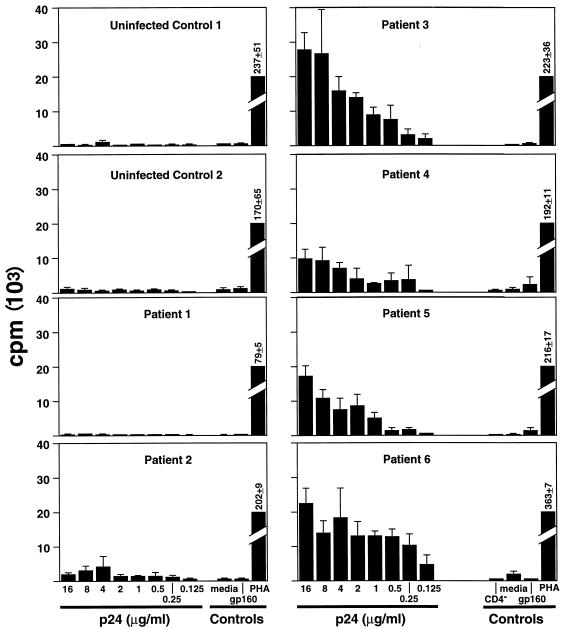
In vitro proliferation to HIV p24 antigen. PBMC (105) from two uninfected controls and patients 1 to 6 were incubated with the indicated antigens or media in a standard [H3]thymidine uptake assay. Results of triplicate cultures are shown. For patients 3 to 6, controls included CD4+-T-cell-depleted PBMC stimulated with 10 μg of p24 per ml. PHA, phytohemagglutinin.
References
-
- Barker E, Mackewicz C E, Reyes-Teran G, Sato A, Stranford S A, Fujimura S H, Christopherson C, Chang S Y, Levy J A. Virological and immunological features of long-term human immunodeficiency virus-infected individuals who have remained asymptomatic compared with those who have progressed to acquired immunodeficiency syndrome. Blood. 1998;92:3105–3114. - PubMed
-
- Barker T D, Weissman D, Daucher J A, Roche K M, Fauci A S. Identification of multiple and distinct CD8+ T cell suppressor activities: dichotomy between infected and uninfected individuals, evolution with progression of disease, and sensitivity to gamma irradiation. J Immunol. 1996;156:4476–4483. - PubMed
-
- Boyle M J, Connors M, Flanigan M E, Geiger S P, Ford H, Jr, Baseler M, Adelsberger J, Davey R T, Jr, Lane H C. The human HIV/peripheral blood lymphocyte (PBL)-SCID mouse. A modified human PBL-SCID model for the study of HIV pathogenesis and therapy. J Immunol. 1995;154:6612–6623. - PubMed
Publication types
MeSH terms
Substances
LinkOut - more resources
Full Text Sources
Other Literature Sources
Research Materials
