. 2000 Jan;10(1):62-71.

Simple sequence repeats in Escherichia coli: abundance, distribution, composition, and polymorphism

Affiliations

Simple sequence repeats in Escherichia coli: abundance, distribution, composition, and polymorphism

R Gur-Arie et al. Genome Res. 2000 Jan.

Abstract

Computer-based genome-wide screening of the DNA sequence of Escherichia coli strain K12 revealed tens of thousands of tandem simple sequence repeat (SSR) tracts, with motifs ranging from 1 to 6 nucleotides. SSRs were well distributed throughout the genome. Mononucleotide SSRs were over-represented in noncoding regions and under-represented in open reading frames (ORFs). Nucleotide composition of mono- and dinucleotide SSRs, both in ORFs and in noncoding regions, differed from that of the genomic region in which they occurred, with 93% of all mononucleotide SSRs proving to be of A or T. Computer-based analysis of the fine position of every SSR locus in the noncoding portion of the genome relative to downstream ORFs showed SSRs located in areas that could affect gene regulation. DNA sequences at 14 arbitrarily chosen SSR tracts were compared among E. coli strains. Polymorphisms of SSR copy number were observed at four of seven mononucleotide SSR tracts screened, with all polymorphisms occurring in noncoding regions. SSR polymorphism could prove important as a genome-wide source of variation, both for practical applications (including rapid detection, strain identification, and detection of loci affecting key phenotypes) and for evolutionary adaptation of microbes.


Figures
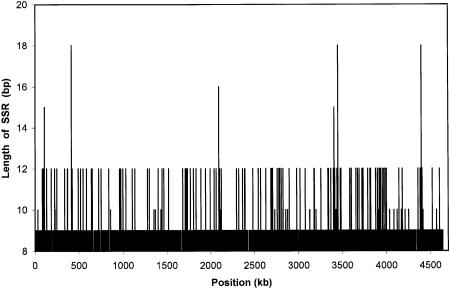
Figure 1
Figure 1
Abundance, distribution, and lengths of SSR tracts in the E. coli genome, shown as overall length of an SSR tract at a given position in the genome.
Figure 2
Figure 2
Histograms showing frequencies of fine locations of SSR tracts in the entire E. coli genome relative to start of translation for particular ORFs downstream of the SSR tracts for mononucleotide SSRs >6 bp (A), dinucleotide SSRs >6 bp (B), and trinucleotide SSRs >9 bp (C). The horizontal axis shows position relative to the ATG codon marking the start of translation.
Figure 3
Figure 3
Mobility differences in PCR products harboring specific SSR tracts among strains of E. coli following electrophoresis in a 5% acrylamide TBE denaturing sequencing gel. PCR was performed using primer pairs, one radiolabeled, flanking the poly(G) tract at a genomic site ∼77 bp upstream from the ATG site of the ycgW locus. The dried gel was exposed to a PhosphorImager. The expected size of the E. coli K12 amplification product was 200 bp. Shown are amplification products for the following strains: (lane 1) K12:DH5α; (lane 2) B:SR9c; (lane 3) B:SR9b; (lane 4) ETEC:O78:H [E10407]; (lane 5) EPEC: O111[E639616]; (lane 6) E:1; (lane 7) E:7; (lane 8) E:18; (lane 9) E:47.
Figure 4
Figure 4
DNA sequence alignments for complementary DNA strands for four loci bearing mononucleotide repeat polymorphisms among strains of E. coli. PCR products were sequenced using the dideoxy-chain termination method and aligned using the Pile-up GCG program. Polymorphic SSR tracts are shown in boldface letters. (A) Poly(G) tract 77 bp and poly(T) tract 84–89 bp upstream of the ATG element of ycgW; (B) poly(C) tract ∼90 bp and poly(T) tract 76 bp upstream of the ATG element of yaiN; (C) poly(A) tract 35 bp and poly(T) tract 67 bp downstream of the tRNA gene serW; (D) poly(T) tract 38 bp upstream of the ATG element of caiF.

References

    1. Ahmed R, Bopp C, Bonczyk A, Kasatiya S. Phage typing scheme for Escherichia coli 0157:H7. J Infect Dis. 1987;155:806–809. - PubMed
    1. American Public Health Association (APHA); American Water Works Association; Water Pollution Control Association. Standard methods for the examination of water and wastewater. 16th ed. Washington, D.C.: APHA; 1985. p. 878.
    1. Andachi Y, Yamao F, Iwami M, Muto A, Osawa S. Occurrence of unmodified adenine and uracil at the first position of anticodon in threonine tRNA in Mycoplasma capriculum. Proc Natl Acad Sci. 1987;84:7398–7402. - PMC - PubMed
    1. Bewley CA, Gronenborn AM, Clore GM. Minor groove-binding architectural proteins: Structure, function, and DNA recognition. Annu Rev Biophys Biomol Struct. 1998;27:105. - PMC - PubMed
    1. Bhagwat AS, McClelland M. DNA mismatch correction by Very Short Patch repair may have altered the abundance of oligonucleotides in the E. coli genome. Nucleic Acids Res. 1992;20:1663–1668. - PMC - PubMed

Publication types

MeSH terms

LinkOut - more resources