. 2000 Feb;182(4):911-8.
doi: 10.1128/JB.182.4.911-918.2000.

Cloning and characterization of the Flavobacterium johnsoniae gliding-motility genes gldB and gldC

Affiliations

Cloning and characterization of the Flavobacterium johnsoniae gliding-motility genes gldB and gldC

D W Hunnicutt et al. J Bacteriol. 2000 Feb.

Abstract

The mechanism of bacterial gliding motility (active movement over surfaces without the aid of flagella) is not known. A large number of mutants of the gliding bacterium Flavobacterium johnsoniae (Cytophaga johnsonae) with defects in gliding motility have been previously isolated, and genetic techniques to analyze these mutants have recently been developed. We complemented a nongliding mutant of F. johnsoniae (UW102-99) with a library of wild-type DNA by using the shuttle cosmid pCP26. The complementing plasmid (pCP200) contained an insert of 26 kb and restored gliding motility to 4 of 50 independently isolated nongliding mutants. A 1.9-kb fragment which encompassed two genes, gldB and gldC, complemented all four mutants. An insertion mutation in gldB was polar on gldC, suggesting that the two genes form an operon. Disruption of the chromosomal copy of gldB in wild-type F. johnsoniae UW101 eliminated gliding motility. Introduction of the gldBC operon, or gldB alone, restored motility. gldB appears to be essential for F. johnsoniae gliding motility. It codes for a membrane protein that does not exhibit strong sequence similarity to other proteins in the databases. gldC is not absolutely required for gliding motility, but cells that do not produce GldC form colonies that spread less well than those of the wild type. GldC is a soluble protein and has weak sequence similarity to the fungal lectin AOL.


Figures
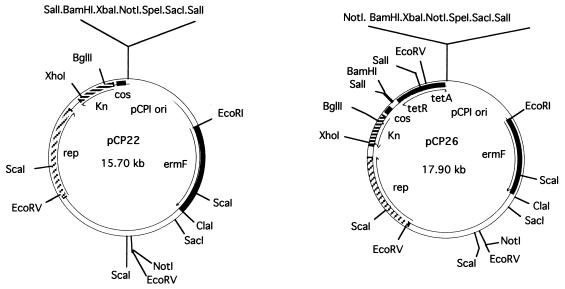
FIG. 1
FIG. 1
Maps of the F. johnsoniae-E. coli shuttle cosmids pCP22 and pCP26.
FIG. 2
FIG. 2
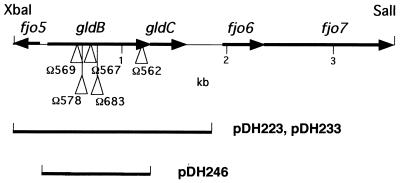
Map of the gldBC region. The sites of the Tn4351 insertions in CJ562, CJ567, CJ569, CJ578, and CJ683 are indicated by triangles. Regions of F. johnsoniae DNA contained in pDH223, pDH233, and pDH246 are shown beneath the map.
FIG. 3
FIG. 3
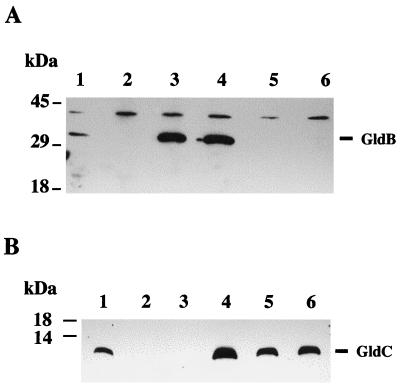
Western immunoblot detection of GldB and GldC in wild-type and mutant strains of F. johnsoniae. Cells were lysed in SDS-PAGE loading buffer, and proteins were separated by SDS-PAGE and transferred to PVDF membranes. GldB (A) and GldC (B) were detected using antisera raised against recombinant GldB or GldC proteins, respectively, as described in Materials and Methods. Lanes: 1, wild-type F. johnsoniae; 2, gldB insertional knockout mutant CJ588; 3, CJ767 (CJ588 complemented with pDH246, which carries gldB); 4, CJ594 (CJ588 complemented with pDH233, which carries gldB and gldC); 5, Tn4351-induced gldB mutant CJ562; 6, Tn4351-induced gldB mutant CJ567.
FIG. 4
FIG. 4
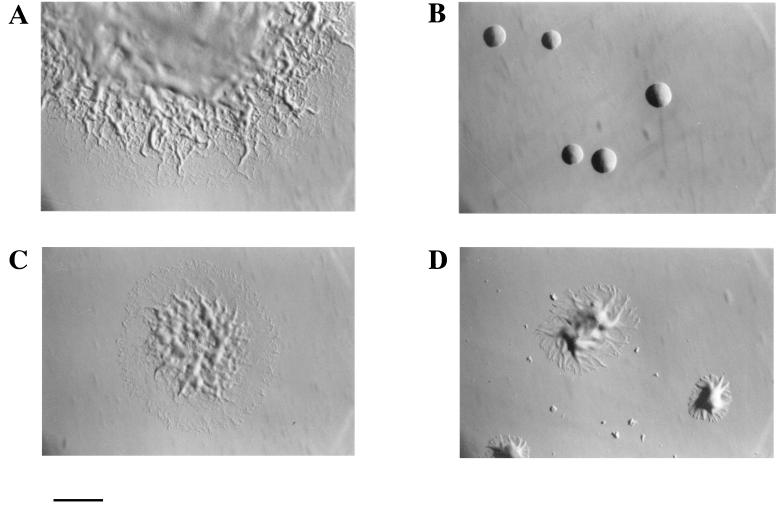
Photomicrographs of F. johnsoniae colonies. Colonies were grown for 2 days at 25°C on PY2 agar medium. Photomicrographs were taken with an Olympus OM-4T camera mounted on a Nikon Diaphot inverted phase-contrast microscope. (A) Wild-type F. johnsoniae UW101. (B) gldBC knockout mutant CJ588. (C) CJ594 (CJ588 complemented with pDH233, which carries gldBC). (D) CJ767 (CJ588 complemented with pDH246, which carries gldB). Bar, 1 mm.
FIG. 5
FIG. 5
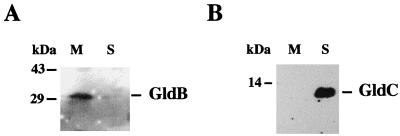
Localization of GldB and GldC. Cells were grown to mid-exponential phase, concentrated by centrifugation, and disrupted by passage through a French pressure cell. Unbroken cells and debris were removed by centrifugation at 2,500 × g for 10 min. Insoluble material was pelleted from the supernatant fraction by centrifugation at 352,900 × g for 30 min. The pellet was dissolved in 10 mM Tris buffer (pH 7.5), and the proteins in both the 352,900 × g pellet (lanes M) and supernatant (lanes S) fractions were separated by SDS-PAGE and transferred to PVDF membranes. GldB (A) and GldC (B) were detected using antisera raised against recombinant GldB or GldC proteins, respectively.
FIG. 6
FIG. 6
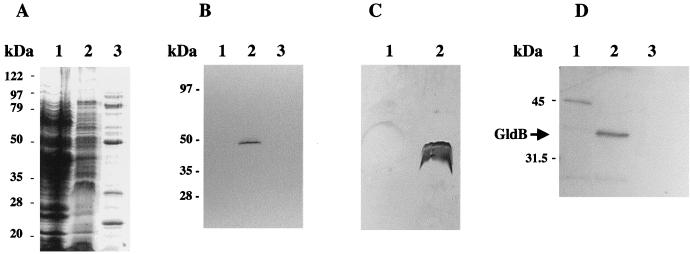
Localization of GldB to the Sarkosyl-soluble (cytoplasmic membrane) fraction of cells. Cells were disrupted and separated into soluble and membrane fractions. Membranes were fractionated further by differential solubilization in Sarkosyl as described in Materials and Methods. Equal amounts of each fraction were separated by SDS-PAGE and examined for total protein (A), cytochrome c (cytoplasmic membrane marker) (B), LPS (outer membrane marker) (C), and GldB protein (D). (A) Coomassie blue-stained gel to detect total protein. Lanes: 1, soluble (cytoplasmic and periplasmic) fraction; 2, Sarkosyl-soluble (cytoplasmic membrane) fraction; 3, Sarkosyl-insoluble (outer membrane) fraction. (B) Heme-stained gel to detect cytochrome c. Lanes: 1, soluble (cytoplasmic and periplasmic) fraction; 2, Sarkosyl-soluble (cytoplasmic membrane) fraction; 3, Sarkosyl-insoluble (outer membrane) fraction. (C) Silver-stained gel to detect LPS. Lanes: 1, Sarkosyl-soluble (cytoplasmic membrane) fraction; 2, Sarkosyl-insoluble (outer membrane) fraction. (D) Western blot analysis to detect GldB. Lanes: 1, soluble (cytoplasmic and periplasmic) fraction; 2, Sarkosyl-soluble (cytoplasmic membrane) fraction; 3, Sarkosyl-insoluble (outer membrane) fraction.

References

    1. Abbanat D R, Leadbetter E R, Godchaux III W, Escher A. Sulphonolipids are molecular determinants of gliding motility. Nature. 1986;324:367–369.
    1. Agarwal S, Hunnicutt D W, McBride M J. Cloning and characterization of the Flavobacterium johnsoniae (Cytophaga johnsonae) gliding motility gene, gldA. Proc Natl Acad Sci USA. 1997;94:12139–12144. - PMC - PubMed
    1. Altschul S F, Gish W, Miller W, Myers E W, Lipman D J. Basic local alignment search tool. J Mol Biol. 1990;215:403–410. - PubMed
    1. Bernardet J-F, Segers P, Vancanneyt M, Berthe F, Kersters K, Vandamme P. Cutting a gordian knot: emended classification and description of the genus Flavobacterium, and proposal of Flavobacterium hydatis nom. nov. (basonym, Cytophaga aquatilis Strohl and Tait 1978) Int J Syst Bacteriol. 1996;46:128–148.
    1. Bolivar F, Backman K. Plasmids of E. coli as cloning vectors. Methods Enzymol. 1979;68:245–267. - PubMed

Publication types

Substances

Associated data

LinkOut - more resources