


Barriers to genetic exchange between bacterial species: Streptococcus pneumoniae transformation
- PMID: 10648528
- PMCID: PMC94378
- DOI: 10.1128/JB.182.4.1016-1023.2000
Barriers to genetic exchange between bacterial species: Streptococcus pneumoniae transformation
Abstract
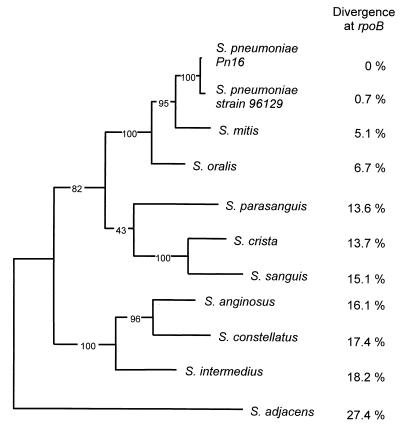
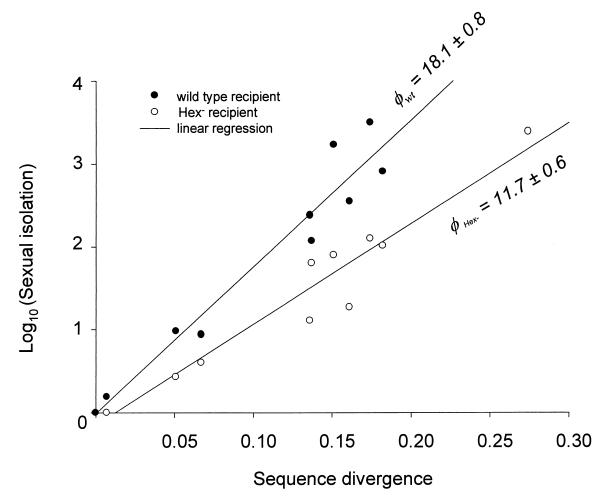
Interspecies genetic exchange is an important evolutionary mechanism in bacteria. It allows rapid acquisition of novel functions by transmission of adaptive genes between related species. However, the frequency of homologous recombination between bacterial species decreases sharply with the extent of DNA sequence divergence between the donor and the recipient. In Bacillus and Escherichia, this sexual isolation has been shown to be an exponential function of sequence divergence. Here we demonstrate that sexual isolation in transformation between Streptococcus pneumoniae recipient strains and donor DNA from related strains and species follows the described exponential relationship. We show that the Hex mismatch repair system poses a significant barrier to recombination over the entire range of sequence divergence (0.6 to 27%) investigated. Although mismatch repair becomes partially saturated, it is responsible for 34% of the observed sexual isolation. This is greater than the role of mismatch repair in Bacillus but less than that in Escherichia. The remaining non-Hex-mediated barrier to recombination can be provided by a variety of mechanisms. We discuss the possible additional mechanisms of sexual isolation, in view of earlier findings from Bacillus, Escherichia, and Streptococcus.
Figures
References
-
- Biswas G D, Ravin A W. Heterospecific transformation of Pneumococcus and Streptococcus. IV. Variations in hybrid DNA produced by recombination. Mol Gen Genet. 1971;110:1–22. - PubMed
-
- Boor K J, Duncan M L, Price C W. Genetic and transcriptional organization of the region encoding the beta subunit of Bacillus subtilis RNA polymerase. J Biol Chem. 1995;270:20329–20336. - PubMed
Publication types
MeSH terms
Substances
Associated data
- Actions
- Actions
- Actions
- Actions
- Actions
- Actions
- Actions
- Actions
- Actions
- Actions
- Actions
- Actions
- Actions
- Actions
- Actions
- Actions
- Actions
- Actions
- Actions
- Actions
- Actions
- Actions
Grants and funding
LinkOut - more resources
Full Text Sources
Other Literature Sources
Molecular Biology Databases
