. 2000 Feb;182(4):1035-45.
doi: 10.1128/JB.182.4.1035-1045.2000.

Insertional inactivation of genes encoding components of the sodium-type flagellar motor and switch of Vibrio parahaemolyticus

Affiliations

Insertional inactivation of genes encoding components of the sodium-type flagellar motor and switch of Vibrio parahaemolyticus

B R Boles et al. J Bacteriol. 2000 Feb.

Abstract

Vibrio parahaemolyticus possesses two types of flagella, polar and lateral, powered by distinct energy sources, which are derived from the sodium and proton motive forces, respectively. Although proton-powered flagella in Escherichia coli and Salmonella enterica serovar Typhimurium have been extensively studied, the mechanism of torque generation is still not understood. Molecular knowledge of the structure of the sodium-driven motor is only now being developed. In this work, we identify the switch components, FliG, FliM, and FliN, of the sodium-type motor. This brings the total number of genes identified as pertinent to polar motor function to seven. Both FliM and FliN possess charged domains not found in proton-type homologs; however, they can interact with the proton-type motor of E. coli to a limited extent. Residues known to be critical for torque generation in the proton-type motor are conserved in the sodium-type motor, suggesting a common mechanism for energy transfer at the rotor-stator interface regardless of the driving force powering rotation. Mutants representing a complete panel of insertionally inactivated switch and motor genes were constructed. All of these mutants were defective in sodium-driven swimming motility. Alkaline phosphatase could be fused to the C termini of MotB and MotY without abolishing motility, whereas deletion of the unusual, highly charged C-terminal domain of FliM disrupted motor function. All of the mutants retained proton-driven, lateral motility over surfaces. Thus, although central chemotaxis genes are shared by the polar and lateral systems, genes encoding the switch components, as well as the motor genes, are distinct for each motility system.


Figures
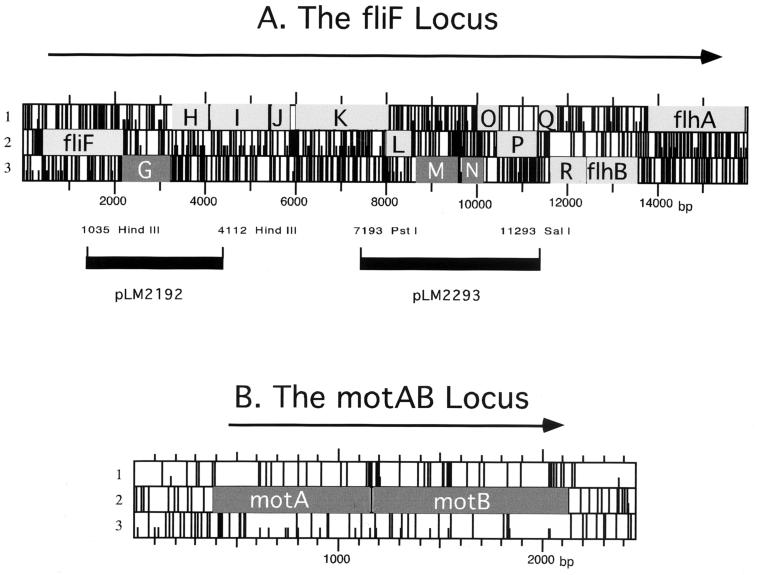
FIG. 1
FIG. 1
The fliF and motAB loci. The physical maps are derived from the nucleotide sequences. Gene designations, which are adopted from the closest E. coli homolog, are superimposed on the open reading frame (ORF) map; full bars indicate stop codons, and small bars indicate ATG codons. ORFs coding for switch and motor genes are dark. Arrows indicate the direction of transcription. The coding sequence upstream of fliF codes for a potential transcriptional regulator resembling E. coli GcvA. The sequence upstream of motA codes for a potential polypeptide with homology to the small subunit of E. coli exodeoxyribonuclease (type VII). The sequence downstream of motB codes for a potential homolog of S. enterica serovar Typhimurium ThiI. Regions containing the fliG and fliMN genes were subcloned using the restriction sites indicated to make plasmids pLM2192 and pLM2293.
FIG. 2
FIG. 2
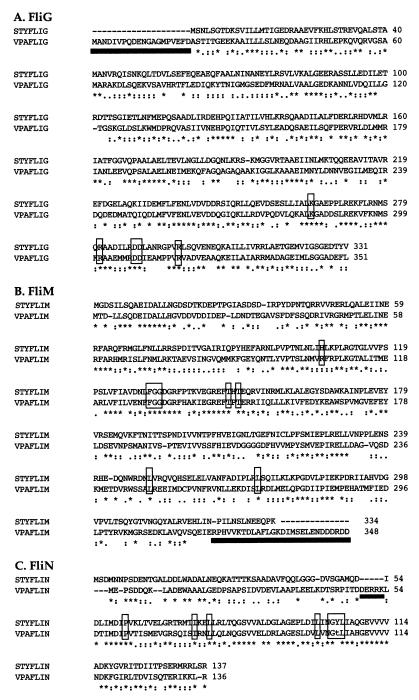
Sequence alignment of sodium-type flagellar switch components of V. parahaemolyticus (VPA) with proton-type switch components of S. enterica serovar Typhimurium (STY). Amino acids are represented by the single-letter code. Gaps introduced to facilitate alignment are indicated by dashes. The consensus line below the sequence alignment indicates identity (*), strong conservation (:), and weak conservation (.) of amino acid matches. The open boxes outline conserved amino acids, and the lowercase letter indicates a nonconserved amino acid with respect to residues known to be critical for torque generation in S. enterica serovar Typhimurium or E. coli. Black bars underline the unusual domains of the V. parahaemolyticus proteins.
FIG. 3
FIG. 3
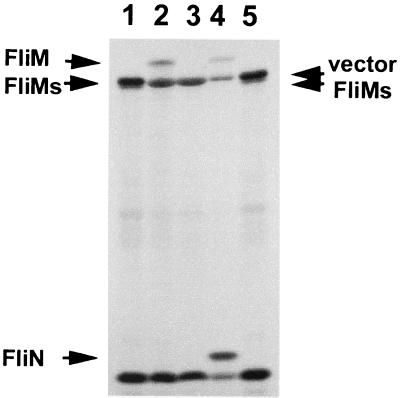
FliM and FliN synthesis in minicells. Autoradiogram (12-h exposure) of 35S-labeled proteins synthesized in minicells containing plasmids. Lanes: 1, pLM2297 (fliMshort); 2, pLM2296 (fliM+); 3, pLM1877 (vector); 4, pLM2294 (fliM+N+); 5, pLM2297 (fliMshort). Arrows indicate polypeptides encoded by the fli genes and a vector-encoded product. The resolving gel contained 10.5% acrylamide. FliMs, the product of truncated fliMshort.
FIG. 4
FIG. 4
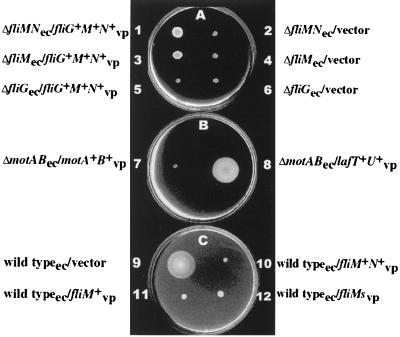
Complementation experiments of E. coli (ec) proton-type motor and switch mutants with V. parahaemolyticus (vp) sodium-type genes. Strains: 1, DFB232 (ΔfliMN)/pLM2047 (containing V. parahaemolyticus fliF locus); 2, DFB232/pLAFRII (parental vector control); 3, DFB228 (ΔfliM)/pLM2047; 4, DFB228/pLAFRII; 5, DFB225 (ΔfliG)/pLM2047; 6, DFB225/pLAFRII; 7, DFB210 (ΔmotAB)/pLM2058 (containing V. parahaemolyticus motAB); 8, DFB210/pLM1796 (containing the V. parahaemolyticus lafTU locus, which contains the lateral, proton-type motor genes); 9, DFB9 (wild type)/pLM1877; 10, DFB9/pLM2294; 11, DFB9/pLM2296; 12, DFB9/pLM2297. Plates A to C were incubated at 37°C for 60, 48, and 8 h, respectively. M agar in plates A and B contained 10 μg of tetracycline/ml for maintenance of the plasmids. M agar in plate C contained 40 μg of gentamicin/ml and 0.5 mM IPTG for induction of transcription of the fli genes contained on the expression vector pLM1877. fliMs, fliMshort.
FIG. 5
FIG. 5
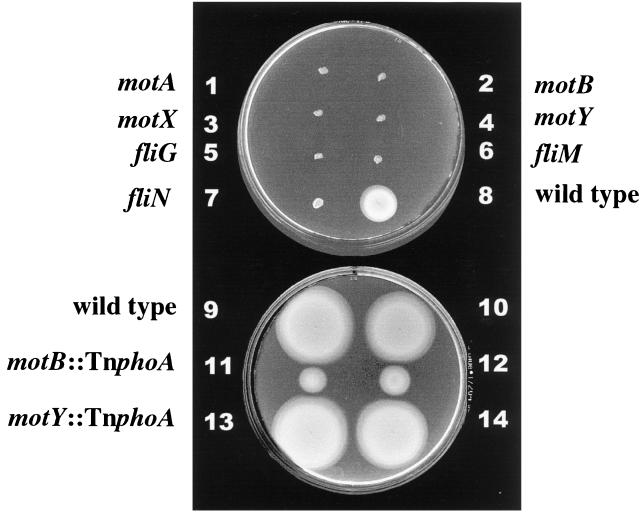
Swimming motility of V. parahaemolyticus mutant strains with flagellar switch or motor defects in M agar. Strains: 1, LM4657 (motA); 2, LM4661 (motB); 3, LM4170 (motX); 4, LM4171 (motY); 5, LM4811 (fliG); 6, LM4815 (fliM); 7, LM4812 (fliN); 8, LM1017; 9 and 10, LM1017; 11 and 12, LM4659 (motB2::TnphoA); 13 and 14, LM4289 (motY1719::TnphoA). Semisolid motility plates were incubated at 30°C for 8 (top) and 9.5 h (bottom). All mutant strains are derivatives of LM1017. Strain LM1017 fails to produce lateral flagella; therefore, there is no contribution to motility from the lateral motility system.
FIG. 6
FIG. 6
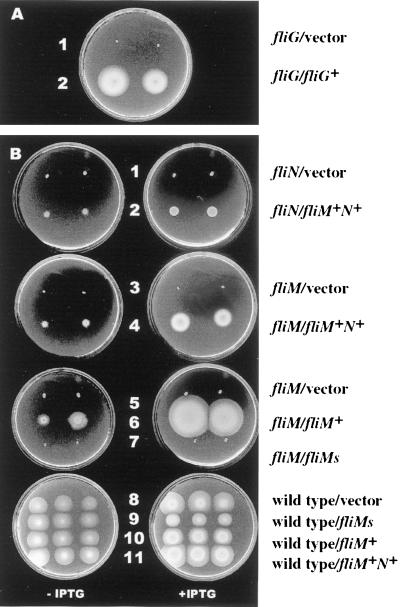
Complementation of swimming motility defects in V. parahaemolyticus switch mutants with plasmids carrying V. parahaemolyticus switch genes. (A) Strains: 1, LM4811 (fliG)/pRK415 (vector); 2, LM4811 (fliG)/pLM2192 (fliG+H+). M agar was supplemented with 10 μg of chloramphenicol and 10 μg of tetracycline/ml. The plate was incubated for 16 h at 30°C. (B) Strains: 1, LM4812 (fliN)/pLM1877 (vector); 2, LM4812 (fliN)/pLM2294 (fliM+N+); 3, LM4815 (fliM)/pLM1877; 4, LM4815 (fliM)/pLM2294 (fliM+N+); 5, LM4815 (fliM)/pLM1877; 6, LM4815 (fliM)/pLM2296 (fliM+); 7, LM4815 (fliM)/pLM2297 (fliMshort+); 8, LM1017/pLM1877 (vector); 9, LM1017/pLM2297 (fliMshort+); 10, LM1017/pLM2296 (fliM+); 11, LM1017/pLM2294 (fliM+N+). M agar was supplemented with 10 μg of chloramphenicol/ml, 40 μg of gentamicin/ml, and 0.5 mM IPTG as indicated. Plates, from top to bottom, were incubated at 30°C for 14, 14, 19, and 10 h, respectively.
FIG. 7
FIG. 7
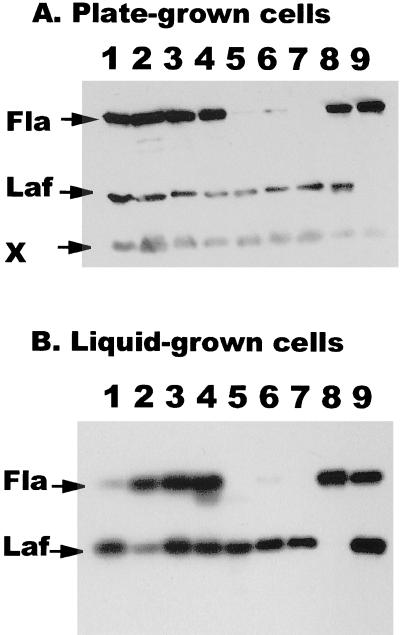
Immunoblot analysis of polar and lateral flagellin production by strains with polar switch and motor defects. All mutant strains were derived from the wild-type strain BB22. Blots were reacted with pooled antisera directed against polar (Fla) and lateral (Laf) flagellins. (A) Mutant strains were harvested from plates. Lanes: 1, LM4652 (motA); 2, LM4656 (motB); 3, LM4262 (motX); 4, LM4474 (motY); 5, LM4810 (fliG); 6, LM4830 (fliM); 7, LM4832 (fliN); 8, BB22 (from plates); 9, BB22 (from liquid). (B) Strains harvested from liquid cultures were loaded into lanes as in panel A, except that lane 8 contained BB22 from liquid and lane 9 contained BB22 from plates. The immunoblot in panel A was reacted with pooled antisera at a dilution of 1:5,000 during an overnight incubation. A minor, antiserum-reactive, nonflagellin band (X) served as a control for the amount of whole cells loaded in each lane. The immunoblot in panel B was reacted with a 1:1,000 dilution of antilateral serum and a 1:5,000 dilution of antipolar serum for a 2-h incubation.
FIG. 8
FIG. 8
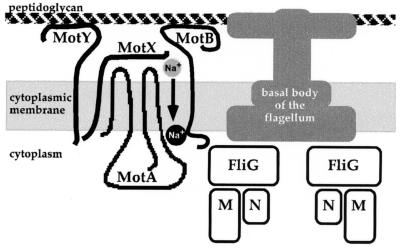
Model for the sodium-type flagellar motor. Seven genes that encode components of the motor have been identified. Allelic disruption using transposons demonstrates that all are essential for polar-type motility. Alkaline phosphatase fusions at the C termini of MotB or MotY interfere with, but do not abolish, polar motility. The function of MotX is unknown, although it is essential for torque generation and has been shown to interact with MotY. MotA and MotB resemble their homologs in the proton-driven motor; although they are not interchangeable with the motor parts of E. coli. Potential Na+ interaction sites on the cytoplasmic face of MotA and MotB (proximal to the Na+ that is indicated by the black circle) have been defined by mutations conferring phenamil resistance. On passage of sodium ions through the motor, torque is transmitted from the presumed stationary components (MotA, -B, -X, and -Y) to the flagellar switch components (FliG, -M, and -N) located at the base of the flagellar basal body. Switch components are reserved for polar, and not lateral, function in V. parahaemolyticus, although they can partially interact with the E. coli flagellar apparatus.

References

    1. Altschul S F, Madden T L, Schaffer A A, Zhang J, Zhang Z, Miller W, Lipman D J. Gapped BLAST and PSI-BLAST: a new generation of protein database search programs. Nucleic Acids Res. 1997;25:3389–3402. - PMC - PubMed
    1. Asai Y, Kojima S, Kato H, Nishioka N, Kawagishi I, Homma M. Putative channel components for the fast-rotating sodium flagellar motor of a marine bacterium. J Bacteriol. 1997;179:5104–5110. - PMC - PubMed
    1. Atsumi T, McCarter L, Imae Y. Polar and lateral flagellar motors of marine Vibrio are driven by different ion membrane forces. Nature (London) 1992;355:182–184. - PubMed
    1. Belas R, Simon M, Silverman M. Regulation of lateral flagella gene transcription in Vibrio parahaemolyticus. J Bacteriol. 1986;167:210–218. - PMC - PubMed
    1. Berg H C. Torque generation by the flagellar rotary motor. Biophys J. 1995;68:163s–167s. - PMC - PubMed

Publication types

MeSH terms

Associated data

LinkOut - more resources