


Molecular characterization of Irish Salmonella enterica serotype typhimurium: detection of class I integrons and assessment of genetic relationships by DNA amplification fingerprinting
- PMID: 10653725
- PMCID: PMC91870
- DOI: 10.1128/AEM.66.2.614-619.2000
Molecular characterization of Irish Salmonella enterica serotype typhimurium: detection of class I integrons and assessment of genetic relationships by DNA amplification fingerprinting
Erratum in
- Appl Environ Microbiol 2000 Apr;66(4):1767
Abstract
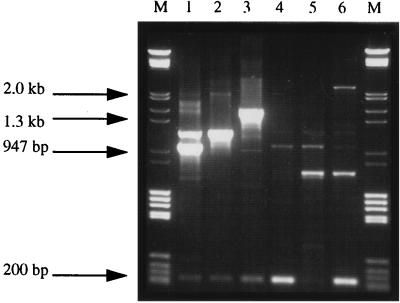
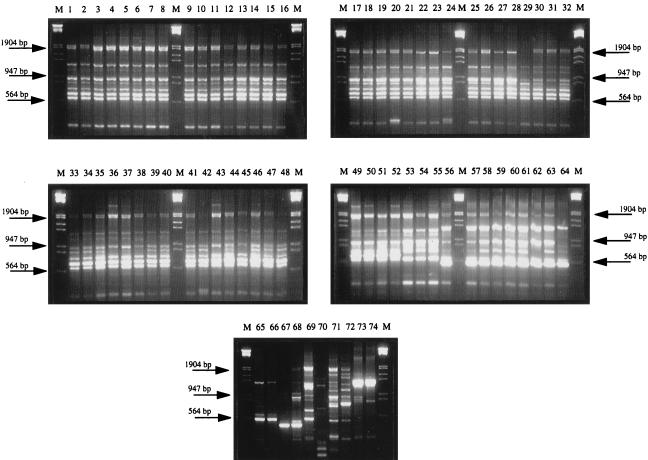
Salmonella enterica is among the principal etiological agents of food-borne illness in humans. Increasing antimicrobial resistance in S. enterica is a cause for worldwide concern. There is concern at present in relation to the increasing incidence of human infection with antimicrobial agent-resistant strains of S. enterica serotype Typhimurium, in particular of phage type DT104. Integrons appear to play an important role in the dissemination of antimicrobial resistance genes in many Enterobacteriaceae including S. enterica. In this study the antimicrobial susceptibilities and phage types of 74 randomly collected strains of S. enterica serotype Typhimurium from the Cork region of southern Ireland, obtained from human, animal (clinical), and food sources, were determined. Each strain was examined for integrons and typed by DNA amplification fingerprinting (DAF). Phage type DT104 predominated (n = 48). Phage types DT104b (n = 3), -193 (n = 9), -195 (n = 6), -208 (n = 3), -204a (n = 2), PT U302 (n = 1), and two nontypeable strains accounted for the remainder. All S. enterica serotype Typhimurium DT104 strains were resistant to ampicillin, chloramphenicol, streptomycin, Sulfonamide Duplex, and tetracycline, and one strain was additionally resistant to trimethoprim. All DT104 strains but one were of a uniform DAF type (designated DAF-I) and showed a uniform pattern of integrons (designated IP-I). The DT104b and PT U302 strains also exhibited the same resistance phenotype, and both had the DAF-I and IP-I patterns. The DAF-I pattern was also observed in a single DT193 strain in which no integrons were detectable. Greater diversity of antibiograms and DAF and IP patterns among non-DT104 phage types was observed. These data indicate a remarkable degree of homogeneity at a molecular level among contemporary isolates of S. enterica serotype Typhimurium DT104 from animal, human, and food sources in this region.
Figures
References
-
- Aarts H J, van Lith L A, Keijer J. High-resolution genotyping of Salmonella strains by AFLP. Lett Appl Microbiol. 1998;26:3–135. - PubMed
-
- Baggesen D L, Aarestrup F M. Characterization of recently emerged multiple antibiotic resistant Salmonella enterica serovar typhimurium DT104 and other multiresistant phage types from Danish pig herds. Vet Rec. 1998;25:95–97. - PubMed
-
- Baquar N, Threlfall E J, Rowe B, Stanley J. Phage type 193 of Salmonella typhimurium contains different chromosomal genotypes and multiple IS200 profiles. FEMS Microbiol Lett. 1994;115:291–296. - PubMed
Publication types
MeSH terms
Substances
Associated data
- Actions
LinkOut - more resources
Full Text Sources
Medical
Miscellaneous
