


Evidence for evolutionarily conserved secondary structure in the H19 tumor suppressor RNA
- PMID: 10666466
- PMCID: PMC102599
- DOI: 10.1093/nar/28.5.1221
Evidence for evolutionarily conserved secondary structure in the H19 tumor suppressor RNA
Abstract
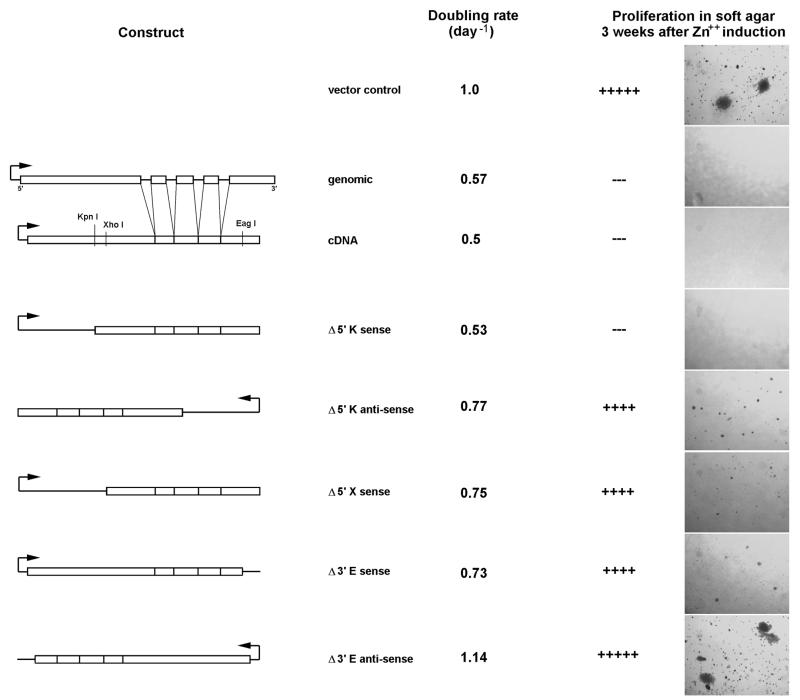
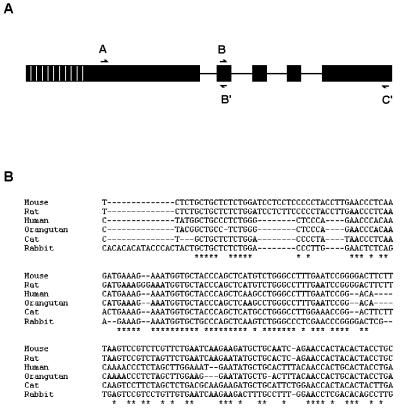
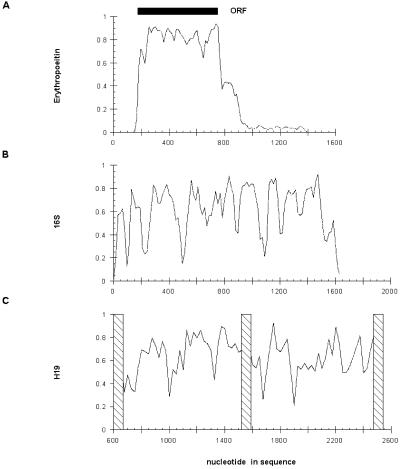
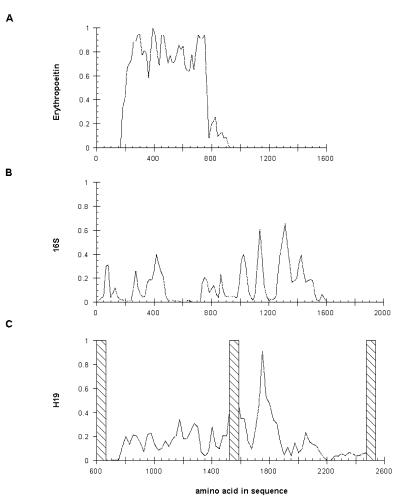
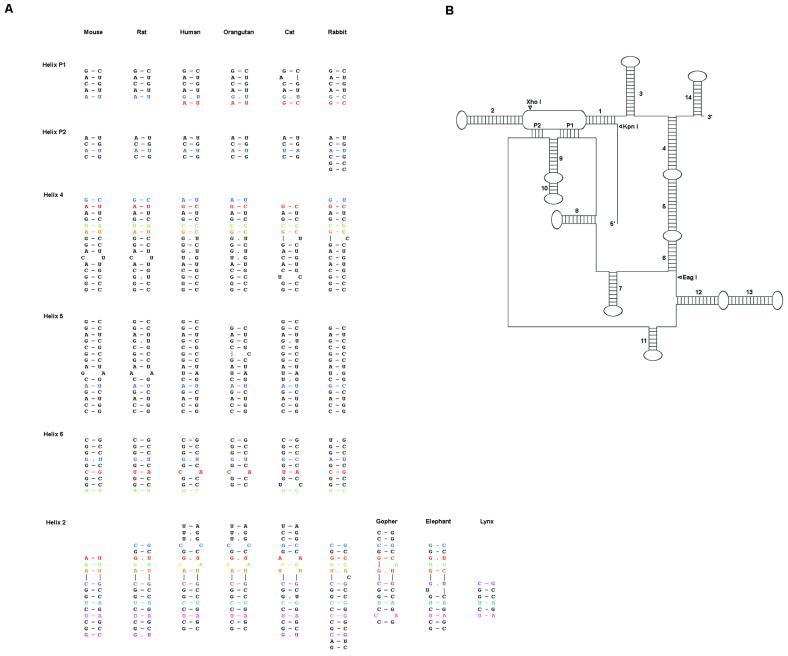
The molecular basis for function of the mammalian H19 as a tumor suppressor is poorly understood. Large, conserved open reading frames (ORFs) are absent from both the human and mouse cDNAs, suggesting that it may act as an RNA. Contradicting earlier reports, however, recent studies have shown that the H19 transcript exists in polysomal form and is likely translated. To distinguish between possible functional roles for the gene product, we have characterized the sequence requirements for H19-mediated in vitro suppression of tumor cell clonogenicity and analyzed the sequence of the gene cloned from a range of mammals. A cDNA version of the human gene, lacking the unusually short introns characteristic of imprinted genes, is as effective as a genomic copy in blocking anchorage-independent growth by G401 cells. The first 710 nucleotides of the gene can be deleted with no effect on in vitro activity. Further truncations from either the 5'- or 3'-end, however, cause a loss of suppression of clonogenicity. Using conserved sequences within the H19 gene as PCR primers, genomic DNA fragments were amplified from a range of mammalian species that span the functional domain defined by deletion analysis. Sequences from cat, lynx, elephant, gopher and orangutan complement the previous database of sequences from human, mouse, rat and rabbit. Hypothetical translation of the resulting sequences shows an absence of conserved ORFs of any size. Free energy and covariational analysis of the RNA sequences was used to identify potential helical pairings within the H19 transcript. A set of 16 helices are supported by covariation (i.e. conservation of base pairing potential in the absence of primary sequence conservation). The predicted RNA pairings consist largely of local hairpins but also include several long range interactions that bridge the 5'- and 3'-ends of the functional domain. Given the evolutionary conservation of structure at the RNA level and the absence of conservation at the protein level, we presume that the functional product of the H19 gene is a structured RNA.
Figures
References
-
- Feinberg A.P. (1999) Cancer Res., 59 (suppl.), 1743s–1746s. - PubMed
-
- Dao D., Walsh,C.P., Yuan,L., Gorelov,D., Feng,L., Hensle,T., Nisen,P., Yamashiro,D.J., Bestor,T.H. and Tycko,B. (1999) Hum. Mol. Genet., 8, 1337–1352. - PubMed
-
- Joyce J.A., Lam,W.K., Catchpoole,D.J., Jenks,P., Reik,W., Maher,E.R. and Schofield,P.N. (1997) Hum. Mol. Genet., 6, 1543–1548. - PubMed
-
- Chung W.Y., Yuan,L., Feng,L., Hensle,T. and Tycko,B. (1996) Hum. Mol. Genet., 5, 1101–1108. - PubMed
Publication types
MeSH terms
Substances
Associated data
- Actions
- Actions
- Actions
- Actions
- Actions
Grants and funding
LinkOut - more resources
Full Text Sources
Other Literature Sources
Miscellaneous
