Psychological consequences for parents of false negative results on prenatal screening for Down's syndrome: retrospective interview study
- PMID: 10669444
- PMCID: PMC27284
Psychological consequences for parents of false negative results on prenatal screening for Down's syndrome: retrospective interview study
Abstract
Objective: To determine the psychological consequences for parents of children with Down's syndrome of having received a false negative result on prenatal screening.
Design: Comparison of adjustment of parents who received a false negative result with that of parents not offered a test and those who declined a test.
Setting: Parents were interviewed in their own homes.
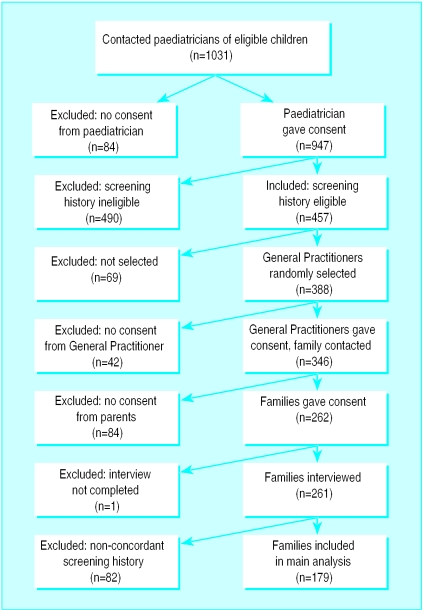
Participants: Parents of 179 children with Down's syndrome (mean age 4 (range 2-6) years).
Main outcome measures: Anxiety, depression, parenting stress, attitudes towards the child, and attributions of blame for the birth of the affected child.
Results: Overall, regardless of screening history, parents adjusted well to having a child with Down's syndrome. Compared with mothers who declined a test, mothers in the false negative group had higher parenting stress (mean score 81.2 v 71.8, P=0.016, 95% confidence interval for the difference 1.8 to 17.0) and more negative attitudes towards their children (124.9 v 134.2, P=0. 009, -16.2 to -2.4). Fathers in the false negative group had higher parenting stress test scores (77.8 v 70.0, P=0.046, 1.5 to 14.2) than fathers not offered a test. Mothers in the false negative group were more likely to blame others for the outcome than mothers who had not been offered the test (28% v 13%, P=0.032, 3% to 27%). Mothers and fathers in the false negative group were more likely to blame others for this outcome than parents who had declined a test (mothers 28% v 0%, P=0.001, 19% to 37%; fathers 27% v 0%, P=0.004, 17% to 38%). Blaming others was associated with poorer adjustment for mothers and fathers.
Conclusions: A false negative result on prenatal screening seems to have a small adverse effect on parental adjustment evident two to six years after the birth of an affected child.
Figures
References
-
- Petticrew M, Sowden AJ, Lister-Sharp D. False negative results in screening programmes: impact and implications. Health Technol Assess (in press). - PubMed
-
- Wald NJ, Huttly WJ, Hennessy CF. Down's syndrome screening in the UK in 1998. Lancet. 1999;354:1264. - PubMed
-
- Wald NJ, Kennard A, Hackshaw A, McGuire A. Antenatal screening for Down's syndrome. J Med Screen. 1997;4:181–246. - PubMed
-
- Snijders RJM, Noble P, Sebire N, Souka A, Nicolaides KH. UK multicentre project on assessment of risk of trisomy 21 by maternal age and fetal nuchal-translucency thickness at 10-14 weeks' gestation. Lancet. 1998;352:343–346. - PubMed
-
- The right to a perfect baby. Independent 1992 August 22:3.
Publication types
MeSH terms
LinkOut - more resources
Full Text Sources
Medical
Research Materials