. 2000 Feb 15;523 Pt 1(Pt 1):13-8.
doi: 10.1111/j.1469-7793.2000.t01-1-00013.x.

Heterodimeric amino acid transporters: expression of heavy but not light chains of CD98 correlates with induction of amino acid transport systems in human placental trophoblast

Affiliations

Heterodimeric amino acid transporters: expression of heavy but not light chains of CD98 correlates with induction of amino acid transport systems in human placental trophoblast

Y Kudo et al. J Physiol. .

Abstract

1. Activity of amino acid transport and relative abundance of mRNAs encoding related transporters have been studied in parallel either before or following in vitro culture of explants of human placental chorionic villi. 2. Amino acid transport activities through systems L (1.9-fold), y+L (2.6-fold) and y+ (3.2-fold) were markedly enhanced following culture for 48 h. 3. Relative mRNA abundance (determined by reverse transcription-polymerase chain reaction) for the heavy chain of CD98 surface antigen and for the cationic amino acid transporter-1 were similarly stimulated (2.8-fold and 2.6-fold, respectively). In contrast, none of the mRNA levels for light chains of CD98 (system L-amino acid transporter-1, system L-amino acid transporter-2, system y+L-amino acid transporter-1 and system y+L-amino acid transporter-2) studied nor for the cationic amino acid transporter-2B were altered.


Figures

Figure 1
Figure 1. Effect of in vitro culture on L-leucine influx in placental explants
L-Leucine influx in either fresh or cultured explant of villous tissue over a 30 s period was measured in a medium containing 2 μM L-[3H]leucine (2 μCi ml−1 or 74 KBq ml−1) with or without unlabelled amino acid (2 mm for BCH or L-leucine, final concentration) in the absence (choline) of Na+ as described in Methods. Data show carrier-mediated influx rate defined by subtracting the diffusional component from the total influx. The diffusional component was determined by measuring the influx of L-[3H]leucine in the presence of 20 mm unlabelled L-leucine. Data represent the mean ± s.d. of three separate experiments from three placentae. The mediated BCH-sensitive fluxes in fresh and in cultured tissue are, respectively, 9.91 ± 1.51 and 18.64 ± 3.52 pmol (mg protein)−1 (30 s)−1. These are significantly different (P = 0.025). BCH, 2-aminobicyclo-(2,2,1)-heptane-2-carboxylic acid.
Figure 2
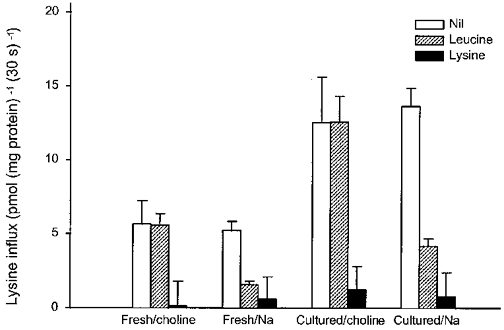
Figure 2. Effect of in vitro culture on L-lysine influx in placental explants
L-Lysine influx in either fresh or cultured explant of villous tissue over a 30 s period was measured in a medium containing 2 μM L-[3H]lysine (2 μCi ml−1 or 74 KBq ml−1) with or without unlabelled amino acid (100 μM for L-leucine or 2 mm for L-lysine, final concentration) in the presence or absence (choline) of Na+ as described in Methods. Data show carrier-mediated influx rate defined by subtracting the diffusional component from the total influx in either the presence or absence of Na+. The diffusional component was determined by measuring the influx of L-[3H]lysine in the presence of 20 mm unlabelled L-lysine. Data represent the mean ± s.d. of three separate experiments from three placentae. The mediated L-leucine-sensitive fluxes in the presence of Na+ in fresh and in cultured tissue are, respectively, 3.66 ± 0.61 and 9.49 ± 1.24 pmol (mg protein)−1 (30 s)−1. These are significantly different (P = 0.026). The mediated L-leucine-insensitive fluxes in the presence of Na+ in fresh and in cultured tissue are, respectively, 0.95 ± 0.21 and 3.01 ± 0.01 pmol (mg protein)−1 (30 s)−1. These are significantly different (P = 0.014).
Figure 3
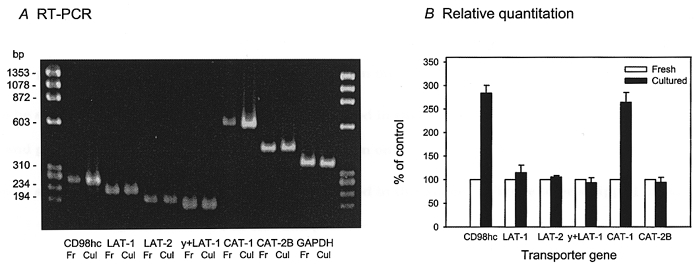
Figure 3. Effect of in vitro culture on the relative abundance of the amino acid transporter mRNA in placental explants
A, RT-PCR. The relative abundance of amino acid transporter mRNA and GAPDH mRNA were analysed by RT-PCR as described in Methods. The results presented are from a single representative experiment. Fr, fresh explant; Cul, cultured explant. B, relative quantification of the amino acid transporter mRNA. The intensity of both the amino acid transporter and the GAPDH band was quantified by using a gel documentation and analysis system of PCR products and the ratio of the two was used as a normalised relative abundance value of each transporter gene. Data represent the mean ± s.d. of three separate experiments from three placentae, expressed as a percentage of control (i.e. values for fresh explant). For CD98hc and for CAT-1 the observed changes were highly significant (P < 0.01). CD98hc, heavy chain of CD98 surface antigen; LAT-1, system L-amino acid transporter-1; LAT-2, system L-amino acid transporter-2; y+LAT-1, system y+L-amino acid transporter-1; CAT-1, cationic amino acid transporter-1; CAT-2B, cationic amino acid transporter-2B; GAPDH, glyceraldehyde 3-phosphate dehydrogenase.

References

    1. Ayuk P, Glazier J, Sides K, D'Souza S, Sibley CP. L-Arginine transport in human placental syncytiotrophoblast microvillous and basal plasma membrane vesicles: membrane polarization and gestational regulation. The Journal of Physiology. 1998;509.P:78. P.
    1. Broer A, Hamprecht B, Broer S. Discrimination of two amino acid transport activities in 4F2 heavy chain-expressing Xenopus laevis oocytes. Biochemical Journal. 1998;333:549–554. - PMC - PubMed
    1. Christensen HN. Exploiting amino acid structure to learn about membrane transport. Advances in Enzymology. 1979;49:41–101. - PubMed
    1. Closs EI, Graf P, Habermeier A, Cunningham JM, Forstermann U. Human cationic amino acid transporters hCAT-1, hCAT-2A, and hCAT-2B: three related carriers with distinct transport properties. Biochemistry. 1997;36:6462–6468. - PubMed
    1. Eleno N, Devés R, Boyd CAR. Membrane potential dependence of the kinetics of cationic amino acid transport systems in human placenta. The Journal of Physiology. 1994;479:291–300. - PMC - PubMed

LinkOut - more resources