


Autosomal recessive disorder otospondylomegaepiphyseal dysplasia is associated with loss-of-function mutations in the COL11A2 gene
- PMID: 10677296
- PMCID: PMC1288089
- DOI: 10.1086/302750
Autosomal recessive disorder otospondylomegaepiphyseal dysplasia is associated with loss-of-function mutations in the COL11A2 gene
Abstract
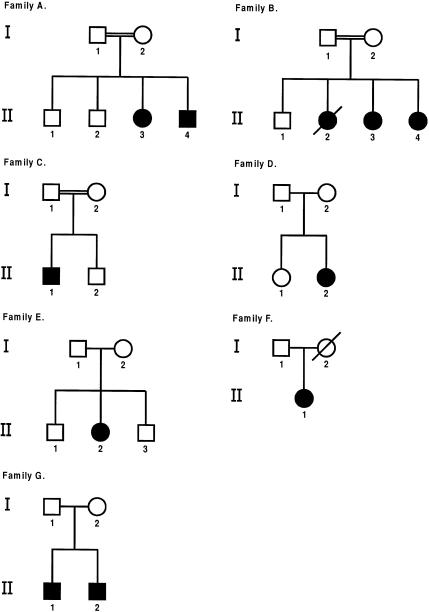
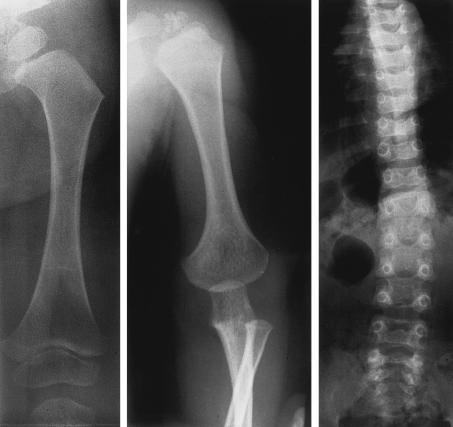
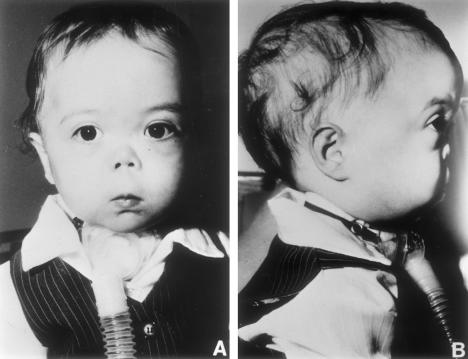
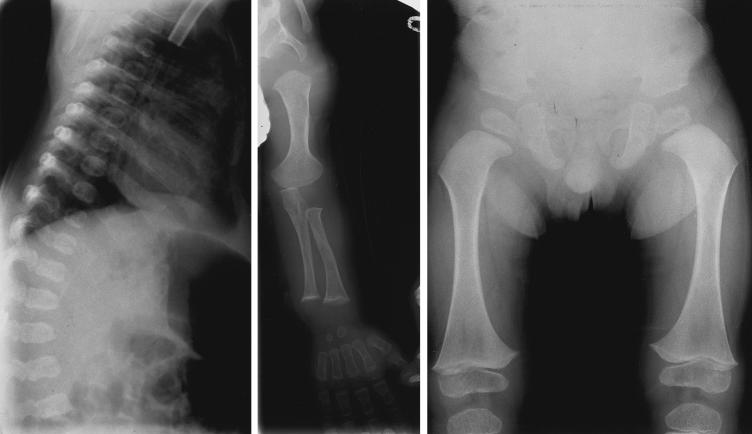
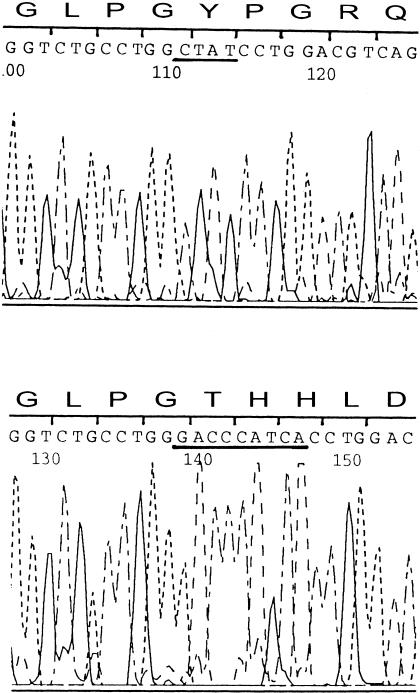
Otospondylomegaepiphyseal dysplasia (OSMED) is an autosomal recessive skeletal dysplasia accompanied by severe hearing loss. The phenotype overlaps that of the autosomal dominant disorders-Stickler and Marshall syndromes-but can be distinguished by disproportionately short limbs, severe hearing loss, and lack of ocular involvement. In one family with OSMED, a homozygous Gly-->Arg substitution has been described in COL11A2, which codes for the alpha2 chain of type XI collagen. We report seven further families with OSMED. All affected individuals had a remarkably similar phenotype: profound sensorineural hearing loss, skeletal dysplasia with limb shortening and large epiphyses, cleft palate, an extremely flat face, hypoplasia of the mandible, a short nose with anteverted nares, and a flat nasal bridge. We screened affected individuals for mutations in COL11A2 and found different mutations in each family. Individuals from four families, including three with consanguineous parents, were homozygous for mutations. Individuals from three other families, in whom parents were nonconsanguineous, were compound heterozygous. Of the 10 identified mutations, 9 are predicted to cause premature termination of translation, and 1 is predicted to cause an in-frame deletion. We conclude that the OSMED phenotype is highly homogenous and results from homozygosity or compound heterozygosity for COL11A2 mutations, most of which are predicted to cause complete absence of alpha2(XI) chains.
Figures
References
Electronic-Database Information
-
- Online Mendelian Inheritance in Man (OMIM), http://www.nbci.nlm.nih.gov/Omim (for OSMED [215150], Stickler syndrome types I [108300] and II [184840], Marshall syndrome [154780], and Weissenbacher-Zweymüller syndrome [277610])
References
-
- Ala-Kokko L, Kvist A-P, Metsäranta M, Kivirikko KI, de Crombrugghe B, Prockop DJ, Vuorio E (1995) Conservation of the sizes of 53 introns and over 100 intronic sequences for the binding of common transcription factors in the human and mouse genes for type II procollagen (COL2A1). Biochem J 308:923–929 - PMC - PubMed
-
- Brewton RG, Mayne R (1994) Heterotypic type II, IX and XI fibrils: comparison of vitreous and cartilage forms. In: Yurchenco PD, Birk DE, Mecham RP (eds) Extracellular matrix assembly and structure. Academic Press, San Diego, pp 129–170
-
- Cremer MA, Rosloniec EF, Kang AH (1998) The cartilage collagens: a review of their structure, organization, and role in the pathogenesis of experimental arthritis in animals and in human rheumatic disease. J Mol Med 76:275–288 - PubMed
Publication types
MeSH terms
Substances
Grants and funding
LinkOut - more resources
Full Text Sources
Medical
Molecular Biology Databases
Miscellaneous
