


Survey of the fragile X syndrome CGG repeat and the short-tandem-repeat and single-nucleotide-polymorphism haplotypes in an African American population
- PMID: 10677308
- PMCID: PMC1288101
- DOI: 10.1086/302762
Survey of the fragile X syndrome CGG repeat and the short-tandem-repeat and single-nucleotide-polymorphism haplotypes in an African American population
Abstract
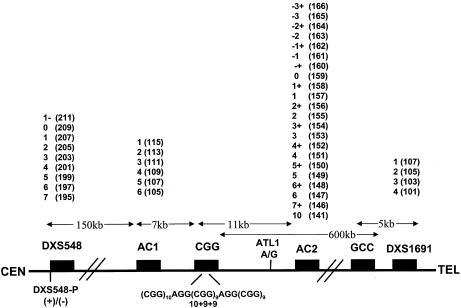
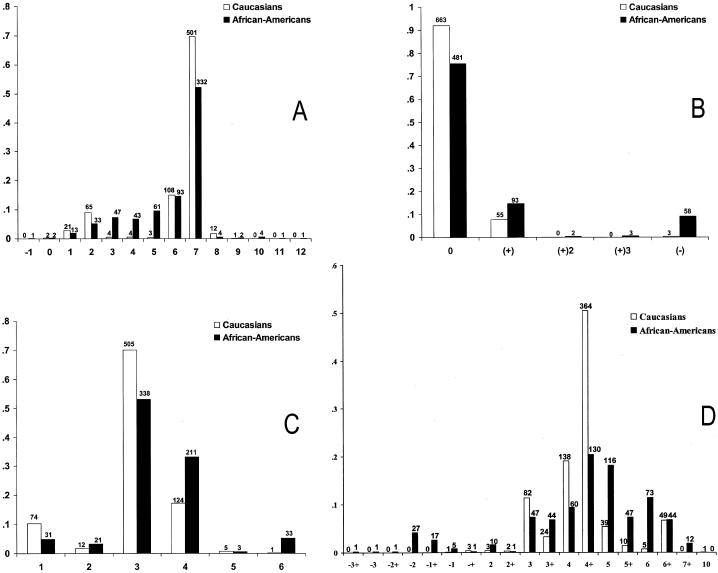
Previous studies have shown that specific short-tandem-repeat (STR) and single-nucleotide-polymorphism (SNP)-based haplotypes within and among unaffected and fragile X white populations are found to be associated with specific CGG-repeat patterns. It has been hypothesized that these associations result from different mutational mechanisms, possibly influenced by the CGG structure and/or cis-acting factors. Alternatively, haplotype associations may result from the long mutational history of increasing instability. To understand the basis of the mutational process, we examined the CGG-repeat size, three flanking STR markers (DXS548-FRAXAC1-FRAXAC2), and one SNP (ATL1) spanning 150 kb around the CGG repeat in unaffected (n=637) and fragile X (n=63) African American populations and compared them with unaffected (n=721) and fragile X (n=102) white populations. Several important differences were found between the two ethnic groups. First, in contrast to that seen in the white population, no associations were observed among the African American intermediate or "predisposed" alleles (41-60 repeats). Second, two previously undescribed haplotypes accounted for the majority of the African American fragile X population. Third, a putative "protective" haplotype was not found among African Americans, whereas it was found among whites. Fourth, in contrast to that seen in whites, the SNP ATL1 was in linkage equilibrium among African Americans, and it did not add new information to the STR haplotypes. These data indicate that the STR- and SNP-based haplotype associations identified in whites probably reflect the mutational history of the expansion, rather than a mutational mechanism or pathway.
Figures
References
Electronic-Database Information
-
- Online Mendelian Inheritance in Man (OMIM), http://www.ncbi.nlm.nih.gov/Omim (for fragile X syndrome [MIM 309550])
References
-
- Arrieta I, Gil A, Nunez T, Elez M, Artinez B, Criado B, Stao C (1999) Stability of the FMR1 CGG repeat in a Basque sample. Hum Biol 71:55–68 - PubMed
-
- Brown TC, Tarleton JC, Go RC, Longshore JW, Descartes M (1997) Instability of the FMR2 trinucleotide repeat region associated with expanded FMR1 alleles. Am J Med Genet 73:447–455 - PubMed
-
- Brown WT, Houck GEJ, Jeziorowska A, Levinson FN, Ding X, Dobkin C, Zhong N, et al (1993) Rapid fragile X carrier screening and prenatal diagnosis using a nonradioactive PCR test. JAMA 270:1569–1575 [published erratum appears in JAMA 271:28] - PubMed
Publication types
MeSH terms
Substances
Grants and funding
LinkOut - more resources
Full Text Sources
Other Literature Sources
Medical
