. 2000 Feb;122(2):543-52.
doi: 10.1104/pp.122.2.543.

Induction of an extracellular cyclic nucleotide phosphodiesterase as an accessory ribonucleolytic activity during phosphate starvation of cultured tomato cells

Affiliations

Induction of an extracellular cyclic nucleotide phosphodiesterase as an accessory ribonucleolytic activity during phosphate starvation of cultured tomato cells

S Abel et al. Plant Physiol. 2000 Feb.

Abstract

During growth under conditions of phosphate limitation, suspension-cultured cells of tomato (Lycopersicon esculentum Mill.) secrete phosphodiesterase activity in a similar fashion to phosphate starvation-inducible ribonuclease (RNase LE), a cyclizing endoribonuclease that generates 2':3'-cyclic nucleoside monophosphates (NMP) as its major monomeric products (T. Nürnberger, S. Abel, W. Jost, K. Glund [1990] Plant Physiol 92: 970-976). Tomato extracellular phosphodiesterase was purified to homogeneity from the spent culture medium of phosphate-starved cells and was characterized as a cyclic nucleotide phosphodiesterase. The purified enzyme has a molecular mass of 70 kD, a pH optimum of 6.2, and an isoelectric point of 8.1. The phosphodiesterase preparation is free of any detectable deoxyribonuclease, ribonuclease, and nucleotidase activity. Tomato extracellular phosphodiesterase is insensitive to EDTA and hydrolyzes with no apparent base specificity 2':3'-cyclic NMP to 3'-NMP and the 3':5'-cyclic isomers to a mixture of 3'-NMP and 5'-NMP. Specific activities of the enzyme are 2-fold higher for 2':3'-cyclic NMP than for 3':5'-cyclic isomers. Analysis of monomeric products of sequential RNA hydrolysis with purified RNase LE, purified extracellular phosphodiesterase, and cleared -Pi culture medium as a source of 3'-nucleotidase activity indicates that cyclic nucleotide phosphodiesterase functions as an accessory ribonucleolytic activity that effectively hydrolyzes primary products of RNase LE to substrates for phosphate-starvation-inducible phosphomonoesterases. Biosynthetical labeling of cyclic nucleotide phopshodiesterase upon phosphate starvation suggests de novo synthesis and secretion of a set of nucleolytic enzymes for scavenging phosphate from extracellular RNA substrates.


Figures
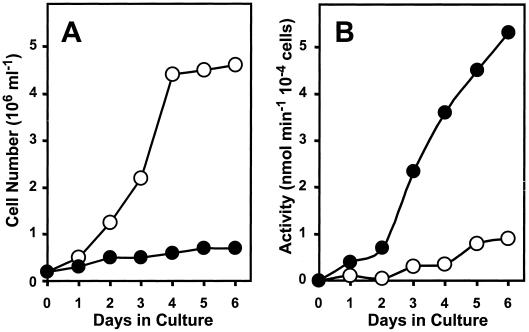
Figure 1
Figure 1
Extracellular phosphodiesterase activity during growth of suspension-cultured tomato cells. Cell number (A) and extracellular phosphodiesterase activity (B) during culture growth under conditions of constant Pi supply (○) and constant Pi limitation (●).
Figure 2
Figure 2
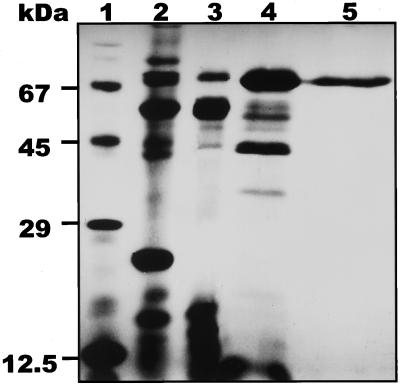
SDS-PAGE analysis of purification steps of tomato extracellular phosphodiesterase. Lane 1, Molecular mass markers; lane 2, total proteins of the spent medium of a 4-d-old −Pi culture (4 μg of protein); lane 3, pooled active fractions from Sephadex SP-C25 ion-exchange chromatography (4 μg of protein); lane 4, pooled active fractions from the chromatofocusing step eluted at pH 8.1 (3 μg of protein); lane 5, pooled active fractions from Sephadex G-100 gel permeation chromatograhy (1 μg of protein).
Figure 3
Figure 3
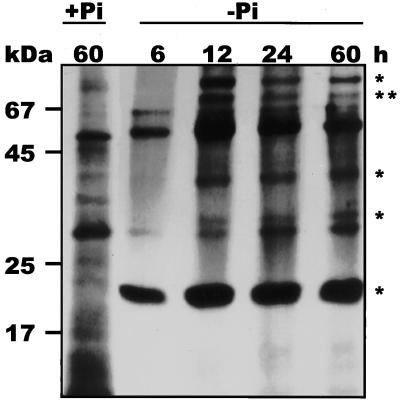
De novo synthesis of extracellular proteins during −Pi culture of tomato cells. Cells (2 × 10⁷) of a 60-h-old +Pi culture and of a −Pi culture grown for 6, 12, 24, and 60 h were incubated with 100 μCi of a l-[U-14C]amino acid mix for 6 h. Biosynthetically labeled extracellular proteins were separated by SDS-PAGE and visualized by fluorography (50,000 dpm per lane). Asterisks indicate proteins that are apparently not synthesized under +Pi conditions, including a protein of about 70 kD (two asterisks).
Figure 4
Figure 4
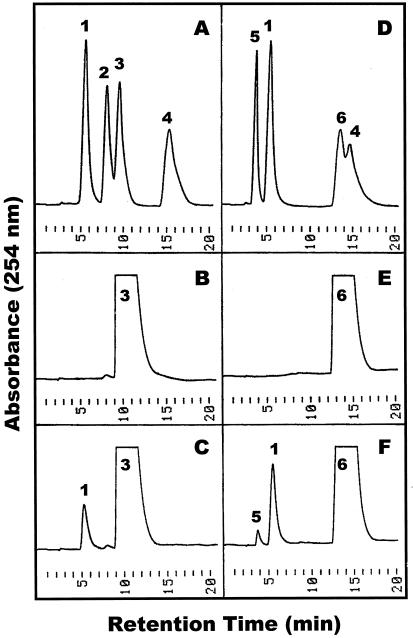
Hydrolysis of cAMP isomers by purified tomato extracellular phosphodiesterase. Enzymatic hydrolysis of 2′:3′-cAMP (A–C) and 3′:5′-cAMP (D–F) was performed as described in “Materials and Methods.” Standard compounds (A and D), control incubations with heat-inactivated enzyme (B and E), and enzymatic digests for 30 min (C and F) were separated by reverse-phase HPLC on Butyl-Si 100. Peak identities: 1, 3′-AMP; 2, 2′-AMP; 3, 2′:3′-cAMP; 4, adenosine; 5, 5′-AMP; 6, 3′:5′-AMP.
Figure 5
Figure 5
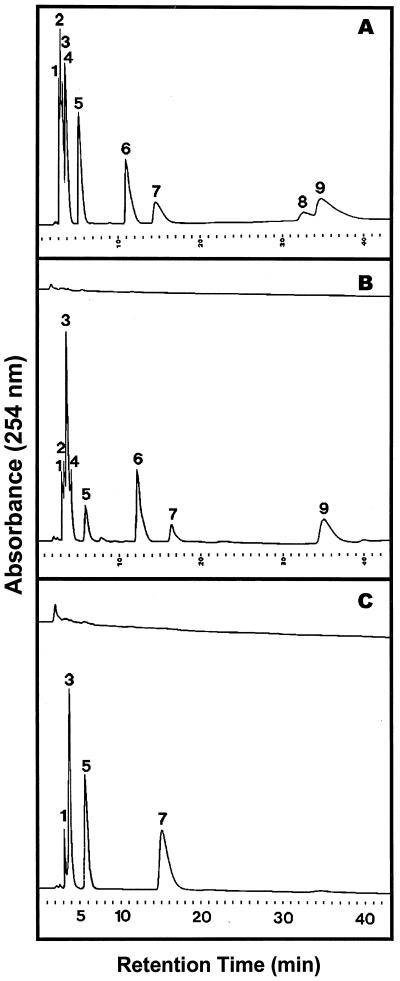
Elution profile of ribonucleoside monophosphates after hydrolysis of yeast RNA with purified RNase LE and purified tomato extracellular phosphodiesterase. Enzymatic hydrolysis of RNA and HPLC separation of monomeric products on Octadecyl-Si 100 were performed as described in “Materials and Methods.” Shown are elution profiles of standard compounds (A), monomeric products of RNA hydrolysis with RNase LE for the zero-time control (B, upper tracing) and after 6 h of reaction (B, lower tracing), and monomeric products of RNA hydrolysis with extracellular phosphodiesterase for 6 h (C, upper tracing) and with RNase LE for 6 h followed with extracellular phosphodiesterase for 3 h (C, lower tracing). Peak identities: 1, 3′-CMP/2′-CMP; 2, 2′:3′-cyclic CMP; 3, 3′-UMP/2′-UMP; 4, 2′:3′-cyclic UMP; 5, 3′-GMP/2′-GMP; 6, 2′:3′-cyclic GMP; 7, 3′-AMP; 8, 2′-AMP; 9, 2′:3′-cAMP.
Figure 6
Figure 6
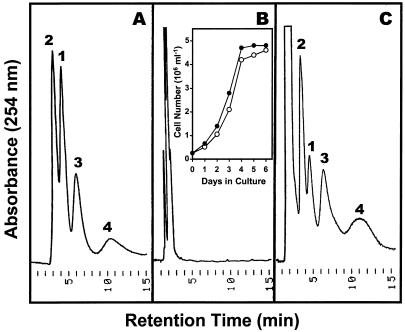
Growth of suspension-cultured tomato cells in +RNA/−Pi medium and analysis of monomeric products of RNA hydrolysis during culture growth. Yeast RNA (1.6 mg mL−1) was substituted for KH2PO4 as a source of phosphorus, and growth of +Pi (○) and +RNA/−Pi (●) cultures was monitored (inset in B). HPLC separation of ribonucleosides on dihydroxyboryl-Si 100 were performed as described in “Materials and Methods.” Shown are elution profiles of standard ribonucleosides (A) and of monomeric RNA degradation products at 0 h (B) and 3 d (C) after cell transfer to +RNA/−Pi medium. Peak identities: 1, Uridine; 2, cytidine; 3, guanosine; 4, adenosine.
Figure 7
Figure 7
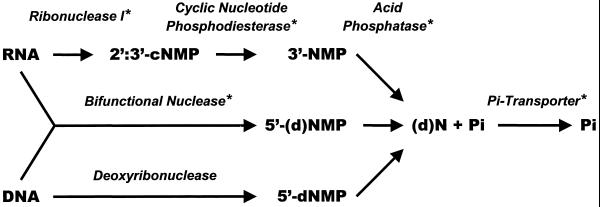
Model of extracellular nucleic acid degradation and Pi recycling by secretory nucleolytic enzymes. Asterisks indicate proteins known to be inducible by Pi starvation.

References

    1. Abel S, Blume B, Glund K. Evidence for RNA-oligo-nucleotides in plant vacuoles isolated from cultured tomato cells. Plant Physiol. 1990;94:1163–1171. - PMC - PubMed
    1. Abel S, Glund K. Ribonuclease in plant vacuoles: purification and molecular properties of the enzyme from cultured tomato cells. Planta. 1987;172:71–78. - PubMed
    1. Abel S, Krauss G-J, Glund K. Ribonuclease in tomato vacuoles: high-performance liquid chromatographic analysis of ribonucleolytic activities and base specificity. Biochim Biophys Acta. 1989;998:145–150.
    1. Ashton AR, Polya GM. Higher plant cyclic nucleotide phosphodiesterases. Biochem J. 1975;149:329–339. - PMC - PubMed
    1. Bieleski RL. Phosphate pools, phosphate transport, and phosphate availability. Annu Rev Plant Physiol. 1973;24:225–252.

MeSH terms