. 2000 Feb 15;97(4):1477-82.
doi: 10.1073/pnas.0305463397.

Folding and activity of circularly permuted forms of a polytopic membrane protein

Affiliations

Folding and activity of circularly permuted forms of a polytopic membrane protein

R Beutler et al. Proc Natl Acad Sci U S A. .

Erratum in

  • Proc Natl Acad Sci U S A 2000 May 9;97(10):5679-80

Abstract

The transmembrane subunit of the Glc transporter (IICB(Glc)), which mediates uptake and concomitant phosphorylation of glucose, spans the membrane eight times. Variants of IICB(Glc) with the native N and C termini joined and new N and C termini in the periplasmic and cytoplasmic surface loops were expressed in Escherichia coli. In vivo transport/in vitro phosphotransferase activities of the circularly permuted variants with the termini in the periplasmic loops 1 to 4 were 35/58, 32/37, 0/3, and 0/0% of wild type, respectively. The activities of the variants with the termini in the cytoplasmic loops 1 to 3 were 0/25, 0/4 and 24/70, respectively. Fusion of alkaline phosphatase to the periplasmic C termini stabilized membrane integration and increased uptake and/or phosphorylation activities. These results suggest that internal signal anchor and stop transfer sequences can function as N-terminal signal sequences in a circularly permuted alpha-helical bundle protein and that the orientation of transmembrane segments is determined by the amino acid sequence and not by the sequential appearance during translation. Of the four IICB(Glc) variants with new termini in periplasmic loops, only the one with the discontinuity in loop 4 is inactive. The sequences of loop 4 and of the adjacent TM7 and TM8 are conserved in all phosphoenolpyruvate-dependent carbohydrate:phosphotransferase system transporters of the glucose family.


Figures
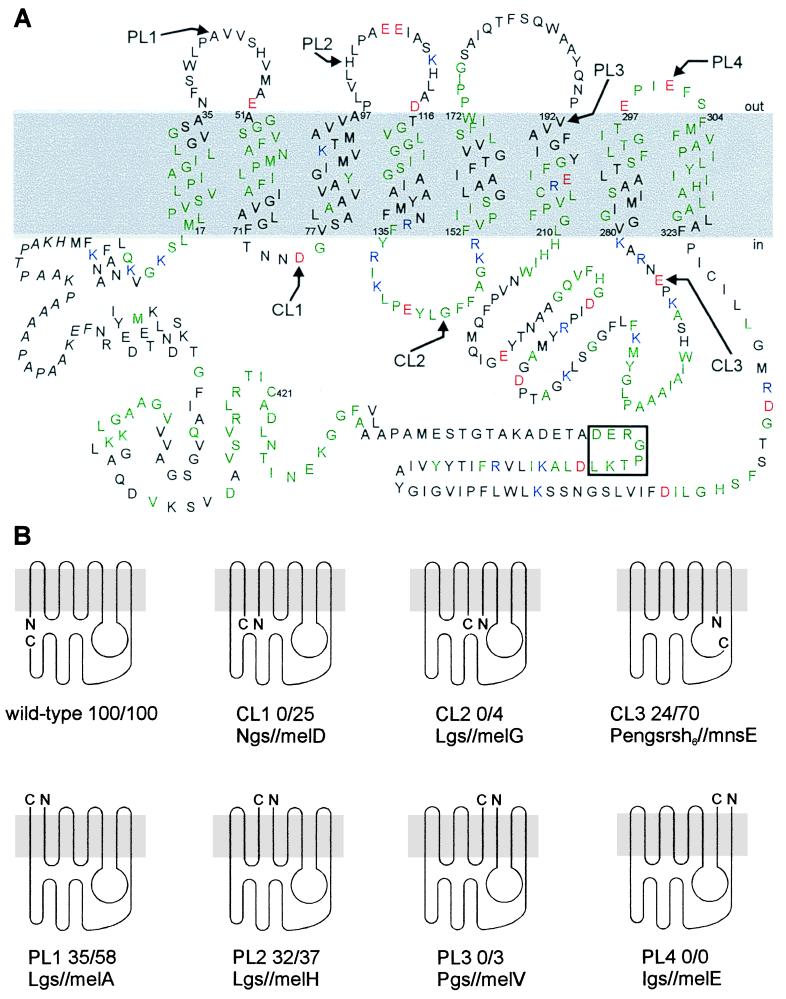
Figure 1
Figure 1
(A) Topology model of IICBGlc. Arrows indicate the position at which the new N and C termini were introduced in the circularly permuted variants PL1–PL4 and CL1–CL3. The Ala-Pro-rich linker connecting the original C and N terminus is shown in italics. Positively charged residues of the IICGlc domain are blue; negatively charged residues are red. The LKTPGRED linker between the IICGlc and the IIBGlc domain is framed. Amino acids that are conserved in six homologous sequences and/or are within amino acid sequences with a similarity score of more than five are green (average similarity 4.3). (B) Topology models of the circularly permuted variants PL1–PL4 and CL1–CL3. The in vivo transport activity and the in vitro phosphotransferase activity in percentage of the wild-type control are given together with the exact amino acid sequences of the new C and N termini. Upper case letters indicate the last and first residues of the native IICBGlc sequence; lower case letters indicate residues added to generate the translation start and termination signals.
Figure 2
Figure 2
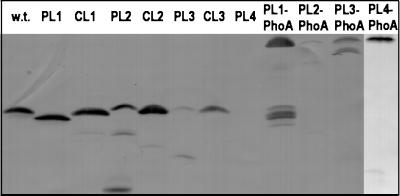
Protein expression and stability. Circularly permuted variants were visualized with mAbs against the IIBGlc domain on a Western blot of membrane preparations. PL2, PL3, PL1-PhoA, PL2-PhoA, and PL3-PhoA are partially degraded. A total of 100 μg of membrane protein was loaded per lane. w.t., wild-type.
Figure 3
Figure 3
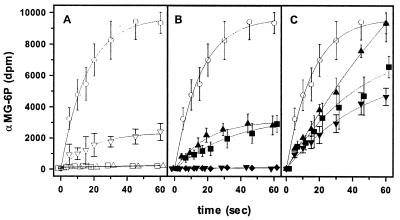
Uptake of αMG by intact cells expressing circularly permuted variants of IICBGlc. (A) Wild-type (open circle) and variants with N and C termini in CL1 (open square), CL2 (open triangle up), and CL3 (open triangle down). (B) Wild-type (open circle) and variants with N and C termini in PL1 (solid square), PL2 (solid triangle up), PL3 (solid triangle down), and PL4 (solid diamond). (C) Wild-type (open circle) and PhoA fusion proteins PL1-PhoA (solid square), PL2-PhoA (solid triangle up), and PL3-PhoA (solid triangle down). The uptake reaction was started by the addition of 12 μl of 10 mM [14C]αMG (6,000 dpm/nmol) to 1 ml of the cell suspensions diluted to OD550 = 13 at room temperature, and 100-μl aliquots were withdrawn at the indicated time points, filtered through glass fiber filters, and counted.
Figure 4
Figure 4
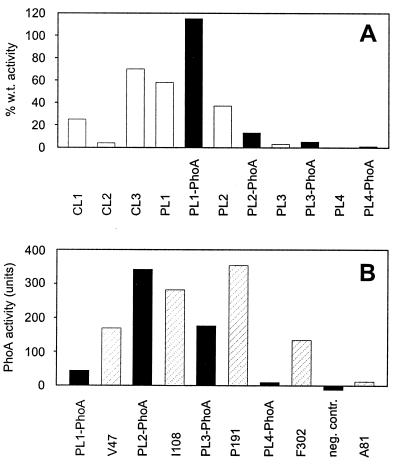
Enzymatic activities of circularly permuted variants. (A) Glc phosphotransferase activities of membrane preparations. Activities of the circularly permuted variants (open bars) and the fusion proteins with PhoA (solid bars) are given in percentage of wild-type (w.t.) IICBGlc; 100% activity corresponds to 31,000 nmol Glc-6-phosphate per mg of membrane protein per 30 min for Glc and to 15,000 nmol α-Me-Glc-6-phosphate per mg of membrane protein per 30 min for αMG. (B) PhoA activities of fusion proteins between circularly permuted variants and PhoA (solid bars) and between truncated IICBGlc and PhoA (hatched bars). PhoA activities were measured in permeabilized cells.
Figure 5
Figure 5
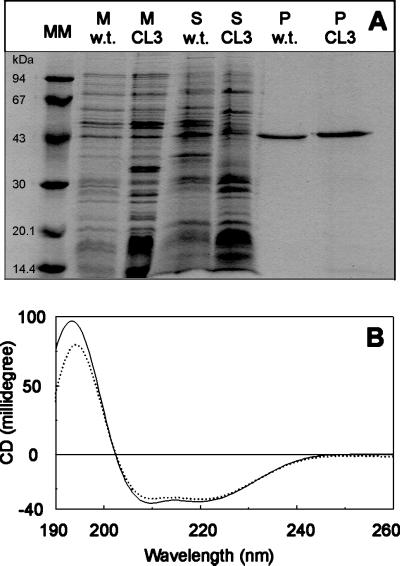
Purification and CD spectroscopy of wild-type (w.t.) IICBGlc and CL3. (A) Coomassie-stained SDS/PAGE of the purification of wild-type IICBGlc and CL3 by metal chelate affinity chromatography. MM, molecular mass; M, membranes; S, solubilized membranes; P, purified proteins. (B) CD spectra of wild-type IICBGlc (0.3 mg/ml) (solid line) and CL3 (0.4 mg/ml) (dashed line). Shown spectra were noise reduced and corrected for buffer contributions.

References

    1. Newitt J A, Bernstein H D. J Biol Chem. 1998;273:12451–12456. - PubMed
    1. Bernstein H D. Proc Natl Acad Sci USA. 1998;95:14587–14589. - PMC - PubMed
    1. Qi H Y, Bernstein H D. J Biol Chem. 1999;274:8993–8997. - PubMed
    1. de Gier J W, Scotti P A, Saaf A, Valent Q A, Kuhn A, Luirink J, von Heijne G. Proc Natl Acad Sci USA. 1998;95:14646–14651. - PMC - PubMed
    1. Rapoport T A, Jungnickel B, Kutay U. Annu Rev Biochem. 1996;65:271–304. - PubMed

Publication types

MeSH terms

Substances

LinkOut - more resources