Factors influencing the effect of age on prognosis in breast cancer: population based study
- PMID: 10678859
- PMCID: PMC27289
- DOI: 10.1136/bmj.320.7233.474
Factors influencing the effect of age on prognosis in breast cancer: population based study
Abstract
Objective: To investigate whether young age at diagnosis is a negative prognostic factor in primary breast cancer and how stage of disease at diagnosis and treatment influences such an association.
Design: Retrospective cohort study based on a population based database of patients with breast cancer containing detailed information on tumour characteristics, treatment regimens, and survival.
Setting: Denmark.
Subjects: 10 356 women with primary breast cancer who were less than 50 years old at diagnosis.
Main outcome measures: Relative risk of dying within the first 10 years after diagnosis according to age at diagnosis after adjustment for known prognostic factors and expected mortality.
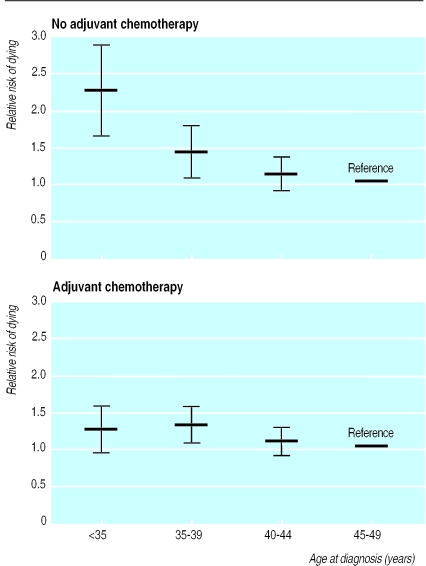
Results: Overall, young women with low risk disease who did not receive adjuvant treatment had a significantly increased risk of dying; risk increased with decreasing age at diagnosis (adjusted relative risk: 45-49 years (reference): 1; 40-44 years: 1.12 (95% confidence interval 0.89 to 1.40); 35-39 years: 1.40 (1.10 to 1.78); <35 years: 2.18 (1.64 to 2.89). However, no similar trend was seen in patients who received adjuvant cytotoxic treatment. The increased risk in younger women who did not receive adjuvant treatment compared with those who did remained when women were grouped according to presence of node negative disease and by tumour size.
Conclusion: The negative prognostic effect of young age is almost exclusively seen in women diagnosed with low risk disease who did not receive adjuvant cytotoxic treatment. These results suggest that young women with breast cancer, on the basis of age alone, should be regarded as high risk patients and be given adjuvant cytotoxic treatment.
Figures
Comment in
-
Treating young patients with breast cancer. The evidence suggests that all should be treated with adjuvant therapy.BMJ. 2000 Feb 19;320(7233):457-8. doi: 10.1136/bmj.320.7233.457. BMJ. 2000. PMID: 10678839 Free PMC article. No abstract available.
-
Commentary: much still to learn about relations between tumour biology, prognosis, and treatment outcome in early breast cancer.BMJ. 2000 Feb 19;320(7233):478-9. BMJ. 2000. PMID: 10722296 No abstract available.
-
Optimum treatment for young women with breast cancer needs to be determined.BMJ. 2000 Jul 1;321(7252):53. doi: 10.1136/bmj.321.7252.53. BMJ. 2000. PMID: 10939831 Free PMC article. No abstract available.
References
-
- Albain KS, Allred DC, Clark GM. Breast cancer outcome and predictors of outcome: are there age differentials? Monogr Natl Cancer Inst. 1994;(16):35–42. - PubMed
-
- Remvikos Y, Magdelenat H, Dutrillaux B. Genetic evolution of breast cancers. 3. Age-dependent variations in the correlations between biological indicators of prognosis. Breast Cancer Res Treat. 1995;34:25–33. - PubMed
-
- Adami HO, Malker B, Holmberg L, Persson I, Stone B. The relation between survival and age at diagnosis in breast cancer. N Engl J Med. 1986;315:559–563. - PubMed
-
- Høst H, Lund E. Age as a prognostic factor in breast cancer [correction appears in Cancer 1986;15:996] Cancer. 1986;57:2217–2221. - PubMed
Publication types
MeSH terms
LinkOut - more resources
Full Text Sources
Medical