. 2000 Mar;68(3):1048-53.
doi: 10.1128/IAI.68.3.1048-1053.2000.

Construction and characterization of an agr deletion mutant of Staphylococcus epidermidis

Affiliations

Construction and characterization of an agr deletion mutant of Staphylococcus epidermidis

C Vuong et al. Infect Immun. 2000 Mar.

Abstract

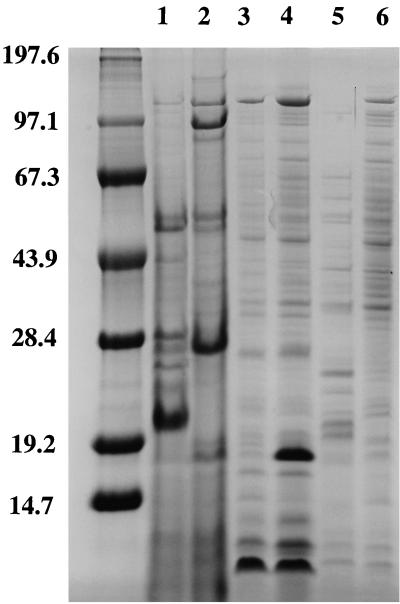
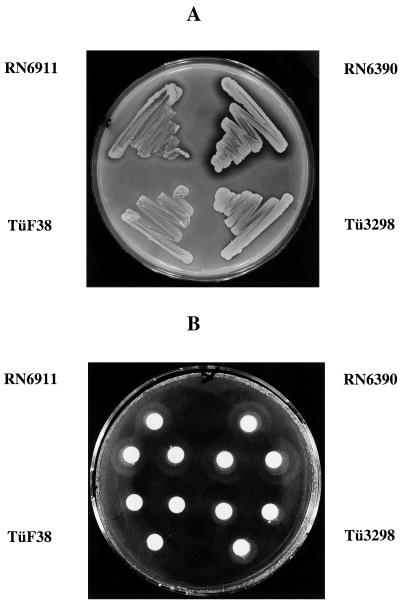
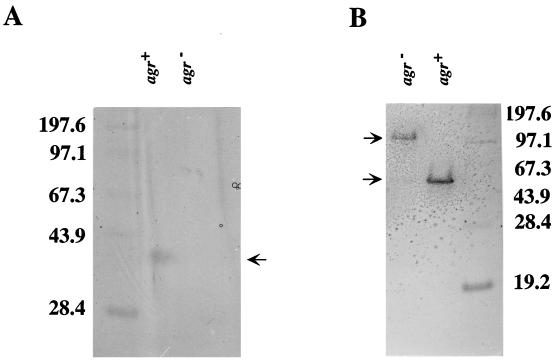
The physiological significance of the accessory gene regulator (agr) system of Staphylococcus epidermidis was investigated by construction of an agr deletion mutant via allelic replacement with a spectinomycin resistance cassette. Sodium dodecyl sulfate-polyacrylamide gel electrophoresis (SDS-PAGE) analysis showed that the protein pattern was strongly altered in the mutant; the amounts of most surface proteins were higher, whereas the amounts of most exoproteins were lower. The agr system of S. epidermidis thus appears to have an important impact on growth phase-dependent protein synthesis as has been shown for Staphylococcus aureus. The activity of the exoenzymes lipase and protease, assumed to be involved in staphylococcal pathogenicity, was investigated by agar diffusion assays and SDS-PAGE activity staining. A general reduction of these enzyme activities in the agr mutant was found. The difference in overall lipase activity was small, but zymographic analysis suggested a clear defect in lipase processing in the agr mutant.


Figures
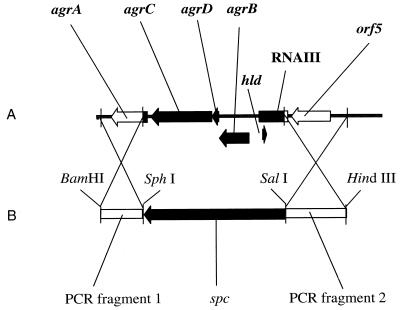
FIG. 1
FIG. 1
Physical map of the agr system of S. epidermidis (A) and construction of pBTΔagr (B). Plasmid pBTΔagr was constructed for homologous recombination of the agr system of S. epidermidis by the insertion of a spectinomycin adenyltransferase gene (spc) and two PCR-amplified agr-flanking regions into plasmid pBT2. Open reading frames are depicted by arrows, which indicate their orientation. Recognition sites for restriction enzymes, resistance markers, and PCR-amplified fragments are also shown. The crosses indicate the sites of homologous recombination.
FIG. 2
FIG. 2
Protein profiles of the S. epidermidis wild-type Tü3298 and the isogenic agr deletion strain TüF38. SDS-polyacrylamide (10%, wt/vol) gels of exoproteins (lane 1, agr+; lane 2, agr mutant), surface-associated proteins prepared by boiling with SDS (lane 3, agr+; lane 4, agr mutant), and surface proteins prepared by treatment with lysostaphin (lane 5, agr+; lane 6, agr mutant) are shown. Aliquots were collected after 12 h of growth, and protein samples were prepared as described in Materials and Methods. The proteins were stained with Coomassie blue R250; the molecular mass protein standards are in the left lane and are indicated in kilodaltons.
FIG. 3
FIG. 3
Lipase and protease activity on agar plates. (A) Protease activity. Bacterial strains were grown overnight on skim milk agar plates at 37°C. (B) Lipase activity. A total of 25 μl of supernatants, 5× concentrated by lyophylization, were applied four times onto filters, air dried, and laid on Tween 20 agar plates, which were incubated 24 h at 37°C.
FIG. 4
FIG. 4
Zymographic analysis of lipase and protease activity. Exoprotein samples of S. epidermidis agr+ (Tü3298) and agr mutant (TüF38) strains were prepared as described in Materials and Methods and run on SDS-polyacrylamide (10%, wt/vol) protease (A) and lipase (B) test gels. The molecular mass standard is shown on the right in panel A and on the left in panel B; the molecular masses are indicated in kilodaltons.

References

    1. Abdelnour A, Arvidson S, Bremell T, Ryden C, Tarkowski A. The accessory gene regulator (agr) controls Staphylococcus aureus virulence in a murine arthritis model. Infect Immun. 1993;61:3879–3885. - PMC - PubMed
    1. Augustin J, Götz F. Transformation of Staphylococcus epidermidis and other staphylococcal species with plasmid DNA by electroporation. FEMS Microbiol Lett. 1990;66:203–208. - PubMed
    1. Booth M C, Atkuri R V, Nanda S K, Iandolo J J, Gilmore M S. Accessory gene regulator controls Staphylococcus aureus virulence in endophthalmitis. Investig Ophthalmol Vis Sci. 1995;36:1828–1836. - PubMed
    1. Brückner R. Gene replacement in Staphylococcus carnosus and Staphylococcus xylosus. FEMS Microbiol Lett. 1997;151:1–8. - PubMed
    1. Cheung A L, Eberhardt K J, Chung E, Yeaman M R, Sullam P M, Ramos M, Bayer A S. Diminished virulence of a sar−/agr− mutant of Staphylococcus aureus in the rabbit model of endocarditis. J Clin Investig. 1994;94:1815–1822. - PMC - PubMed

MeSH terms

LinkOut - more resources